Self-help · Book club
Crucial Conversations: Tools for Talking When Stakes Are High book club questions
Here are 12 book club questions for Crucial Conversations: Tools for Talking When Stakes Are High by Kerry Patterson, Joseph Grenny, Ron McMillan, and Al Switzler, ordered to open easily and end somewhere worth arguing about. Copy them, print them, or bring them up one at a time.
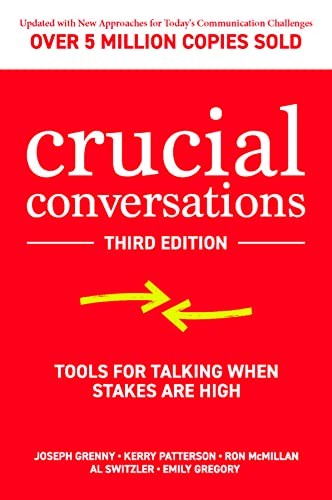
Crucial Conversations is a book about what to do when the stakes are high, emotions run strong, and opinions diverge.
Kerry Patterson, Joseph Grenny, Ron McMillan, and Al Switzler · 2002 · 5h 15m
Full summary and key takeaways →The 12 questions
- 1.
Think of a conversation you have been avoiding for more than two weeks. What story are you telling yourself about why it is not worth having?
- 2.
The book distinguishes going silent from going violent. Which is your default when a conversation feels dangerous?
- 3.
Patterson and colleagues argue that safety, not tact, is what makes honesty possible. What is a relationship in your life where low safety has made you less honest than you should be?
- 4.
Pick a recent argument that escalated. At what point did the conversation leave the content and become about respect or purpose? Could you have named that shift in the moment?
- 5.
The authors describe "clever stories" that cast others as villains and ourselves as victims. What clever story have you told yourself about someone that a more complete view might complicate?
- 6.
STATE asks you to share facts before conclusions. How often do you lead with your interpretation rather than the behavior you actually observed?
- 7.
What would it look like to apply mutual purpose in a situation where you and someone else seem to want genuinely different things?
- 8.
The book argues that how you enter a conversation determines what is possible in it. What do you typically do to prepare for a hard conversation, and is it enough?
- 9.
AMPP includes priming — putting words to what you think someone might be feeling so they can confirm or correct. When has someone done that for you, and what effect did it have?
- 10.
The decision-making framework asks who should consult, who should decide, and who should be informed. Where in your work or home life is that ambiguity causing real friction?
- 11.
What does "going to the balcony" look like for you — is there a physical move, a phrase, or a pause that helps you step back when a conversation is starting to run away from you?
- 12.
What is the most expensive silence you have witnessed in a team or organization? What was the cost of not saying the thing that needed to be said?
How to run the discussion
- Pick six to eight, not all of them. An hour of real discussion covers fewer questions than anyone expects, and racing the list is what makes a book club feel like homework.
- Open with what people noticed, not what they concluded. Asking for a verdict first hardens opinions before anyone has heard each other.
- Let the disagreement run. The questions below that split a room are the ones worth the time; the ones everyone answers the same way can be skipped.
- Ask the quiet person a specific question. A direct, narrow question is far easier to answer than an open invitation to contribute.
Themes worth steering toward
If the conversation stalls, these are the threads that usually restart it.
Common questions
What are good book club questions for Crucial Conversations: Tools for Talking When Stakes Are High?
Here are 12 book club questions for Crucial Conversations: Tools for Talking When Stakes Are High by Kerry Patterson, Joseph Grenny, Ron McMillan, and Al Switzler, ordered to open easily and end somewhere worth arguing about. The strongest openers ask what each reader noticed rather than what they concluded, and the discussion usually turns on communication, conflict, dialogue.
How long should a book club discussion of Crucial Conversations: Tools for Talking When Stakes Are High last?
Most groups run 60 to 90 minutes of actual discussion. That is roughly six to eight questions, not all of them, so pick the ones that suit your group rather than working down the list in order.
What are the main themes in Crucial Conversations: Tools for Talking When Stakes Are High?
Communication, Conflict, Dialogue, Emotional intelligence, Relationships. Those are the threads most likely to divide a room, which makes them the useful places to steer a discussion that has gone quiet.
Picking the next one? See books like Crucial Conversations: Tools for Talking When Stakes Are High or questions for other book club picks.
