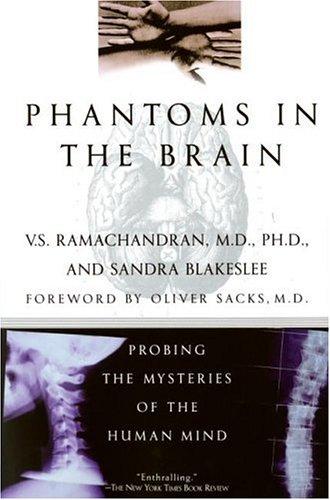
Phantoms in the Brain: Probing the Mysteries of the Human Mind by V. S. Ramachandran and Sandra Blakeslee is a 1998 psychology book about neuroscience, phantom limbs, brain plasticity. Phantom limbs demonstrate that the brain models the body rather than simply receiving signals from it. The model can persist after the physical limb is gone.
Summary
V. S. Ramachandran is a neurologist at UC San Diego who investigates the mysteries of the brain through clinical cases — not through expensive brain imaging but through careful bedside experiments that are often elegantly simple and deeply revealing. Phantoms in the Brain, written with science journalist Sandra Blakeslee and published in 1998, describes the cases that Ramachandran found most illuminating, from phantom limbs to denial of paralysis to religious experience.
The opening chapters on phantom limbs are the book's best-known contribution. Amputees often feel sensations — including pain — in limbs that are no longer there. Ramachandran asked why and produced a breakthrough: the brain maps the body, but maps can be remapped. When an arm is amputated, the cortex devoted to the arm can be taken over by adjacent cortex — the face, in some cases — producing the sensation that touching the face causes feelings in the phantom arm. The mirror box treatment, which uses the reflection of the intact arm to create a visual illusion of the phantom moving, can reduce phantom pain — simple, cheap, and derived from first principles.
Beyond phantom limbs, Ramachandran covers neglect (patients who deny or ignore the left half of their world after right hemisphere strokes), anosognosia (denial of paralysis), capgras syndrome (the belief that a close relative has been replaced by an impostor), cotard's syndrome (the belief that one is dead), and the role of the temporal lobe in religious and mystical experience. Each case is a natural experiment — damage to a specific system reveals what that system normally does.
The book is written with Ramachandran's characteristic blend of scientific precision and showmanship. He is a provocateur who likes to challenge orthodoxy, and some of his speculations extend beyond what his evidence supports. But his experimental inventiveness and his gift for thinking from first principles about what brain cases reveal about mind make Phantoms in the Brain one of the most stimulating introductions to neuropsychology available to general readers.
Talk to Phantoms in the Brain: Probing the Mysteries of the Human Mind like its author wrote you back.
Get the ideas that fit your life — not generic summaries.
- Chat with the book
- Audiobook-style main ideas
- Adapts to your life and goals
- Helps you take action
Key takeaways
- 1.
Phantom limbs demonstrate that the brain models the body rather than simply receiving signals from it. The model can persist after the physical limb is gone.
- 2.
Cortical maps are remappable. After amputation, cortex devoted to the missing limb is taken over by adjacent regions, which explains why amputees sometimes feel face-touching as phantom-limb sensation.
- 3.
The mirror box treatment for phantom limb pain — using visual feedback of the intact limb to 'move' the phantom — demonstrates that visual input can override other sensory signals and reduce pain.
- 4.
Anosognosia, or denial of paralysis, reveals that awareness of your own bodily state is itself a computed output of the brain, not direct access to reality. The denial is neurological, not psychological.
- 5.
Capgras syndrome — believing a family member has been replaced by an impostor — results from disconnection between the face recognition system and the emotional response system, revealing that recognition involves both.
- 6.
The temporal lobe may have a special role in intense emotional, religious, and mystical experiences. Temporal lobe epilepsy is associated with heightened religiosity in ways that raise questions about the neural basis of transcendence.
- 7.
Indirect methods — bedside experiments, behavioral observation, careful questioning — can reveal as much about the brain as expensive imaging, and often produce more theoretically interesting insights.
Discussion questions
Use these on your own, with a book club, or as chat starters in Superbook. Book club version, ready to copy or print →
- 1.
The phantom limb phenomenon shows that the brain models the body. What does it suggest about pain more generally — is pain always the brain's model, even in cases with intact physical tissue?
- 2.
Ramachandran's mirror box is elegantly simple — a mirror and a cardboard box. What does it suggest about the relationship between high-technology medicine and careful first-principles thinking?
- 3.
Anosognosia is the genuine belief that one is not paralyzed despite clear evidence. What does that tell you about the relationship between consciousness and accurate self-knowledge?
- 4.
Capgras syndrome disconnects recognition from emotional response. What does this suggest about what we mean by truly recognizing someone we love?
- 5.
The chapters on temporal lobe experience and religious states are deliberately provocative. What do you make of the argument that transcendent experience has neural correlates?
- 6.
Ramachandran uses cases that are unusual and rare to draw conclusions about normal brain function. How legitimate is that method? What are its limits?
- 7.
He argues that indirect, simple experiments can reveal as much as brain imaging. Does that change how you think about what neuroscience requires in terms of resources and complexity?
- 8.
The book was published in 1998. How has neuroplasticity research developed since, and which of Ramachandran's claims have been confirmed or complicated by subsequent work?
- 9.
Phantom limb pain is genuine pain caused by a missing limb. What does that case tell you about how you would evaluate pain reports in someone whose pain seems to have no physical cause?
- 10.
Ramachandran is willing to speculate and acknowledges it. Does scientific speculation of this kind feel irresponsible or valuable to you?
- 11.
Which case in the book surprised you most, and what did it change about your understanding of something you had taken for granted?
- 12.
The book describes conditions where patients are detached from their own bodies, or their own illnesses, or their own perceptions. What does that suggest about the stability of self-knowledge in general?
Themes
Frequently asked questions
-
What is a phantom limb?
The sensation that a limb that has been amputated is still present. Amputees can feel movement, touch, and pain in the missing limb. Ramachandran showed that this results from cortical remapping — the brain's map of the body persists after the body part is gone.
-
What is the mirror box treatment?
A device Ramachandran invented using a mirror to create the visual illusion that the phantom limb is moving. By watching the intact limb's reflection, amputees can 'move' the phantom and, in many cases, reduce phantom limb pain.
-
Is the neuroscience in this book current?
Published in 1998, it reflects the science of that period. The core findings on phantom limbs and cortical remapping have been confirmed and extended. Some speculations — particularly about mirror neurons and their role in social cognition — have been revised in the decades since.
-
What is anosognosia?
The neurological condition of denying one's own illness or disability, typically following a stroke. A patient with left-sided paralysis from a right hemisphere stroke may genuinely believe they are not paralyzed, confabulating explanations for why they are not moving the affected limb.
-
Who should read this book?
Anyone curious about how neurological cases reveal the structure of normal cognition. Also excellent for readers interested in consciousness, identity, and what it means to have a self. The writing is engaging and the cases are unforgettable.
Similar books
How Emotions Are Made: The Secret Life of the Brain
Lisa Feldman Barrett

The Man Who Mistook His Wife for a Hat
Oliver Sacks
The Brain That Changes Itself
Norman Doidge

Incognito: The Secret Lives of the Brain
David Eagleman
