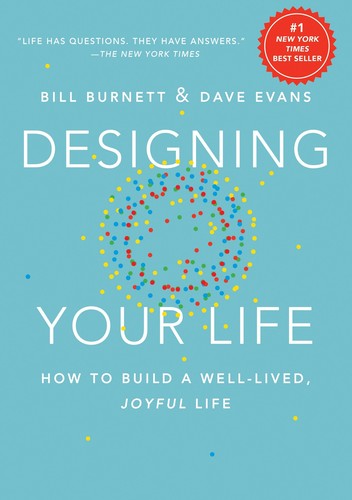
Designing Your Life by Bill Burnett and Dave Evans is a 2016 self-help book about career design, life planning, prototyping. Life is not a problem to be solved but a design to be prototyped. Iteration beats planning, because you learn what you actually want by trying things, not by analyzing them in advance.
Summary
Designing Your Life borrows tools from Silicon Valley product design and applies them to the messier problem of building a fulfilling life. Stanford professors Bill Burnett and Dave Evans argue that most career advice fails because it treats life as a problem to be optimized rather than a prototype to be tested. Their alternative is design thinking: instead of finding the one right path, you build, test, and iterate through multiple possible lives.
The book's central technique is creating "odyssey plans" — three distinct five-year plans for three radically different versions of your life. Rather than forecasting from your current trajectory, you sketch parallel futures that might look very different from each other. This forces the realization that you are not locked into one story. Each plan comes with a confidence dial and a set of questions about what appeals to you in that version, which makes the comparison concrete rather than abstract.
Burnett and Evans also introduce the concept of "workview" and "lifeview" — your beliefs about why you work and what life is for. Most people have never made these explicit. Surfacing them reveals whether your current career decisions are actually in tension with values you've held for years. The "good time journal" exercise runs alongside this: tracking what energizes and drains you during a normal week, then looking for patterns the data suggests.
The book is most useful for people in transitions — recent graduates, mid-career pivots, people coming back from a sabbatical — though the authors push back against the idea that it only applies when things feel stuck. The design-thinking framing has genuine reach, and the exercises are more structured than most career books manage. Where it falls short is in acknowledging how much external constraint shapes real careers; the tone occasionally assumes more latitude than many readers have. Still, even readers with limited options report that the exercises clarify what they actually want, which is itself useful information.
Talk to Designing Your Life like its author wrote you back.
Get the ideas that fit your life — not generic summaries.
- Chat with the book
- Audiobook-style main ideas
- Adapts to your life and goals
- Helps you take action
Key takeaways
- 1.
Life is not a problem to be solved but a design to be prototyped. Iteration beats planning, because you learn what you actually want by trying things, not by analyzing them in advance.
- 2.
The odyssey plan technique asks you to sketch three five-year plans for three genuinely different futures. Having three plans breaks the illusion that there is only one right answer.
- 3.
Your 'workview' and 'lifeview' — your beliefs about work and the meaning of life — are the hidden architecture behind every career decision. Making them explicit reveals which choices are actually out of alignment.
- 4.
Reframing dysfunctional beliefs matters as much as adding new habits. Many people are stuck not because they lack options but because they believe constraints are permanent when they aren't.
- 5.
A 'prototype conversation' is a structured informational interview with someone already living a life you're curious about. It tests assumptions before you commit to anything.
- 6.
The good time journal tracks what energized and what drained you during a normal week. The patterns, over two or three weeks, are more honest than any personality test.
- 7.
Gravity problems look like constraints but are actually beliefs. Before you decide something is impossible, test whether it's truly fixed or just feels that way.
- 8.
Wayfinding, not mapping, is how people find satisfying careers. You cannot see the whole path from the start. You take a step, learn, adjust, and take the next one.
Discussion questions
Use these on your own, with a book club, or as chat starters in Superbook. Book club version, ready to copy or print →
- 1.
Burnett and Evans say most people treat career decisions as engineering problems with one correct answer. Where in your own life are you still looking for the one right path?
- 2.
Write down your workview in two or three sentences — why do you work, and what do you believe work is for? Does it match how you actually spend your days?
- 3.
Which of your three 'odyssey plan' futures would you most resist showing someone else? What does that resistance tell you?
- 4.
Think about a decision you've been stuck on for months. Is it really a constraint, or is it a belief you've been treating as a constraint?
- 5.
Who in your life is already living a version of a future you're curious about? What would you actually ask them if you had an hour?
- 6.
When did you last feel fully engaged at work — energized by the task rather than just pushing through it? What made that state possible?
- 7.
The book distinguishes between being stuck and being in transition. Which one are you in right now, and does that change what kind of action makes sense?
- 8.
Burnett and Evans argue that failure is data. What's a professional failure from the last few years that you haven't fully examined for what it revealed?
- 9.
What assumptions about your current job or career path have you stopped questioning because you've held them so long?
- 10.
If you ran a prototype of one of your alternative futures for just one month, what would you actually do? What's stopping you?
- 11.
The book is optimistic about agency and choice. Where does its framework feel unrealistic given your actual situation?
- 12.
What's one thing you learned from keeping a good time journal, or would learn if you tried it for two weeks?
Themes
Frequently asked questions
-
Is Designing Your Life worth reading?
Yes, especially if you're in a career transition or questioning your direction. The exercises are more rigorous than most self-help books manage, and the design-thinking frame gives you permission to treat life decisions as testable rather than final. Less useful if you're firmly settled and not questioning anything.
-
How long does it take to read Designing Your Life?
About four to five hours of reading, but the exercises add time. The book has roughly fifteen exercises throughout. Readers who engage with them seriously spend two to four weeks working through the material.
-
What is the main idea of Designing Your Life?
That careers and lives can be approached like design projects: prototype multiple options, get feedback quickly, and iterate rather than planning everything in advance. There is no single right path, and the goal is to build something that genuinely fits rather than optimize for an abstract ideal.
-
Who should read Designing Your Life?
Anyone at an inflection point — graduating students, people considering a career shift, or anyone who has been doing the same thing for years and feels the ground shifting. Also useful for coaches, advisors, and therapists working with people on career questions.
-
What's the most useful exercise in Designing Your Life?
The good time journal. Two weeks of tracking what actually engages and depletes you produces more honest information than any personality test, because it's based on your real behavior rather than your self-image.
Similar books
Atomic Habits
James Clear
Essentialism: The Disciplined Pursuit of Less
Greg McKeown
Range: Why Generalists Triumph in a Specialized World
David Epstein
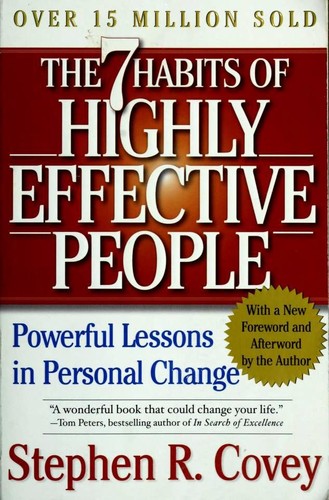
The 7 Habits of Highly Effective People
Stephen R. Covey
