Essentialism: The Disciplined Pursuit of Less by Greg McKeown is a 2014 self-help book about focus, decision-making, simplicity. The essentialist's question is not 'How do I fit it all in?' but 'What is the most important thing, and how do I protect time for that?' Almost everything is noise; a very few things are vital.
Summary
Essentialism is Greg McKeown's argument that the way most people approach work and life — saying yes to almost everything — is a slow form of defeat. The essentialist's question is not "How can I fit it all in?" but "What is the very most important thing I can do right now, and how do I protect time for that?" McKeown's central claim is that almost everything is noise and a very few things are vital, and that until you learn to distinguish between them you will remain perpetually busy and perpetually unfulfilled.
The book is organized around a simple framework. Explore: create space to look at your choices carefully before committing. Eliminate: cut what doesn't serve your highest contribution, including obligations accepted out of guilt or social pressure. Execute: remove obstacles and build systems that make the most important work nearly effortless. McKeown argues that most people skip the first two steps entirely, jumping straight into execution on the wrong things. The word "no" is the book's central tool — not the passive, apologetic no, but the clear, direct refusal that comes from knowing what you're actually for.
The book's signature concept is the 90/10 rule for decisions: if an option doesn't score a 9 or 10 out of 10 against your criteria, the right answer is no. This is McKeown's way of fighting what he calls the endowment effect applied to time — the tendency to overvalue existing commitments just because you already have them. He also examines how social pressure, the fear of missing out, and unclear personal priorities combine to make people systematically bad at protecting what actually matters to them.
Essentialism shares obvious territory with Deep Work and The 7 Habits, but its specific contribution is the emphasis on selection criteria rather than time management. McKeown isn't primarily telling readers to schedule better; he's arguing for wanting less, choosing deliberately, and saying no more often than feels comfortable. The book is more philosophical than tactical, which makes it a quick read but also means some readers will find it short on implementation detail. Where Atomic Habits gives tools, Essentialism gives a frame for deciding which tools are even worth picking up.
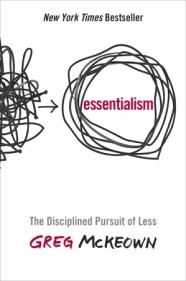
Talk to Essentialism: The Disciplined Pursuit of Less like its author wrote you back.
Get the ideas that fit your life — not generic summaries.
- Chat with the book
- Audiobook-style main ideas
- Adapts to your life and goals
- Helps you take action
Key takeaways
- 1.
The essentialist's question is not 'How do I fit it all in?' but 'What is the most important thing, and how do I protect time for that?' Almost everything is noise; a very few things are vital.
- 2.
The Explore-Eliminate-Execute framework. Most people skip Explore and Eliminate and go straight to executing on the wrong priorities.
- 3.
The 90/10 rule: if an opportunity doesn't score a 9 or 10 out of 10 against your own criteria, the answer should be no. A 7 is effectively a no.
- 4.
The endowment effect distorts time decisions. People overvalue existing commitments just because they already have them, making it hard to quit things that no longer serve them.
- 5.
Saying no is a skill. McKeown distinguishes between the vague, apologetic no and the clear, unhesitating refusal that comes from knowing your highest contribution.
- 6.
Uncommitted time is not laziness — it's the raw material for your best thinking. Protecting white space on the calendar is a precondition for doing anything important.
- 7.
Trade-offs are real. Choosing one thing means not choosing another, and pretending otherwise is how people end up spread thin across many mediocre commitments.
- 8.
Remove obstacles before adding effort. Before trying harder, ask what's in the way. Often the path to progress is subtraction, not addition.
Discussion questions
Use these on your own, with a book club, or as chat starters in Superbook. Book club version, ready to copy or print →
- 1.
McKeown says almost everything is a distraction and only a few things are vital. In your own work right now, what is the 'vital few' and what is the noise you're treating as urgent?
- 2.
Think of a time you said yes to something out of social pressure rather than genuine importance. What would it have cost you to say no?
- 3.
The 90/10 rule means a 7 is a no. What's a commitment in your life right now that scores a 7 — clearly positive but not essential — that you haven't been able to cut?
- 4.
McKeown argues that uncommitted time is the raw material for your best thinking. How much genuinely uncommitted time does your average week contain?
- 5.
Essentialism treats trade-offs as real and unavoidable, not problems to be solved. Where in your life are you pretending a trade-off doesn't exist?
- 6.
The book distinguishes between the reactive 'no' driven by overwhelm and the deliberate 'no' driven by clarity. Which kind do you mostly use?
- 7.
What would the 'highest contribution' version of your current role actually look like? How does it differ from what you spend most of your time on?
- 8.
McKeown uses the word 'play' as a serious, restorative activity that essentialists protect. Has play disappeared from your week? What has replaced it?
- 9.
Which commitments in your life feel like they were chosen by a past version of you who didn't know what you know now? What would it take to exit one of them?
- 10.
The book argues that the ability to say no gets harder the more successful you become, because more people want your time. Have you noticed this in your own career?
- 11.
McKeown says clarity about purpose makes decisions easy. What decision in your life right now would become obvious if you were clearer on what you're actually for?
- 12.
Where are you trying harder instead of removing the obstacle in front of you? What would subtraction look like in that situation?
Themes
Frequently asked questions
-
Is Essentialism worth reading?
Yes, particularly if you feel chronically overcommitted and are looking for a framework to justify saying no more often. The book is short and the argument is clear. If you've already absorbed The 7 Habits or Deep Work you'll find some overlap, but McKeown's specific focus on selection criteria — rather than time management — adds something distinct.
-
How long does it take to read Essentialism?
Around four to four-and-a-half hours at average reading pace. The book is 260 pages and written in short, accessible chapters. Most readers can finish it in a weekend. It rewards a second read to take notes on where you're violating its principles.
-
What is the main idea of Essentialism?
That doing less, but choosing better, produces more meaningful results than trying to do everything. McKeown's framework — Explore, Eliminate, Execute — is a systematic way to find your highest contribution and ruthlessly protect time for it.
-
Who should read Essentialism?
Knowledge workers, managers, and anyone who feels perpetually busy but not productive. It's especially useful for people who struggle to say no, take on too many commitments, or feel that their calendar is controlled by other people's priorities.
-
What's the most actionable idea in Essentialism?
The 90/10 rule: if something doesn't score a 9 or 10 out of 10 against your explicit criteria, the answer is no. Writing down your criteria before evaluating any opportunity is the practice. Most people skip this step and end up saying yes to a lot of mediocre things.
-
How is Essentialism different from minimalism?
Essentialism is about decisions, not possessions. It's less about owning fewer things and more about committing to fewer things — projects, meetings, obligations, goals. McKeown's lens is professional and personal effectiveness, not lifestyle aesthetics.
Similar books
Deep Work
Cal Newport
The 7 Habits of Highly Effective People
Stephen R. Covey
Indistractable: How to Control Your Attention and Choose Your Life
Nir Eyal
The 4-Hour Workweek
Timothy Ferriss
