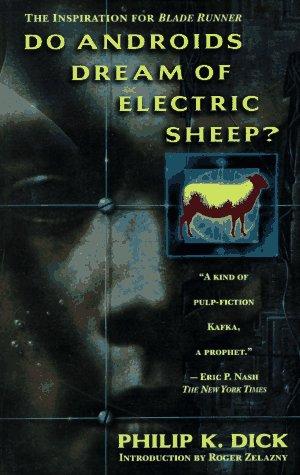
Do Androids Dream of Electric Sheep? by Philip K. Dick is a 1968 science fiction book about empathy and its limits, what makes us human, consumerism and authenticity. The Voigt-Kampff test identifies androids by their lack of empathy, but the novel keeps asking whether empathy is a capacity or a performance — and whether the humans in this world are performing it too.
Summary
Rick Deckard is a bounty hunter in a post-nuclear-war San Francisco, tasked with "retiring" — killing — six escaped androids who have fled a Martian colony to Earth. The androids are nearly indistinguishable from humans except for their inability to feel empathy, which the Voigt-Kampff test is designed to detect. Over one day, Deckard hunts his six targets, grows uncertain about who and what deserves to live, and falls into a relationship with one of them that destabilizes his convictions about what he is doing and why.
The novel's real subject is empathy — what it is, who has it, whether it can be faked, and whether its absence is definitional of non-humanity. In the world of the novel, empathy has become a social religion: Mercerism, practiced via an "empathy box" that connects users into a communal experience of suffering. Owning a real animal (most have been killed by nuclear fallout) signals emotional status; synthetic animals serve as substitutes for those who can't afford the real thing. Dick uses this world to ask whether performed empathy and real empathy can be distinguished — and whether the distinction matters.
Dick's prose is not literary in the conventional sense; it is functional, flat, and fast, which suits a novel narrated in the register of a man doing a job. The world-building is impressionistic rather than systematic — details accumulate into atmosphere rather than cohere into a physics. This is a feature for some readers and a frustration for others. Dick was working on ideas, and the fictional frame is the vehicle rather than the destination. The empathy test, the mood organ that lets you dial up your emotional state, the kipple — the creeping entropy of consumer goods — these are philosophical thought experiments in pulp science fiction packaging.
Blade Runner (1982) and Blade Runner 2049 (2017) are both loosely adapted from this novel, and most readers now come to the book having seen the film first. The film is more beautiful and more coherent; the novel is stranger, more claustrophobic, and more interested in the religious and metaphysical questions the films only gesture at. Both are worth your time. The book takes four hours and will leave questions that the films don't ask.
Talk to Do Androids Dream of Electric Sheep? like its author wrote you back.
Get the ideas that fit your life — not generic summaries.
- Chat with the book
- Audiobook-style main ideas
- Adapts to your life and goals
- Helps you take action
Key takeaways
- 1.
The Voigt-Kampff test identifies androids by their lack of empathy, but the novel keeps asking whether empathy is a capacity or a performance — and whether the humans in this world are performing it too.
- 2.
Mercerism — the empathy religion — may be a complete fabrication, and the novel suggests that shared fictions of empathy may be more socially useful than authentic feeling.
- 3.
Kipple is Dick's term for the accumulating detritus of consumer society — the entropy that fills empty spaces. It is both literal (junk) and metaphorical (meaninglessness).
- 4.
Owning a real animal in the novel is a social and moral status signal. Dick wrote this in 1968, and the ecological anxiety it reflects reads as prescient.
- 5.
The androids Dick creates are not evil — they are indifferent, and that indifference is scarier to the novel than malice would be.
- 6.
Deckard's certainty about what he's doing erodes across the novel, and the erosion is the point: the work of killing something that looks like a person and acts like a person has psychological consequences.
- 7.
Dick's mood organ — a device that lets you set your emotional state for the day — is played for dark comedy, but it raises a serious question: if you can choose to feel better, do you have an obligation to?
- 8.
The novel's ending doesn't resolve its questions about what is real; it intensifies them. That refusal of resolution is characteristic of Dick and is what makes his work feel philosophical rather than merely strange.
Discussion questions
Use these on your own, with a book club, or as chat starters in Superbook. Book club version, ready to copy or print →
- 1.
The Voigt-Kampff test measures empathic response. Can empathy actually be tested? What would a real test look like?
- 2.
Rachael is an android who believes she is human. When she finds out the truth, it changes her behavior. What does her reaction suggest about the relationship between identity and belief?
- 3.
Deckard retires androids for a living, and the novel makes him uncomfortable with that. Is the discomfort earned, or does Dick let him off too easy?
- 4.
Mercerism turns out to be, possibly, a fabricated religion. Does the possibility of its falsity change what it provides to the people who practice it?
- 5.
The real animals in the novel are status objects. Is Dick commenting on something specific about 1968, or does that observation feel as true now?
- 6.
The androids want to live. Does wanting to live make something deserving of life? The novel doesn't fully answer this — do you?
- 7.
Blade Runner is visually stunning and emotionally coherent in ways the novel isn't. Does knowing the film change your reading of the book? Which version of the story is more interesting to you?
- 8.
Dick's prose is functional rather than literary. Does that flat affect suit the story, or does it distance you from the characters?
- 9.
J.R. Isidore — a human with cognitive impairment who cares for the androids and real animals with genuine empathy — is arguably the moral center of the novel. Do you read him that way?
- 10.
The novel ends in a way that suggests Deckard's understanding of his world is not stable. Is that ambiguity earned or frustrating?
- 11.
Philip K. Dick was writing during the Vietnam War, and questions about who deserves to die and who is actually human were politically charged. Does that context change how you read the bounty hunting premise?
- 12.
Compared to The Fifth Season or Kindred — other SF works that use the genre to examine what it means to be treated as less than human — where does Dick's novel land? What does it do better or worse?
Themes
Frequently asked questions
-
Should I read the book or watch Blade Runner?
Both, ideally. Blade Runner (1982) is visually and emotionally richer; the novel is philosophically stranger and more interested in religion, empathy, and entropy. They are different enough that reading the novel after seeing the film is not redundant. Start with whichever version appeals more and follow the other.
-
Is Do Androids Dream of Electric Sheep hard to read?
No. It's short — about four hours — and Dick's prose is functional and fast. The ideas can be challenging, but the surface is accessible. This is not a technically demanding novel; it's a conceptually demanding one.
-
What is the novel actually about?
A bounty hunter is hired to kill six escaped androids in a post-apocalyptic San Francisco. Over one day, he begins to question whether what he's doing is right, whether the androids deserve the life he's taking, and whether the humans around him — including himself — are as human as they assume.
-
Why is this novel considered important?
Dick was asking questions in 1968 that the field of AI ethics is now asking formally: what is the basis for moral status? Can empathy be faked? What distinguishes a sufficiently sophisticated simulation from the real thing? He was working in pulp SF packaging, but the questions were serious and they haven't dated.
-
Who shouldn't read this book?
Readers who need narrative coherence, worldbuilding consistency, and resolved endings. Dick's novel is impressionistic rather than systematic — some details contradict others, some plotlines don't pay off — and the ending intensifies the ambiguity rather than resolving it. Readers who want answers will find it frustrating.