Doctor Zhivago by Boris Pasternak is a 1957 classics book about individual against history, love under revolution, art and survival. Pasternak's central argument is that history's attempt to dissolve the individual into the collective represents a fundamental spiritual violence — Zhivago's poetry is an act of resistance that requires no political content.
Summary
Doctor Zhivago is the novel Boris Pasternak spent much of his adult life writing and which the Soviet state refused to publish, leading to its smuggled publication in Italian in 1957. It follows Yuri Zhivago — a poet, doctor, and deeply private man — from childhood through the Russian Revolution, the Civil War, and into the early Soviet period. It is not primarily a political novel, though politics saturate every page. It is a novel about a particular kind of consciousness — artistic, spiritual, individualistic — trying to survive in a century that wants to dissolve individuals into movements.
The love story between Zhivago and Lara is the novel's emotional spine, but Pasternak is interested in something broader than romance. His Russia is a landscape of almost metaphysical significance — the forests, the winter light, the countryside — and the characters move through history less like agents than like figures in a painting, swept along by forces they can name but not control. The coincidences that keep Zhivago and Lara circling each other across years and thousands of miles are not realistic by any conventional standard; Pasternak seems to be arguing that history has a pattern underneath its violence, that lives of genuine depth trace out something with the shape of meaning.
The novel's structure is loose and episodic in ways that can frustrate readers expecting a tightly plotted narrative. Pasternak was primarily a poet, and the book reads like poetry in some of its best passages: language for its own sake, the precise image over the explanatory sentence, an interest in atmosphere and consciousness over plot mechanics. The poems appended at the end — attributed to Zhivago — are themselves significant works, and reading the novel without them misses a layer of meaning. The character of Zhivago is also difficult — passive, self-absorbed, capable of cowardice in his personal life even while achieving a kind of spiritual heroism through his art.
Readers drawn to large Russian novels and interested in questions of individual consciousness versus historical necessity will find this deeply rewarding. Readers who want a more conventional love story or a sharper political narrative may find the pace and emotional diffuseness demanding. The Nobel Committee awarded Pasternak the 1958 prize for it; the Soviet state forced him to refuse the award.
Talk to Doctor Zhivago like its author wrote you back.
Get the ideas that fit your life — not generic summaries.
- Chat with the book
- Audiobook-style main ideas
- Adapts to your life and goals
- Helps you take action
Key takeaways
- 1.
Pasternak's central argument is that history's attempt to dissolve the individual into the collective represents a fundamental spiritual violence — Zhivago's poetry is an act of resistance that requires no political content.
- 2.
The novel's coincidences are not plot failures but metaphysical statements: Pasternak is suggesting that the lives of people with genuine inner depth trace out a pattern history cannot fully erase.
- 3.
Lara is both a fully realized character and an embodiment of Russia itself — that dual function creates both the novel's emotional power and some of its narrative strangeness.
- 4.
Zhivago's passivity in his personal life coexists with his artistic vitality, and Pasternak seems to treat this not as a contradiction but as a description of how genuine artists often live.
- 5.
The appended poems — attributed to Zhivago — are essential to the novel's argument: the book suggests that the poems are what survives after everything else is destroyed, which is the only form of victory available.
- 6.
Russia's landscape is treated as a spiritual entity throughout the novel — winter, forest, light — in a way that is religious without being conventionally Christian.
- 7.
The Revolution is shown not primarily as political event but as a kind of weather: vast, impersonal, and as capable of beauty as of destruction.
- 8.
The novel's publication history is part of its meaning: a book about the individual's survival under totalitarianism was itself a survivor, smuggled out, published abroad, and awarded the Nobel Prize its author couldn't accept.
Discussion questions
Use these on your own, with a book club, or as chat starters in Superbook. Book club version, ready to copy or print →
- 1.
Zhivago is a passive protagonist in many respects — events happen to him more than he drives them. Does this passivity undermine your engagement with him, or is it essential to what Pasternak is arguing?
- 2.
The novel's famous coincidences — Zhivago and Lara kept crossing paths across vast distances — don't follow realistic probability. What is Pasternak doing with this structural choice?
- 3.
Pasternak was primarily a poet. Do you think the novel reads differently knowing that — does it explain anything about its texture, pace, or priorities?
- 4.
The Soviet state suppressed the novel and forced Pasternak to refuse the Nobel Prize. How does knowing that history change the experience of reading it?
- 5.
Zhivago is not a political actor — he doesn't resist the Revolution, he just tries to survive it while remaining himself. Is that enough? Does the novel think it's enough?
- 6.
The poems at the end are attributed to Zhivago and are presented as his greatest achievement. Having read the novel, do the poems feel like they belong to the character you spent 500 pages with?
- 7.
Lara has been read as an idealization, a male projection, a symbol of Russia. Does she work as a fully realized human character to you — and does it matter for the novel's success whether she does?
- 8.
The novel covers an enormous span of history but often skips past events rather than dramatizing them, returning to Zhivago's inner life instead. Is this a failure of historical imagination or a principled artistic choice?
- 9.
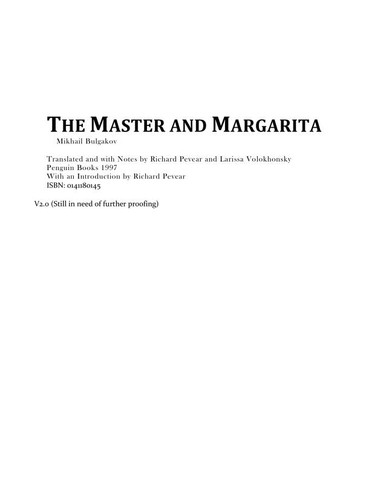
How does Doctor Zhivago compare to The Master and Margarita as a novel about surviving under Soviet totalitarianism? What does each novel think is most important to protect?
- 10.
Zhivago's marriage to Tonya and his relationship with Lara run simultaneously for much of the novel. How does Pasternak ask us to read the two relationships — are they in competition or do they serve different needs?
- 11.
The novel ends in what amounts to defeat for Zhivago but suggests a kind of posthumous victory through his poetry. Is that consolation convincing, or does it feel like an evasion?
- 12.
Russia's specific landscape — winter, steppes, provincial cities — is almost a character in the novel. For readers who don't know Russia: did the place feel real to you, or did it remain abstraction?
- 13.
The Nobel Committee awarded Pasternak the prize in 1958. Do you think Doctor Zhivago is a better or worse novel than its reputation suggests — has its political significance inflated or distorted how we evaluate it?
Themes
Frequently asked questions
-
Is Doctor Zhivago worth reading?
Yes, particularly for readers interested in the inner life of artists under political pressure, or in large Russian novels of consciousness and landscape. It is not a conventionally plotted love story despite how it is often marketed. Its greatest passages are among the most luminous in twentieth-century fiction.
-
Is Doctor Zhivago difficult to read?
Yes, in terms of length and pace. At 500+ pages it moves slowly through its early sections and the cast is large. The narrative structure is episodic and associative rather than tightly causal. Readers who struggle with Russian names should use the list of characters provided in most editions. The rewards are real but require patience.
-
How does the film compare to the book?
David Lean's 1965 film with Omar Sharif and Julie Christie is beautiful and captures the visual grandeur of the story, but it conventionalizes the romance and largely strips out the novel's spiritual and poetic dimensions. It is a good film but a different thing from the novel.
-
Do I need to know Russian history to appreciate Doctor Zhivago?
Basic knowledge of the Russian Revolution and the Civil War helps significantly — who the Bolsheviks and White Russians were, the general shape of events from 1917 onward. Most editions include historical notes. The novel assumes some familiarity but is not incomprehensible without it.
-
Who should not read Doctor Zhivago?
Readers who want narrative momentum and plot-driven satisfaction. The novel is slow, digressive, and more interested in internal states than external events. If your ideal novel has clear dramatic scenes and forward momentum, this will test your patience severely.