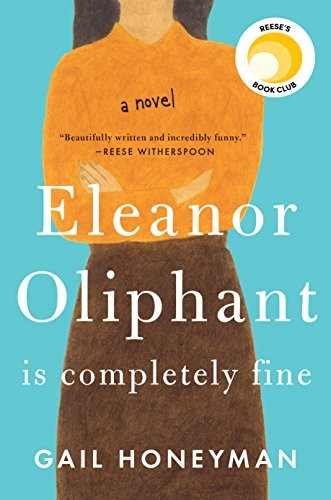
Eleanor Oliphant Is Completely Fine by Gail Honeyman is a 2017 contemporary fiction book about trauma and recovery, loneliness and connection, childhood abuse and its aftermath. Eleanor's cheerful certainty that she is fine is the novel's central irony — and also a very accurate portrait of how dissociation and repression actually work in people who have survived severe trauma.
Summary
Eleanor Oliphant is twenty-nine years old, works in a Glasgow office doing data entry, and has not had a proper conversation with anyone outside of work in years. She eats the same meals on the same days, does not drink on weekdays, and is absolutely certain she is completely fine. She has significant scars on her face and arms, she speaks with an eccentric formality that alienates almost everyone, and she has a weekly phone call with her mother that is the most disturbing thing in the novel for reasons that take time to become clear.
The book is a character study masquerading as a feel-good novel, or perhaps the other way around. Eleanor's voice is funny and odd and frequently astute about the social conventions she refuses to perform, and the humor is real. But beneath it, Honeyman is working with severe childhood trauma, and as the novel progresses and Eleanor forms her first tentative friendships — with a coworker, with an old man they help in the street, with a therapist — the damage begins to surface. The book earns its ending rather than giving it away early.
The structural choice that sustains the novel is Eleanor's narrative unreliability. She tells us what she sees with great precision but misreads almost everything, including herself. She is an unreliable narrator not because she lies but because she genuinely cannot see certain things yet. As the reader understands more than Eleanor does, the gap between her cheerful self-assessment and the reality of her situation becomes the novel's engine.
Eleanor Oliphant was a debut bestseller in multiple countries and a Reese Witherspoon book club pick, which means it has a popular readership that sometimes resists literary analysis. It belongs to the "quirky female loner" subgenre, and its ending is conventional in ways that some readers find satisfying and others find neat. For readers who can hold the genuine emotional insight alongside the commercial shape, it is a book worth spending time with.
Talk to Eleanor Oliphant Is Completely Fine like its author wrote you back.
Get the ideas that fit your life — not generic summaries.
- Chat with the book
- Audiobook-style main ideas
- Adapts to your life and goals
- Helps you take action
Key takeaways
- 1.
Eleanor's cheerful certainty that she is fine is the novel's central irony — and also a very accurate portrait of how dissociation and repression actually work in people who have survived severe trauma.
- 2.
The voice is the achievement: funny, precise, socially oblivious in ways that are both comic and heartbreaking, and credible as the voice of someone who learned to think very carefully to survive a chaotic childhood.
- 3.
The novel treats loneliness as a structural problem, not a personal failing — Eleanor is isolated partly by her damage and partly by a culture that has no mechanisms for people who don't fit its social templates.
- 4.
Small acts of kindness — helping an old man, a coworker who notices her — are shown as genuinely transformative, which is the novel's most sincere argument and also its most conventional one.
- 5.
The unreliable narrator device here works through omission rather than fabrication: Eleanor cannot tell us what she does not yet know about herself, and the gaps are visible to the reader before they are to her.
- 6.
The 'mummy' phone calls, which appear throughout the novel, are the clearest signal that something is seriously wrong — the reader is meant to track them more anxiously than Eleanor does.
- 7.
Therapy is depicted with unusual seriousness for popular fiction — not as a quick fix but as a slow, painful process of becoming able to hold your own history.
- 8.
The revelation of Eleanor's past, when it comes fully, reframes every earlier scene, which is a structurally satisfying payoff that the novel has been working toward honestly.
Discussion questions
Use these on your own, with a book club, or as chat starters in Superbook. Book club version, ready to copy or print →
- 1.
Eleanor misreads almost every social situation she encounters. Is this played primarily for comedy, for pathos, or both — and does the balance shift as the novel progresses?
- 2.
The phone calls with 'Mummy' are increasingly sinister. At what point did you understand what they meant, and did the novel signal it clearly enough?
- 3.
Eleanor's therapist is a supporting character rather than a narrative device. How does the novel treat therapy — as cure, as process, as something else?
- 4.
Eleanor forms an intense, delusional attachment to a musician early in the novel. How does Honeyman use that subplot to introduce the reader to Eleanor's psychology?
- 5.
Raymond, the coworker who befriends Eleanor, is a very ordinary, well-meaning man. What is the novel saying about the role of ordinary people in recovery?
- 6.
The novel's ending is healing and relatively clean. Did you find that satisfying or did it feel too neat given the severity of Eleanor's history?
- 7.
Eleanor is often funny about the social conventions she doesn't understand or refuses to perform. Does the humor make the darker material more accessible or does it sometimes soften it too much?
- 8.
The novel belongs to a recognizable subgenre — the quirky, damaged female narrator who learns to connect. Does knowing that framing affect how you read it?
- 9.
Eleanor's physical scars are present throughout and she never explains them until late in the novel. How did you read those references as you went?
- 10.
What does the novel believe about the causes of adult dysfunction — is it primarily about individual trauma, or does it also implicate social structures?
- 11.
If Eleanor's story were told by an external narrator rather than in first person, what would be lost? What might be gained?
Themes
Frequently asked questions
-
Is Eleanor Oliphant Is Completely Fine worth reading?
Yes, for most readers. It is engagingly written, the voice is genuinely distinctive, and the emotional payoff is earned. The novel is commercial in its shape but more psychologically honest than most books in its category. If you are very sensitive to trauma content, the backstory is severe.
-
Is Eleanor Oliphant a difficult read emotionally?
The book is funnier than you might expect for the first half, and the darker content surfaces slowly. The backstory, when it is fully revealed, is genuinely disturbing — it involves severe childhood abuse and neglect. The novel handles it without being gratuitous, but readers should know it is there.
-
Is there an adaptation?
A film adaptation has been announced with Reese Witherspoon attached as both producer and star, but as of 2026 it has not been released.
-
What is Eleanor Oliphant actually about, without spoilers?
A young woman who has built a very controlled, very isolated life begins to form human connections for the first time, and in doing so has to confront a past she has been avoiding. The novel is about what it takes to let people in when your experience has taught you that people are dangerous.
-
Who shouldn't read this book?
Readers who find unreliable narrators frustrating, who dislike the quirky-loner genre of literary fiction, or who want literary complexity over emotional satisfaction may find the novel's commercial shape frustrating. The ending is tidier than the disorder it resolves.