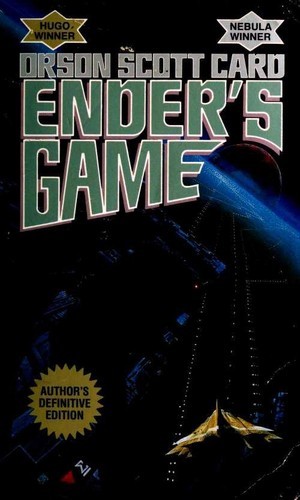
Ender's Game by Orson Scott Card is a 1985 science fiction book about war and manipulation, childhood and agency, empathy and destruction. The novel's central ethical question — whether exceptional individuals can be sacrificed for collective survival without their knowledge or consent — is never resolved, only lived through.
Summary
Ender's Game takes place in a future where Earth has barely survived two invasions by an insectoid alien species called the Formics. The international military, convinced a third invasion is coming, runs a program to identify and train genetically gifted children as commanders. Andrew "Ender" Wiggin, six years old at the novel's opening, is the most promising candidate they've found — monitored since birth, recruited against his will, and placed in a system of battle simulations designed to make him the commander humanity needs.
The book is about what adults do to exceptional children when they decide civilization is at stake. The Battle School is a sophisticated machine for breaking Ender down and rebuilding him: isolating him from peers, escalating the difficulty of every challenge the moment he masters it, ensuring he can never rest or form stable relationships. Card is explicit that the adults running the program understand exactly what they're doing and believe the cost is justified. Ender's gradual moral exhaustion and psychological damage are features of the design, not accidents.
What makes the novel endure is the central irony: the qualities that make Ender the perfect commander are also the qualities that should disqualify him from command. He succeeds because he can understand his enemies better than they understand themselves — and understanding them as he does, he cannot hate them in the way soldiers require. Card layers this carefully, so the famous final revelation (widely known even before reading) feels less like a twist and more like the logical endpoint of everything that came before.
Ender's Game divides readers along a consistent fault line: those who find the child-military-prodigy premise engaging and the moral question about ends and means genuinely resonant, and those who find the premise implausible and the emotional manipulation of the reader (through Ender) less sophisticated than it first appears. It remains a canonical YA-adjacent SF novel, a staple of school reading lists and military academy syllabi alike, and the source of genuine disagreement about what it actually argues.
Talk to Ender's Game like its author wrote you back.
Get the ideas that fit your life — not generic summaries.
- Chat with the book
- Audiobook-style main ideas
- Adapts to your life and goals
- Helps you take action
Key takeaways
- 1.
The novel's central ethical question — whether exceptional individuals can be sacrificed for collective survival without their knowledge or consent — is never resolved, only lived through.
- 2.
Ender succeeds as a commander precisely because he can model his enemies' minds accurately enough to destroy them, but Card suggests that capacity and genuine empathy are the same thing expressed differently.
- 3.
The adults are not villains: they believe they're doing what's necessary, and Card gives their position real weight. The tragedy is that they may be right, and the cost is still a destroyed child.
- 4.
Isolation as a tool of formation is the book's most disturbing argument: the administrators make Ender exceptional by ensuring he can rely on no one, and that process works.
- 5.
The game-within-a-game structure (Battle Room, then Command School) allows Card to withhold information from the reader alongside Ender — both are deceived in the same direction.
- 6.
Peter and Valentine represent the two failure modes Ender is designed to avoid: pure cruelty and pure compassion. Ender contains both, and the story is about which he can sustain.
- 7.
The final revelation recontextualizes the entire novel. On re-read, the administrators' behavior in the final act reads differently, and the question of whether Ender could have understood changes.
- 8.
The Speaker for the Dead framework, introduced in the final pages, gestures toward a redemption arc that the sequels pursue — Ender's capacity for understanding the Formics becomes the basis for a different kind of human relationship with them.
Discussion questions
Use these on your own, with a book club, or as chat starters in Superbook. Book club version, ready to copy or print →
- 1.
The military administrators believe they're justified in what they do to Ender. Do you find that position defensible, monstrous, or somewhere more complicated?
- 2.
Ender's empathy and his capacity for destruction are presented as two sides of the same coin. Does that feel true to you, or like a paradox the novel asserts without fully earning?
- 3.
The novel is often read as a critique of military training and the instrumentalization of children. Is that the reading Card intended? Does it matter?
- 4.
Peter is genuinely dangerous; Valentine is genuinely compassionate. Ender is designed to contain both without being consumed by either. Does he succeed, by the end?
- 5.
The final revelation — widely known even before reading — changes how we see the last act. If you knew going in, how did that affect your experience? Does the novel work as well when the revelation isn't a surprise?
- 6.
Ender's Game is on military academy reading lists and has been cited by actual military strategists. What do you think they take from it that a civilian reader might not?
- 7.
The Formics are exterminated before anyone establishes whether genuine communication was possible. Who bears moral responsibility for that, and does the novel distribute it fairly?
- 8.
Valentine and Peter's political project on Earth (writing as Locke and Demosthenes) runs parallel to Ender's military training. Does that subplot feel organic to the novel's themes or like a separate book trying to share the same cover?
- 9.
Ender is six when the book starts and early teens by the end, but the voice and behavior often feel adult. Is that a flaw in the characterization or a deliberate reflection of what the training has done to him?
- 10.
The sequels (Speaker for the Dead, Xenocide) move dramatically toward empathy and away from warfare. Is that a natural continuation, or do they feel like a different writer's answer to the same problem?
- 11.
The adults in the book ultimately got what they wanted: humanity survived. Does the outcome retroactively justify their methods, even if we wouldn't endorse those methods prospectively?
- 12.
What obligation, if any, does humanity owe Ender after what was done to him? Does the novel answer that question or leave it open?
Themes
Frequently asked questions
-
Is Ender's Game worth reading as an adult?
Yes, though your experience will differ from a teenage reading. As an adult the ethical questions about what the adults do to Ender become the primary focus rather than the gaming and tactics. The moral complexity is real, and the final revelation hits differently when you've been watching the adults with more suspicion all along.
-
Do I need to read the sequels?
No. Ender's Game works as a complete standalone. The sequels (especially Speaker for the Dead) are very different in tone — less war, much more philosophy and empathy — and are often more admired by adult readers. But they're a different kind of book and not required.
-
What is the twist at the end of Ender's Game?
This is widely known enough to mention: what Ender believes is simulation training is actually real combat, and he has commanded the final campaign against the Formics without knowing it. The novel earns this by showing you, in retrospect, exactly where and how the deception operated.
-
Who shouldn't read Ender's Game?
Readers who find child protagonists in adult situations uncomfortable, and readers who need moral clarity in their fiction. The novel refuses to tell you definitively whether what was done to Ender was wrong — it gives the adults their best arguments and then makes you live with the cost.
-
Is there a film adaptation?
Yes — a 2013 film directed by Gavin Hood, starring Asa Butterfield as Ender and Harrison Ford as Graff. It was well-reviewed for its production design and condensed the story effectively but compressed the timeline and psychological development significantly. Most fans consider the novel superior.