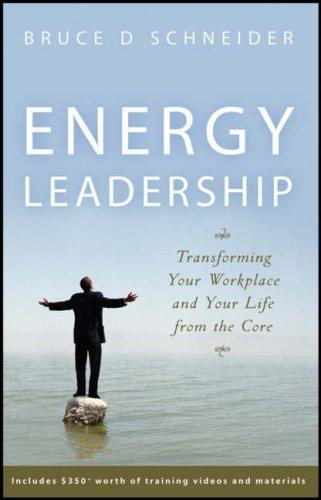
Energy Leadership by Bruce D. Schneider is a 2007 business book about leadership energy, consciousness, self-awareness. Every leader operates from an energy level that ranges from catabolic (draining, reactive, fear-based) to anabolic (constructive, responsive, opportunity-focused). That level shapes their culture and their results.
Summary
Energy Leadership is Bruce Schneider's framework for understanding how leaders show up — the quality of awareness and presence they bring to interactions, decisions, and crises. Schneider is the founder of the Institute for Professional Excellence in Coaching (iPEC), and the book presents the intellectual foundation for the coaching methodology his school teaches. The central concept is that energy operates at seven distinct levels, ranging from the lowest (victimhood and apathy) to the highest (creative awareness and non-judgment), and that the level from which a leader habitually operates determines both their effectiveness and the culture they produce.
Schneider distinguishes between "catabolic" energy — draining, fear-based, resistance-oriented — and "anabolic" energy — constructive, opportunity-focused, sustaining. Most people operate from a mix of the two depending on context, but habitual patterns develop that either chronically deplete or chronically energize the leader and everyone around them. The model is less about personality type and more about how conscious or reactive a person is in any given moment.
The seven levels function as a map for self-diagnosis: Level 1 is pure victimhood ("this is happening to me"); Level 2 is conflict and aggression; Level 3 is responsibility; Level 4 is care; Level 5 is reconciliation; Level 6 is intuition; Level 7 is creation. Each level has characteristic thoughts, feelings, and behavioral patterns. The framework is most useful not as a fixed description of who you are but as a tool for noticing where you currently are in a given situation and choosing to shift.
The book blends business application with a worldview that is more philosophical than empirical. Readers who are comfortable with concepts like energy and consciousness in a non-literal sense will find the framework compelling. Readers who want robust empirical grounding will find the evidence thin — Schneider's model is built on coaching practice and conceptual logic, not controlled research. As a coaching methodology it has generated significant results in practice; as a standalone book it works best alongside the self-assessment the author offers.
Talk to Energy Leadership like its author wrote you back.
Get the ideas that fit your life — not generic summaries.
- Chat with the book
- Audiobook-style main ideas
- Adapts to your life and goals
- Helps you take action
Key takeaways
- 1.
Every leader operates from an energy level that ranges from catabolic (draining, reactive, fear-based) to anabolic (constructive, responsive, opportunity-focused). That level shapes their culture and their results.
- 2.
The seven levels of energy provide a map for self-awareness: from victimhood and conflict at the low end, through responsibility and care in the middle, to intuition and creative awareness at the top.
- 3.
Catabolic and anabolic energy are not fixed personality traits — they're states. The same person can operate from Level 2 in a stress response and Level 5 in a relaxed collaboration. The goal is to expand your range and raise your average.
- 4.
Most leadership failures are energy failures before they are strategy failures. A leader operating primarily from fear or conflict makes worse decisions, not just less pleasant ones.
- 5.
Consciousness — the quality of awareness you bring to a moment — is trainable. The practices Schneider recommends (self-observation, reframing, deliberate response) move leaders toward higher average energy levels over time.
- 6.
The gap between where your energy is and where you think it is is often larger than you expect. Honest self-assessment — ideally with outside feedback — is the starting point.
- 7.
Leaders who expand their average energy level change the culture around them without explicitly trying to. Energy is contagious, and the leader's level sets a ceiling for the team's range.
Discussion questions
Use these on your own, with a book club, or as chat starters in Superbook. Book club version, ready to copy or print →
- 1.
Think of a high-stakes moment at work recently. From which of the seven levels do you think you were operating? What's your evidence?
- 2.
Schneider distinguishes catabolic from anabolic energy. Which pattern is most dominant in your habitual leadership style, and when does it show up most clearly?
- 3.
Where in your current role are you chronically operating from Level 1 or Level 2 — victimhood or conflict — without realizing it?
- 4.
The model says energy levels are states, not traits. When do you most easily shift to higher levels? What conditions allow that?
- 5.
What is the average energy level of the culture on your team? How much of that is a reflection of your own habitual level?
- 6.
Level 3 is responsibility: the shift from 'this is happening to me' to 'I am creating this.' Where are you currently unwilling to make that shift?
- 7.
The book claims leadership failures are often energy failures first. Think of a leadership failure you observed or experienced. Was there an energy component that preceded the strategic or operational problem?
- 8.
Schneider's framework comes from a coaching tradition. Does it feel more useful as a coaching tool used with a guide, or as a solo self-assessment framework?
- 9.
How comfortable are you with the non-empirical aspects of this model? Does that affect how useful you find it?
- 10.
If you raised your average energy level by one full level, what would change in how you lead? What would it require of you?
- 11.
Which level do you most admire in leaders you've worked with? Have you ever worked with someone you'd describe as operating at Level 6 or 7?
Themes
Frequently asked questions
-
What is Energy Leadership about?
Bruce Schneider presents a seven-level model of leadership energy, ranging from catabolic (draining, reactive) to anabolic (constructive, creative). The framework is designed to help leaders identify their habitual energy level, understand its effects on culture and performance, and develop practices to raise their average.
-
Is Energy Leadership scientifically rigorous?
Not by academic standards. The framework is built on coaching practice and conceptual logic rather than controlled research. The underlying concepts — emotional contagion, self-regulation, mindfulness — are supported by scientific literature, but Schneider's specific seven-level model is his own construction. Take it as a practical map, not a verified theory.
-
How long does Energy Leadership take to read?
About four to five hours. The book is around 200 pages and is written accessibly. The first half lays out the framework; the second half covers application. The self-assessment is most useful when done alongside a certified coach.
-
Who gets the most from this book?
Leaders who work with coaches or in coaching cultures will find it most useful. It's particularly relevant for executive coaches who want to understand the iPEC methodology, and for leaders who want a framework that goes deeper than personality-type models into the moment-to-moment quality of their presence.
-
Do I need to take the ELI assessment to use the framework?
The book stands alone without the assessment, but the ELI (Energy Leadership Index) provides a more precise personal baseline. The combination of the book plus a debrief with a certified coach is how Schneider intends the framework to be used — the book alone is useful but incomplete.