Science · Book club
Enlightenment Now book club questions
Here are 12 book club questions for Enlightenment Now by Steven Pinker, ordered to open easily and end somewhere worth arguing about. Copy them, print them, or bring them up one at a time.
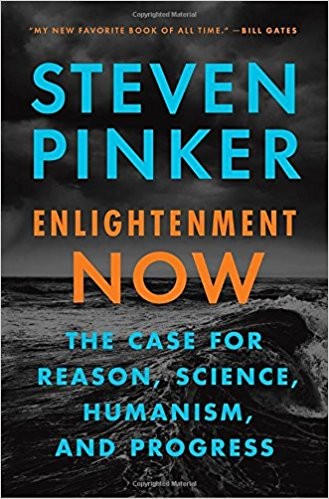
Enlightenment Now is Steven Pinker's argument that the ideals of the Enlightenment — reason, science, humanism, and progress — have been responsible for a dramatic and continuing improvement in human wellbeing across virtually every measurable dimension, and that these ideals are under threat from counter-Enlightenment movements on both the left and the right.
Steven Pinker · 2018 · 12h 0m
Full summary and key takeaways →The 12 questions
- 1.
Pinker argues most people wrongly believe the world is getting worse. Was your intuition corrected by the data in the book, or did you already hold the view he's defending?
- 2.
He credits the Enlightenment specifically for modern progress. How do you evaluate that causal attribution? What else might deserve credit?
- 3.
Some critics argue Pinker's optimism is too comfortable — that it underweights the people and places left behind by progress. Is that criticism fair?
- 4.
The availability heuristic leads people to overweight vivid recent disasters. Does identifying that bias change how you respond to news about the world?
- 5.
Pinker is critical of both left and right versions of counter-Enlightenment thinking. Do you think he treats both sides equally?
- 6.
He presents climate change as a serious but solvable problem. Does that framing seem appropriate to you given current trajectories?
- 7.
How much weight should the benefits of the global order — poverty reduction, peace, trade — receive against its costs — inequality, environmental damage, cultural homogenization?
- 8.
Which metric of progress did you find most surprising or most moving?
- 9.
Pinker explicitly defends liberal democracy and its institutions. Is that defense politically neutral or does it position the book ideologically?
- 10.
He argues that negativity bias explains why people feel things are getting worse even when they're not. How do you personally manage that bias in your reading of the news?
- 11.
What's missing from the data section — a metric of human wellbeing that you think is important but is not well captured in the book?
- 12.
Is the Enlightenment worldview — reason, science, humanism, progress — sufficient to address the challenges of the next century, or does it need to be supplemented or revised?
How to run the discussion
- Pick six to eight, not all of them. An hour of real discussion covers fewer questions than anyone expects, and racing the list is what makes a book club feel like homework.
- Open with what people noticed, not what they concluded. Asking for a verdict first hardens opinions before anyone has heard each other.
- Let the disagreement run. The questions below that split a room are the ones worth the time; the ones everyone answers the same way can be skipped.
- Ask the quiet person a specific question. A direct, narrow question is far easier to answer than an open invitation to contribute.
Themes worth steering toward
If the conversation stalls, these are the threads that usually restart it.
Common questions
What are good book club questions for Enlightenment Now?
Here are 12 book club questions for Enlightenment Now by Steven Pinker, ordered to open easily and end somewhere worth arguing about. The strongest openers ask what each reader noticed rather than what they concluded, and the discussion usually turns on progress, reason, humanism.
How long should a book club discussion of Enlightenment Now last?
Most groups run 60 to 90 minutes of actual discussion. That is roughly six to eight questions, not all of them, so pick the ones that suit your group rather than working down the list in order.
What are the main themes in Enlightenment Now?
Progress, Reason, Humanism, Science, Wellbeing. Those are the threads most likely to divide a room, which makes them the useful places to steer a discussion that has gone quiet.
Picking the next one? See books like Enlightenment Now or questions for other book club picks.
