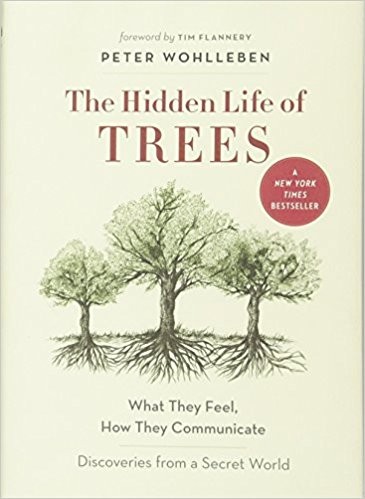
The Hidden Life of Trees by Peter Wohlleben is a 2015 science book about forest ecology, plant communication, nature. Trees in old-growth forests share nutrients through mycorrhizal fungal networks in ways that appear to support weaker and younger trees in the community.
Summary
Peter Wohlleben spent decades as a forester in the Eifel mountains of Germany, and The Hidden Life of Trees is his account of what scientific research and sustained observation have revealed about trees as social organisms. The book's central claim — that trees communicate through chemical signals and fungal networks, support one another across root systems, and behave in ways that look surprisingly like cooperation — was already supported by peer-reviewed research when Wohlleben wrote it, but had not yet reached general audiences.
Wohlleben writes with the authority of someone who has spent decades in forests, and the book is organized as a series of observations about tree behavior: how trees transmit alarm signals when attacked by insects, how parent trees nurse seedlings in their shade, how the wood wide web of mycorrhizal fungi connects trees underground in ways that allow nutrient sharing. He describes how trees in managed monocultures behave differently from trees in old-growth forests, and argues that foresters have largely misunderstood the social dynamics of the ecosystems they manage.
The writing is accessible to the point of being anthropomorphic, which is both the book's appeal and its main scientific controversy. Wohlleben uses language like "friendship," "family," and "communication" deliberately, to break down the assumption that plant behavior is beneath the threshold of interesting. Critics in the scientific community have noted that the language overclaims agency, while others have argued that the underlying science is solid and the framing is a legitimate pedagogical choice.
The book's effect on how people experience forests has been documented: readers report walking through woods differently after reading it. Whether or not trees "feel" or "decide" in any meaningful sense, the research Wohlleben describes is real, the forest dynamics he explains are poorly known among the general public, and the book makes a genuinely compelling case that understanding forests as communities rather than collections of individual organisms changes both how we study them and how we manage them.
Talk to The Hidden Life of Trees like its author wrote you back.
Get the ideas that fit your life — not generic summaries.
- Chat with the book
- Audiobook-style main ideas
- Adapts to your life and goals
- Helps you take action
Key takeaways
- 1.
Trees in old-growth forests share nutrients through mycorrhizal fungal networks in ways that appear to support weaker and younger trees in the community.
- 2.
Trees release chemical volatile compounds when attacked by insects that neighboring trees detect and use to prepare chemical defenses of their own.
- 3.
Mature trees in established forests often nurse their own seedlings, providing sugar through root connections in low-light conditions where photosynthesis is insufficient.
- 4.
Managed plantation forests, because they lack the root network connections of old-growth communities, behave differently and are less resilient to stress.
- 5.
Trees have memory in the form of growth patterns: years of stress leave rings that represent the tree's response history, which affects subsequent growth and resilience.
- 6.
The wood wide web — the mycorrhizal fungal network connecting tree roots — is now a well-established concept in forest ecology, though its extent and significance are still actively researched.
- 7.
Trees in dense forests regulate their canopy growth to avoid direct competition with neighbors, producing an effect called crown shyness that leaves visible gaps at canopy boundaries.
- 8.
Old-growth forests store significantly more carbon per hectare than plantation forests, with implications for climate policy and forest management.
Discussion questions
Use these on your own, with a book club, or as chat starters in Superbook. Book club version, ready to copy or print →
- 1.
Wohlleben uses anthropomorphic language deliberately. Did that choice help you engage with the science, or did it make you skeptical of the underlying claims?
- 2.
The book argues that managed plantation forests are fundamentally different ecosystems from old-growth forests. How does that reframe how you think about timber forestry?
- 3.
Have you ever experienced a forest differently after learning something about how it works? Did reading this book change how you want to experience time outdoors?
- 4.
The wood wide web has entered popular culture significantly since Wohlleben published this book. How do you evaluate popular enthusiasm for a scientific concept that is still actively researched?
- 5.
Wohlleben argues that trees in communities behave in ways that look like care for offspring and neighbors. Does the mechanism matter — do you need to attribute intentionality to find the behavior interesting?
- 6.
The book implies that old-growth forest protection should be a higher conservation priority than it currently is. Do you find that argument persuasive from what Wohlleben presents?
- 7.
Several forest ecologists criticized the book's language as overreaching. How do you weigh the value of accessible, engaging framing against scientific precision?
- 8.
Crown shyness — the gaps that form between neighboring tree canopies — is one of the stranger phenomena in the book. What did you make of it?
- 9.
Wohlleben spent his career managing forests commercially before shifting his views. How did that background shape what he noticed and how he writes about it?
- 10.
The book connects forest health to carbon storage and climate. Does that framing affect how you think about deforestation policy?
- 11.
If trees genuinely function as social communities, does that have ethical implications for how we treat forests? Or does the mechanism have to be more like conscious experience to create ethical obligations?
Themes
Frequently asked questions
-
Is the science in The Hidden Life of Trees accurate?
The underlying research on mycorrhizal networks, chemical signaling, and nutrient sharing between trees is real and peer-reviewed. Wohlleben's anthropomorphic framing goes further than most scientists would, and some researchers object to the language. The phenomena he describes are real; the interpretation he layers on them is more contested.
-
Who should read The Hidden Life of Trees?
Anyone who spends time in forests and wants to understand what they're looking at, anyone interested in ecology or conservation, and anyone curious about how plant biology challenges assumptions about what counts as behavior or communication.
-
How long does it take to read The Hidden Life of Trees?
About four to five hours at average reading pace. The chapters are short and self-contained, making it easy to read in short sessions.
-
Is The Hidden Life of Trees suitable for children?
Yes. The writing is accessible without being patronizing, and the subject matter — trees and forests — is appropriate for all ages. It is a genuinely good introduction to forest ecology.
-
What is the wood wide web?
The informal name for the mycorrhizal fungal networks that connect tree roots underground. The fungi trade water and minerals to trees in exchange for sugars, and the network appears to allow nutrient transfer between connected trees. The extent and significance of this transfer is still an active research area.
Similar books
Entangled Life: How Fungi Make Our Worlds, Change Our Minds and Shape Our Futures
Merlin Sheldrake

The Sixth Extinction: An Unnatural History
Elizabeth Kolbert

A Short History of Nearly Everything
Bill Bryson
