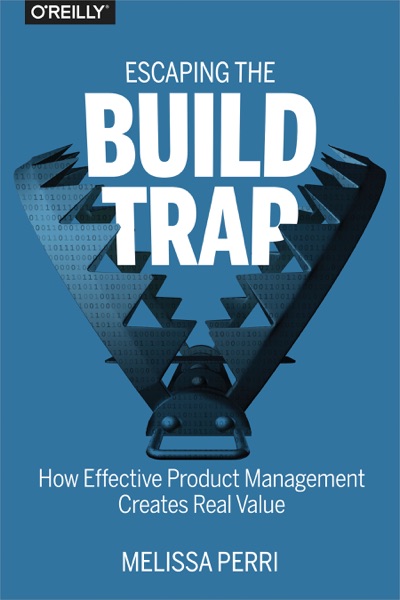
Escaping the Build Trap by Melissa Perri is a 2018 business book about product management, strategy, organizational design. The build trap is the condition where teams measure success by how much they ship rather than by the outcomes shipping produces. Most product organizations are in it without recognizing it.
Summary
Escaping the Build Trap is Melissa Perri's diagnosis of why product organizations ship constantly but rarely deliver real value, and her prescription for how to change that pattern. The build trap, as she defines it, is the condition in which a company measures success by the features and products it ships rather than by the outcomes those features produce for customers and the business. Teams caught in the trap are busy and productive in a narrow sense but are essentially running a feature factory — converting requests into releases without asking whether the releases solve real problems.
Perri's argument draws on her experience as a product management consultant across dozens of companies and her observation that the build trap is not primarily a process failure but a structural one. Companies get trapped because they lack the organizational muscle to make product decisions at the strategic level. Product managers in these companies are essentially project managers with a different title: they take requirements from stakeholders, prioritize them, and track delivery. What they cannot do — because the organization hasn't given them the information, authority, or skills — is determine which problems are worth solving and develop coherent strategies for solving them.
The solution Perri proposes is a shift from output thinking (how many features did we ship?) to outcome thinking (what measurable change did we produce in customer or business behavior?). This requires changes at every level. Executives need to set strategic intent — clear, communicable goals — rather than detailed product roadmaps that leave no room for discovery. Product managers need to develop skills in user research, hypothesis formation, and experiment design. Organizations need processes for connecting strategy to execution without either prescribing the solution from the top or abandoning teams to work without direction.
The book is concise and practical. Perri provides frameworks for structuring product vision and strategy, for running the discovery process alongside delivery, and for identifying which organizational conditions are making the build trap hard to escape. It is not a comprehensive treatment of every product management technique but a focused argument about what most organizations are getting wrong at the strategic level. For teams that recognize themselves in the build trap description, the book provides both diagnosis and a credible starting point for change.
Talk to Escaping the Build Trap like its author wrote you back.
Get the ideas that fit your life — not generic summaries.
- Chat with the book
- Audiobook-style main ideas
- Adapts to your life and goals
- Helps you take action
Key takeaways
- 1.
The build trap is the condition where teams measure success by how much they ship rather than by the outcomes shipping produces. Most product organizations are in it without recognizing it.
- 2.
Product managers in the build trap function as project managers with authority over what to build but no genuine strategic role. Escaping the trap requires giving product managers real strategic ownership.
- 3.
Output thinking measures features shipped, velocity, and release frequency. Outcome thinking measures changes in customer behavior, business metrics, and problem resolution. They require completely different management practices.
- 4.
Product strategy is not a roadmap. A roadmap is a list of features. Strategy is an understanding of the market position the company is trying to achieve and the problems it needs to solve to get there.
- 5.
Discovery and delivery must happen in parallel, not sequentially. Teams that finish delivery before starting discovery cannot learn from what they've built in time to affect the next decision.
- 6.
Executives who manage by dictating features eliminate the strategic layer of the organization. When leadership resolves every product question by specifying the solution, product managers have no meaningful role to play.
- 7.
Customer research is not optional and cannot be substituted by analytics alone. Understanding why customers behave as they do requires direct observation and conversation, not just measurement.
- 8.
Organizational structure shapes product outcomes. How teams are organized — around technology, around business functions, around customer problems — determines what kinds of products they can build.
Discussion questions
Use these on your own, with a book club, or as chat starters in Superbook. Book club version, ready to copy or print →
- 1.
Perri's build trap is defined by measuring features shipped rather than outcomes produced. How would you honestly describe the way your current or most recent team measured success?
- 2.
She argues that product managers in the build trap are really project managers. If you have worked in a product role, does that characterization ring true? What would have needed to change for the role to be genuinely strategic?
- 3.
The shift from output to outcome thinking requires changing not just individual practices but organizational incentives. What incentive structures in your experience have most strongly pushed teams toward output over outcome?
- 4.
Perri's distinction between product strategy and product roadmap is central to the book. Have you seen organizations confuse the two? What went wrong as a result?
- 5.
She argues that executives who specify the solution rather than the goal eliminate the strategic layer of the organization. Have you seen this happen? Is there any context in which it's appropriate?
- 6.
Discovery and delivery in parallel is the ideal she describes. What makes companies default to sequential discovery-then-delivery, and what would it actually take to change that?
- 7.
What is the role of direct customer research versus analytics in the discovery process she describes? When is each more valuable?
- 8.
The book focuses on product organizations, but the build trap pattern — measuring output rather than outcome — appears in many other contexts. Where else have you seen it, and does Perri's analysis apply?
- 9.
Her prescription requires real authority and strategic ownership for product managers. What happens to this proposal when the people setting strategy are unwilling to give up control of the solution?
- 10.
Perri identifies the build trap as partly a cultural problem — teams take pride in shipping. How do you change a culture that has organized its identity around delivery velocity?
- 11.
The book is concise at around 200 pages. What does that brevity make possible or foreclose in the argument?
Themes
Frequently asked questions
-
Is Escaping the Build Trap worth reading?
Yes, especially for product managers, engineering managers, and executives trying to understand why their product organization isn't producing real value. It is concise and direct. If the build trap description matches your organization, the book will be immediately useful.
-
How long does it take to read?
About three hours. At roughly 200 pages with a clear structure, most readers finish it in a single day. The frameworks are dense enough to revisit but the argument is straightforward.
-
What is the main idea?
That most product organizations measure success by what they ship rather than by what changes as a result, and that escaping that trap requires changing how product strategy is set, how product managers are empowered, and how discovery and delivery are connected.
-
Who should read this book?
Product managers frustrated by working in output-obsessed environments, engineering leads who want to understand what the product organization needs from them, and executives who suspect their product teams are busy but not strategic. It is less useful if your organization already practices outcome-driven product management.
-
What is one concrete change the book would recommend for a team stuck in the build trap?
Replace the roadmap of features with a statement of strategic intent — the specific customer problem and business outcome the team is trying to achieve — and let the team determine how to achieve it through discovery and experimentation.
Similar books
Inspired: How to Create Tech Products Customers Love
Marty Cagan
Empowered: Ordinary People, Extraordinary Products
Marty Cagan and Chris Jones
The Lean Startup
Eric Ries
Measure What Matters
John Doerr
