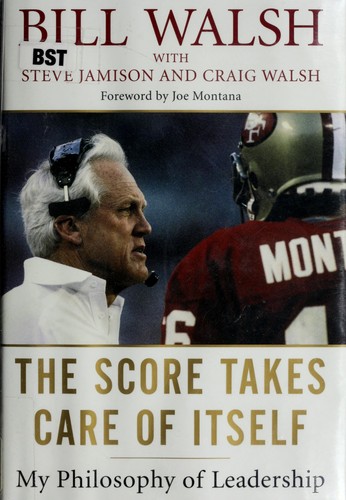
The Score Takes Care of Itself by Bill Walsh is a 2009 business book about leadership, standards, performance culture. The Standard of Performance defines precisely how the work is done — not just the outcome you want but the behavior and habits that produce it. The score follows from the standard.
Summary
The Score Takes Care of Itself is the account of Bill Walsh's leadership philosophy, assembled from his writings and interviews by Steve Jamison and Craig Walsh after Walsh's death in 2007. Walsh transformed the San Francisco 49ers from the worst team in the NFL into a dynasty, winning three Super Bowls in the 1980s. The book is his most sustained attempt to articulate how he did it and what he learned about leadership from the experience.
Walsh's central concept is the Standard of Performance: a precisely defined set of behaviors, habits, and expectations that he believed would lead to excellence if followed consistently. The standard covered everything from how players stood in the huddle to how staff interacted with guests at the stadium. Walsh believed that if you got the performance right — if every person in the organization understood and met the standard — the results would follow. Hence: the score takes care of itself.
The book is organized around the specific elements of Walsh's philosophy: the importance of communicating your intention and values clearly to everyone in the organization, the leadership style he calls "benevolent commander" (high standards with genuine care for people), the management of ego (his own and others'), and his approach to handling adversity, failure, and success. Walsh is unusually honest about his own failures and limitations — his sometimes poor management of his own mental health under pressure, the personnel mistakes he made, the wins that became his losses.
The football context is central rather than incidental. Walsh is at his best when describing specific coaching decisions, specific plays, and specific leadership moments from his career. The particularity of those examples is what makes the principles vivid. The book is especially useful for leaders who want to understand how standards work in practice — not as rules but as a comprehensive expectation of how things are done.
Talk to The Score Takes Care of Itself like its author wrote you back.
Get the ideas that fit your life — not generic summaries.
- Chat with the book
- Audiobook-style main ideas
- Adapts to your life and goals
- Helps you take action
Key takeaways
- 1.
The Standard of Performance defines precisely how the work is done — not just the outcome you want but the behavior and habits that produce it. The score follows from the standard.
- 2.
Leadership is first about defining and communicating your values and intentions to everyone in the organization, at every level, so that behavior is consistent whether you're watching or not.
- 3.
'Benevolent commander' means setting extremely high standards while genuinely caring about the people who are trying to meet them. The two aren't in tension — they reinforce each other.
- 4.
Every detail signals the standard. When the head coach accepts a lower standard in a small thing, he signals that standards are negotiable throughout the organization.
- 5.
Preparation is the primary job. Walsh's confidence came not from believing his team was better but from knowing his team was more prepared than anyone they would face.
- 6.
Ego management is a continuous leadership task — managing your own when success inflates it, and managing others' when it distorts their judgment or behavior.
- 7.
Failure provides information that success doesn't. Walsh's analysis of losses was more useful for his development as a coach than his analysis of wins.
- 8.
The transition from a performer role to a leader role requires redefining your measure of success. Walsh describes the difficulty of this transition honestly.
Discussion questions
Use these on your own, with a book club, or as chat starters in Superbook. Book club version, ready to copy or print →
- 1.
Walsh says the score takes care of itself if you focus on the standard. Do you believe this? Where does results-focus and process-focus come into conflict in your work?
- 2.
What's your Standard of Performance — the behavioral expectations you hold for yourself and your team that go beyond the obvious? How clearly have you articulated it?
- 3.
Walsh paid attention to details that seemed trivial because he believed they signaled the standard. What details in your organization signal standards that people absorb unconsciously?
- 4.
He describes the 'benevolent commander' style — high standards with genuine care. Is this achievable consistently, or does pressure eventually force a choice?
- 5.
Walsh was honest about his own mental health struggles under the pressure of leading at the highest level. What does your organization do to support leaders under extreme pressure?
- 6.
What's the most important standard in your team that is clear to you but unclear to others? How would you know if it was clear to them?
- 7.
Walsh says preparation is the primary job. Where in your work do you feel most under-prepared relative to what the moment requires?
- 8.
He describes managing his own ego as a continuous challenge. When is your ego most likely to distort your judgment as a leader?
- 9.
The book covers Walsh's failures as well as his successes. What's a failure in your leadership that gave you information you couldn't have gotten from success?
- 10.
Walsh's approach is very specific to the context of football coaching. What requires translation to apply in your context, and what transfers directly?
- 11.
What's the difference between holding a high standard and being a perfectionist in ways that damage your team's confidence and willingness to take risks?
Themes
Frequently asked questions
-
Is The Score Takes Care of Itself worth reading for non-sports people?
Yes. The football examples are specific and vivid, but the underlying leadership principles — standards, preparation, ego management, benevolent authority — transfer cleanly. Walsh's honesty about his own limitations makes the book more useful than more hagiographic leadership accounts.
-
How long does it take to read The Score Takes Care of Itself?
Around five hours for the 257-page book. The writing is clear and the football stories carry the argument, making it a fast read.
-
What is the Standard of Performance, concretely?
It's Walsh's precise definition of how things should be done — behaviors, habits, interactions — at every level of the organization. Not just what the offense should achieve but how players should stand in the huddle, how staff should treat visitors, how coaches should communicate. Walsh believed that excellence in the details was how you built excellence in the outcomes.
-
Who should read The Score Takes Care of Itself?
Leaders who want a vivid, concrete account of how high standards work in practice, coaches and teachers, anyone building a performance culture, and people who find management books that use business examples drier than examples from sports.
-
What's the most important idea in the book?
That focusing on the process — getting every behavioral detail right — produces better results than focusing on the outcome. Most leaders focus on results; Walsh focused on how the work was done. The counterintuitive claim that this produces better results is both the book's central argument and its most challenging prescription.