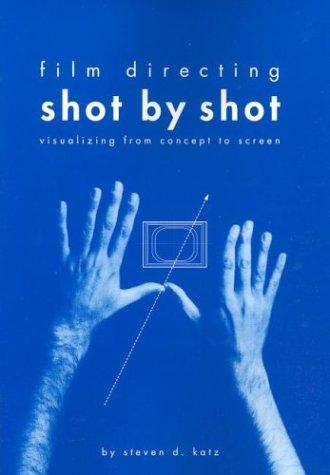
Film Directing Shot by Shot by Steven Katz is a 1991 self-help book about filmmaking, visual storytelling, storyboarding. Directing is fundamentally a visual skill. The placement of the camera, the staging of actors, and the sequencing of shots are how a director tells the story, not just records it.
Summary
Film Directing Shot by Shot is Steven Katz's practical guide to the visual language of cinema — how directors translate script to screen through choices about shot type, camera placement, staging, and the sequencing of images. Published in 1991 and still in print, it has become a standard reference for film students, directors, and cinematographers. The book is organized around the idea that directing is fundamentally a visual skill, and that skill is learnable through the systematic study of how master filmmakers have solved common visual problems.
The book's central concern is staging and coverage: how a scene is physically arranged and how the camera is moved through it. Katz works through the grammar of film — establishing shots, close-ups, over-the-shoulders, inserts, cutaways — not as a technical checklist but as a vocabulary for meaning. A low-angle shot is not just a different view; it changes the power relationship between the subject and the viewer. A long take that refuses to cut shifts emotional responsibility onto the actor. These choices are not decorative; they are the story's substance.
Storyboarding receives extended treatment. Katz argues that boards are a thinking tool, not just a communication tool — drawing forces the director to commit to specific choices before the expensive reality of a film set. He includes extensive examples from films by Kubrick, Hitchcock, Spielberg, and Orson Welles, with frame-by-frame analysis of sequences to show how visual rhythm is constructed over time.
The book also covers point of view, subjectivity, transitions, and the problem of depicting thought on screen. Throughout, Katz is careful to distinguish visual rules from visual principles: there are no rules, but there are recurring solutions to recurring problems, and knowing those solutions frees the director to break them deliberately rather than accidentally. Film Directing Shot by Shot is not a fast read — it rewards slow study with the illustrations open — but it has earned its reputation as one of the most useful books ever written about the craft of directing.
Talk to Film Directing Shot by Shot like its author wrote you back.
Get the ideas that fit your life — not generic summaries.
- Chat with the book
- Audiobook-style main ideas
- Adapts to your life and goals
- Helps you take action
Key takeaways
- 1.
Directing is fundamentally a visual skill. The placement of the camera, the staging of actors, and the sequencing of shots are how a director tells the story, not just records it.
- 2.
Every shot choice carries meaning: angle implies power, distance implies intimacy or alienation, movement implies energy or entrapment. These are not decorative decisions.
- 3.
Storyboarding is a thinking tool, not just a communication tool. Drawing forces commitment to specific visual choices before the expense and constraint of a real set.
- 4.
The grammar of film — establishing shot, close-up, over-the-shoulder, insert — is a vocabulary, not a formula. Understanding it allows directors to use it fluently or break it deliberately.
- 5.
Visual rhythm is constructed over time, through the pacing of cuts and the duration of takes. A scene that feels slow or fast is usually a consequence of editing structure, not acting.
- 6.
Point of view is one of the most powerful — and most commonly misused — tools in the director's kit. Whose eye the camera aligns with determines who the audience identifies with and when.
- 7.
Master filmmakers from Hitchcock to Kubrick solve recurring visual problems in recurring ways. Studying those solutions is the fastest way to develop a directorial vocabulary.
Discussion questions
Use these on your own, with a book club, or as chat starters in Superbook. Book club version, ready to copy or print →
- 1.
Katz argues that directing is primarily a visual skill that can be systematically studied and learned. Do you think great directors are made or born, or is that a false distinction?
- 2.
Pick a scene from a recent film you admired. What specific shot choices do you notice, and what does each one do to your experience as a viewer?
- 3.
Katz uses extensive examples from classic Hollywood filmmakers — Hitchcock, Kubrick, Welles. Does learning visual language from those directors risk making contemporary students imitative rather than original?
- 4.
The book argues that storyboarding forces commitment and clarity. Can you think of contexts outside filmmaking — presentation design, product development, architecture — where the same principle would apply?
- 5.
What is the difference between a rule and a principle in visual composition? When does breaking a visual convention work, and when does it just confuse?
- 6.
Katz spends significant time on depicting subjective experience and thought on screen. What are the most effective techniques you've seen for showing what a character is thinking without dialogue?
- 7.
The book was published in 1991, before digital filmmaking, nonlinear editing, and the smartphone camera. How much of what Katz teaches has changed, and how much remains constant?
- 8.
Coverage — getting enough shots to edit a scene multiple ways — is one of the director's practical concerns. How does the need for coverage interact with the visual intelligence Katz describes?
- 9.
Katz works through films frame by frame to show visual rhythm and construction. How does analytical viewing of this kind change the experience of watching movies for pleasure?
- 10.
Many filmmakers work intuitively without formal study of visual grammar. Is there a risk that too much analytical knowledge inhibits rather than enables creative choices?
- 11.
Which of the directors Katz analyzes most closely — Hitchcock, Kubrick, Spielberg, Welles — do you find most instructive about your own sense of visual storytelling, and why?
Themes
Frequently asked questions
-
Is Film Directing Shot by Shot worth reading for non-filmmakers?
Yes, if you are interested in visual literacy generally. The principles Katz describes — how shot distance creates emotional distance, how angle implies power, how sequencing creates rhythm — apply to photography, game design, and visual communication more broadly. It reads slowly with all the illustrations, but the conceptual framework pays off.
-
What is the main thing Film Directing Shot by Shot teaches?
That the visual choices a director makes — camera placement, shot type, staging, sequencing — are the story itself, not a neutral record of events. Every frame is a decision, and those decisions are learnable and analyzable.
-
How long does it take to read Film Directing Shot by Shot?
Longer than its page count suggests. The book is densely illustrated and designed to be studied rather than read straight through. A first reading takes five to seven hours; many readers return to specific chapters repeatedly when working on projects.
-
Who should read this book?
Aspiring directors and cinematographers first, but also writers who want to think more visually, photographers interested in narrative sequence, and anyone who wants a serious framework for understanding how film works. It is less useful for editors or producers than for those making visual-staging decisions.
-
Does the book cover digital filmmaking?
No — it predates the digital era and focuses on the timeless craft of visual decision-making rather than technical tools. This is mostly a strength: the visual grammar Katz teaches predates and outlasts any particular camera technology.