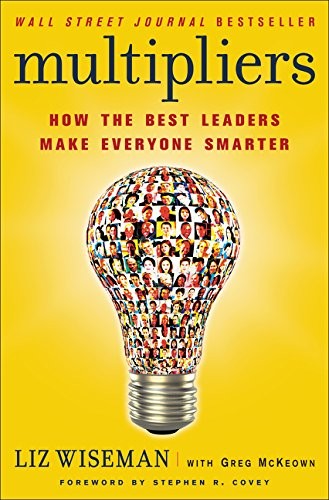
Multipliers by Liz Wiseman is a 2010 business book about leadership, intelligence amplification, management. Multipliers extract twice as much intelligence and capability from their teams as Diminishers do — not by working people harder but by creating conditions that bring out more of what people already have.
Summary
Multipliers is Liz Wiseman's exploration of a striking leadership pattern: some leaders make the people around them smarter, more capable, and more engaged, while other leaders — often equally intelligent and well-intentioned — make the people around them dumber, more dependent, and less confident. Wiseman spent years studying both types and built a framework around what distinguishes them.
Multipliers, the first type, operate on a fundamental assumption: the people around them are intelligent and will figure things out if given the right challenge and context. Diminishers operate on the opposite assumption: the people around them need direction, guidance, and correction at every step. Both assumptions become self-fulfilling. Teams operating under Multipliers develop capability; teams under Diminishers become dependent and eventually stop trying.
The book identifies five specific disciplines of Multipliers — the talent magnet who attracts and grows great people, the liberator who creates the space for people to do their best thinking, the challenger who stretches people beyond what they thought possible, the debate maker who creates decisions through rigorous debate rather than decree, and the investor who gives people ownership and accountability rather than solutions.
One of the book's most useful observations is about "accidental diminishers" — leaders who genuinely believe they're helping but are inadvertently suppressing their teams. The visionary who always shares their idea first trains the team to wait for the answer. The rescuer who jumps in to fix problems trains the team to escalate rather than solve. Wiseman argues that intent doesn't determine impact, and that good leaders regularly audit the effects of their own behavior rather than relying on how things feel from their side.
Talk to Multipliers like its author wrote you back.
Get the ideas that fit your life — not generic summaries.
- Chat with the book
- Audiobook-style main ideas
- Adapts to your life and goals
- Helps you take action
Key takeaways
- 1.
Multipliers extract twice as much intelligence and capability from their teams as Diminishers do — not by working people harder but by creating conditions that bring out more of what people already have.
- 2.
The key distinction is in underlying assumptions: Multipliers assume people are capable and will figure it out; Diminishers assume people need direction and correction at every step.
- 3.
Accidental Diminishers are leaders who genuinely care but whose habits suppress their teams. The visionary who always shares their idea first, the expert who always has the answer — both train teams to be passive.
- 4.
Multipliers ask questions; Diminishers give answers. The question that creates genuine struggle is more valuable than the answer that short-circuits it.
- 5.
Debate-driven decisions outperform decree-driven ones not just in quality but in implementation speed, because the people executing understand why the decision was made.
- 6.
Talent Magnets don't try to retain people forever — they develop them and celebrate when they go on to bigger things. This makes them better at attracting talent than those who try to keep people captive.
- 7.
The Investor discipline means giving people true ownership, which includes the right to fail. Pseudo-ownership — where the leader takes back control at the first sign of trouble — teaches people not to invest.
- 8.
Impact is what matters, not intent. Leaders who want to be Multipliers must study what their behavior actually produces in others, not how they feel about what they're doing.
Discussion questions
Use these on your own, with a book club, or as chat starters in Superbook. Book club version, ready to copy or print →
- 1.
Which of the five Multiplier disciplines — Talent Magnet, Liberator, Challenger, Debate Maker, Investor — do you practice most naturally? Which do you find hardest?
- 2.
Wiseman describes 'accidental Diminishers.' What habit of yours might be suppressing your team's initiative without your realizing it?
- 3.
Think about the most capable person you've worked with. Did your leadership extract more or less than their full capacity? What made the difference?
- 4.
When you have an idea in a meeting, how quickly do you share it? What does your speed signal to the people in the room with you?
- 5.
What's the last significant decision your team made through genuine debate — where the outcome wasn't obvious from the start? What enabled that?
- 6.
Talent Magnets are comfortable developing people who then leave for bigger opportunities. How comfortable are you with that? What would change if you held that view consistently?
- 7.
Think about the best manager you ever had. Which Multiplier disciplines did they use, and which did they do without?
- 8.
What's a question you could ask your team this week that would create productive struggle rather than just delivering the answer you already have?
- 9.
The book argues that Diminishers often believe they're helping. In what area of your leadership might you be more of a Diminisher than you currently see yourself?
- 10.
Wiseman notes that Diminisher behavior is often context-specific — leaders who are Multipliers in one area become Diminishers in another where they're the acknowledged expert. Where are you most likely to fall into that trap?
- 11.
What would it look like to invest in someone on your team so genuinely that they could make a consequential mistake without you taking back control?
- 12.
How do you currently signal to your team that struggle is expected and valuable rather than a sign that they need help?
Themes
Frequently asked questions
-
Is Multipliers worth reading?
Yes, especially if you're in any leadership role and want a framework for understanding why some teams thrive and others stagnate despite having the same raw talent. The concept of accidental Diminishers is particularly valuable — most leaders see themselves as Multipliers, and the book is useful precisely because it makes self-deception harder.
-
How long does it take to read Multipliers?
Around five hours for the 288-page book. It's organized clearly with the five disciplines as the backbone, so it's also useful as a reference after the initial read.
-
What is an accidental Diminisher?
A leader who genuinely wants to help but whose behaviors inadvertently suppress the intelligence and initiative of their team. Common examples include the leader who always has the answer (so people stop thinking), the rescuer who jumps in at the first sign of difficulty (so people stop solving), and the pacesetter who sets the standard so high that nobody else tries.
-
Who should read Multipliers?
Anyone who manages people, coaches teams, or teaches. Also valuable for individual contributors who want to understand why some managers make them better and others make them worse.
-
What's the most actionable idea in Multipliers?
The audit: after a meeting or a conversation, ask yourself what behavior you produced in the other person. Did they leave more energized, more confident, and more likely to act? Or did they leave waiting to hear what you wanted them to do? Doing this consistently reveals your actual impact rather than your intended one.