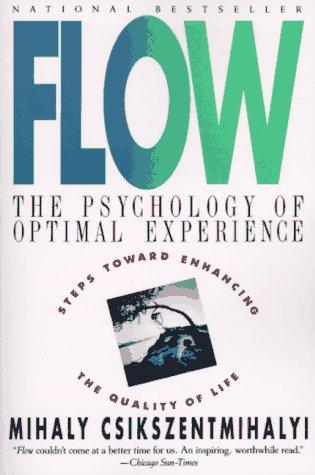
Flow: The Psychology of Optimal Experience by Mihaly Csikszentmihalyi is a 1990 psychology book about flow state, happiness, focus. Flow is the state of complete absorption in a challenging activity that matches your skill level. It produces the strongest sense of happiness and meaning most people ever report.
Summary
Flow is Csikszentmihalyi's landmark study of optimal experience — those moments when people are so deeply absorbed in an activity that time warps, self-consciousness disappears, and effort feels effortless. Drawing on decades of research using the Experience Sampling Method, in which subjects reported their mental states at random intervals throughout the day, he identifies the conditions under which flow occurs and argues that structuring life around these conditions is a primary path to genuine happiness.
The core insight is that happiness is not a passive state to be received but an active one to be cultivated. People consistently report feeling best not during leisure but during challenging activities that stretch their skills just beyond their current level. The key variable is the balance between perceived challenge and perceived skill: if the challenge is too low relative to skill, boredom sets in; if too high, anxiety takes over. Flow lives at the edge where both are high and matched.
Csikszentmihalyi examines flow across domains — rock climbing, surgery, chess, assembly-line work, conversation — and finds the same structural conditions each time: clear goals, immediate feedback, a concentration that excludes irrelevant information, and a feeling of personal control. He also examines the opposite: psychic entropy, the disordered state that arises when attention is pulled in multiple directions without clear purpose.
The second half of the book extends the framework to larger questions of life meaning. Csikszentmihalyi argues that a coherent self — one built around chosen goals that generate flow — is the deepest form of psychological wellbeing available to human beings. This is a denser, more philosophical book than its reputation suggests. It rewards slow reading and is more convincing as a diagnosis of what makes experience feel rich than as a manual for generating flow on demand.
Talk to Flow: The Psychology of Optimal Experience like its author wrote you back.
Get the ideas that fit your life — not generic summaries.
- Chat with the book
- Audiobook-style main ideas
- Adapts to your life and goals
- Helps you take action
Key takeaways
- 1.
Flow is the state of complete absorption in a challenging activity that matches your skill level. It produces the strongest sense of happiness and meaning most people ever report.
- 2.
The challenge-skill balance is the central mechanism. Too easy produces boredom; too hard produces anxiety; matched well, flow emerges.
- 3.
Flow requires clear goals and immediate feedback. Ambiguity about what you're trying to do or whether you're succeeding disrupts the absorption.
- 4.
Psychic entropy — the disordered, unfocused state — is the default when attention has no structure. Structuring attention around chosen challenges is how you escape it.
- 5.
Leisure as usually practiced (passive TV watching, unfocused socializing) produces less flow and less reported happiness than challenging work.
- 6.
Autotelic experience — doing something for its own sake rather than for external rewards — is the hallmark of flow activities and the foundation of intrinsic motivation.
- 7.
Flow can be found in almost any activity: the conditions matter more than the domain. Factory workers, chess players, surgeons, and rock climbers report the same phenomenology.
- 8.
A unified life purpose — choosing an overarching goal that organizes other goals into a coherent hierarchy — is the highest form of flow, sustained over a lifetime.
Discussion questions
Use these on your own, with a book club, or as chat starters in Superbook. Book club version, ready to copy or print →
- 1.
When did you last experience flow — complete absorption where time seemed to stop? What were the conditions that made it possible?
- 2.
Csikszentmihalyi's data shows people feel better during work than during leisure, yet prefer leisure. Does that match your own experience? What explains the gap?
- 3.
Think of an activity that used to produce flow and no longer does. What changed — did the challenge drop, the skill increase, or something else?
- 4.
Where in your daily life is the challenge-skill balance most misaligned right now — too easy, or too hard?
- 5.
The book argues you can find flow in almost any activity by raising the personal complexity of your attention. What's an activity you dismiss as boring that you could reengineer?
- 6.
Csikszentmihalyi distinguishes pleasure (sensory satisfaction) from enjoyment (flow-based growth). Which do you pursue more? Which do you think you need more of?
- 7.
What's the most recent piece of feedback you got on important work? How long after the work did it arrive? Would faster feedback change your engagement?
- 8.
He argues that passive entertainment produces less happiness than active challenge. How much of your free time is genuinely active versus genuinely passive?
- 9.
What would it mean to build your daily schedule around the conditions for flow rather than around obligations and convenience?
- 10.
Csikszentmihalyi says a unified life purpose creates the most sustained flow. What purpose, if you committed to it seriously, would unify most of your current goals?
- 11.
Think of someone in your life who seems consistently engaged and energized by their work. What do you notice about how they structure their days?
- 12.
The book was published in 1990. Which of its insights feel more urgent now, given smartphones and infinite content, than they did then?
Themes
Frequently asked questions
-
Is Flow worth reading in 2026?
Yes. The research holds up and the framework is genuinely useful for thinking about work quality and life satisfaction. The writing is academic in places, and the second half — on life meaning — is denser than the first. Readers who want only the practical framework can focus on the first six chapters.
-
How long does it take to read Flow?
About six hours for the full book at average pace. It is denser than most self-help books and rewards slow reading. The first few chapters are the most accessible; the middle chapters covering specific domains (body, thought, work) can be skimmed if a particular domain doesn't apply to you.
-
What is the main idea of Flow?
Optimal experience — the feeling of deep absorption, stretched skill, and unselfconscious engagement — is the basis of genuine happiness. Designing activities and life around the conditions that produce flow is more reliable than pursuing pleasure or external achievement.
-
Who should read Flow?
Anyone curious about why some work feels deeply satisfying and most doesn't, or who wants a research-grounded framework for understanding motivation and engagement. It is more intellectually demanding than most productivity books and rewards readers willing to sit with ideas rather than collect tactics.
-
Is Flow a psychology book or a self-help book?
Both. It's grounded in decades of empirical research — unusual for the self-help genre — but Csikszentmihalyi is explicitly trying to give readers a framework for improving their own experience. It reads more like an academic text with practical implications than a how-to manual.
Similar books
Deep Work
Cal Newport
Drive: The Surprising Truth About What Motivates Us
Daniel H. Pink
Peak: Secrets from the New Science of Expertise
Anders Ericsson and Robert Pool
The War of Art
Steven Pressfield
