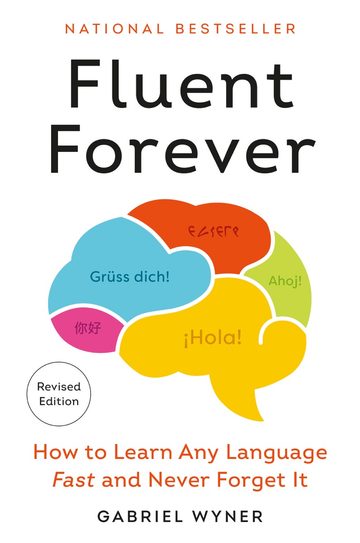
Talk to Fluent Forever: How to Learn Any Language Fast and Never Forget It like its author wrote you back.
Get the ideas that fit your life — not generic summaries.
- Chat with the book
- Audiobook-style main ideas
- Adapts to your life and goals
- Helps you take action
Fluent Forever: How to Learn Any Language Fast and Never Forget It, in detail
Fluent Forever is Gabriel Wyner's system for teaching yourself a foreign language and, crucially, retaining it. Wyner is an opera singer who needed accurate pronunciation in German, Italian, French and Russian, and an engineer by training; the method grew out of both. Its premise is that most adult language learning fails not because adults can't learn but because they forget faster than they acquire, and because they route everything through English translation. Wyner's fix is to build direct, memorable connections between sounds, images and meaning, and to schedule review so that what you learn actually sticks.
The method rests on a specific sequence. You start with pronunciation, training your ears with minimal-pair listening tests to distinguish sounds your native language ignores, then learning the International Phonetic Alphabet and the physical mechanics of producing each sound. Only then do you build vocabulary — beginning with a list of roughly 625 common, concrete words, each learned from a picture rather than a translation. Grammar comes later, absorbed from example sentences instead of rule tables. Throughout, you avoid your native language wherever possible, connecting new words to images and to your own memories, which the book grounds in the 'levels of processing' research: the more personal, visual and emotional the encoding, the better the recall.
The engine that makes it durable is spaced repetition. Wyner is an evangelist for Anki, a free flashcard program that schedules each card to reappear just before you'd forget it, stretching the intervals as memories strengthen. He insists you build your own cards rather than download someone else's, because the act of choosing an image and a personal association is itself what fixes the word in memory. The result is a study system engineered around the spacing effect, the testing effect and vivid mental imagery rather than rote repetition or grammar drills.
Fluent Forever is best for self-directed, patient learners who enjoy building a system and are willing to front-load real setup effort — learning the IPA, installing Anki, making hundreds of cards. Its weakness is the flip side of that strength: the workflow is fiddly, card-making is slow, and the book devotes far more attention to building a private memory of the language than to the messy work of speaking it with people. Readers who want to be talking from day one will find Benny Lewis's approach a better fit; those who want the words to stay put for years will find this the most rigorous popular guide to how memory actually works.
The big ideas
- 1.
Learn pronunciation first. Train your ears with minimal-pair tests to hear the sounds your native language ignores before you build any vocabulary.
- 2.
Stop translating. Connect foreign words directly to images, sounds and personal memories so you retrieve meaning without a detour through English.
- 3.
Spaced repetition is the core engine. Anki reschedules each card to reappear just before you'd forget it, converting short-term study into long-term memory.
