Fluent Forever: How to Learn Any Language Fast and Never Forget It by Gabriel Wyner is a 2014 language book about language learning, pronunciation, spaced repetition. Learn pronunciation first. Train your ears with minimal-pair tests to hear the sounds your native language ignores before you build any vocabulary.
Summary
Fluent Forever is Gabriel Wyner's system for teaching yourself a foreign language and, crucially, retaining it. Wyner is an opera singer who needed accurate pronunciation in German, Italian, French and Russian, and an engineer by training; the method grew out of both. Its premise is that most adult language learning fails not because adults can't learn but because they forget faster than they acquire, and because they route everything through English translation. Wyner's fix is to build direct, memorable connections between sounds, images and meaning, and to schedule review so that what you learn actually sticks.
The method rests on a specific sequence. You start with pronunciation, training your ears with minimal-pair listening tests to distinguish sounds your native language ignores, then learning the International Phonetic Alphabet and the physical mechanics of producing each sound. Only then do you build vocabulary — beginning with a list of roughly 625 common, concrete words, each learned from a picture rather than a translation. Grammar comes later, absorbed from example sentences instead of rule tables. Throughout, you avoid your native language wherever possible, connecting new words to images and to your own memories, which the book grounds in the 'levels of processing' research: the more personal, visual and emotional the encoding, the better the recall.
The engine that makes it durable is spaced repetition. Wyner is an evangelist for Anki, a free flashcard program that schedules each card to reappear just before you'd forget it, stretching the intervals as memories strengthen. He insists you build your own cards rather than download someone else's, because the act of choosing an image and a personal association is itself what fixes the word in memory. The result is a study system engineered around the spacing effect, the testing effect and vivid mental imagery rather than rote repetition or grammar drills.
Fluent Forever is best for self-directed, patient learners who enjoy building a system and are willing to front-load real setup effort — learning the IPA, installing Anki, making hundreds of cards. Its weakness is the flip side of that strength: the workflow is fiddly, card-making is slow, and the book devotes far more attention to building a private memory of the language than to the messy work of speaking it with people. Readers who want to be talking from day one will find Benny Lewis's approach a better fit; those who want the words to stay put for years will find this the most rigorous popular guide to how memory actually works.
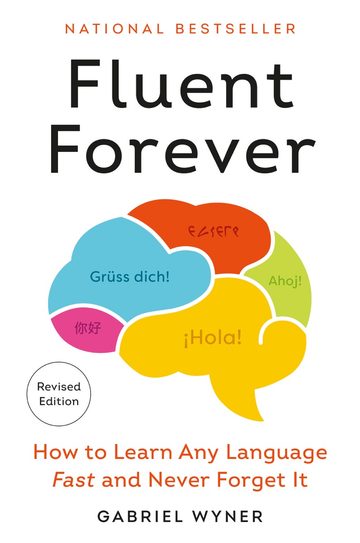
Talk to Fluent Forever: How to Learn Any Language Fast and Never Forget It like its author wrote you back.
Get the ideas that fit your life — not generic summaries.
- Chat with the book
- Audiobook-style main ideas
- Adapts to your life and goals
- Helps you take action
Key takeaways
- 1.
Learn pronunciation first. Train your ears with minimal-pair tests to hear the sounds your native language ignores before you build any vocabulary.
- 2.
Stop translating. Connect foreign words directly to images, sounds and personal memories so you retrieve meaning without a detour through English.
- 3.
Spaced repetition is the core engine. Anki reschedules each card to reappear just before you'd forget it, converting short-term study into long-term memory.
- 4.
Build your own flashcards. The effort of choosing an image and a personal association is what fixes a word in memory; downloaded decks skip the step that matters.
- 5.
Start vocabulary with the 625-word list — common, concrete, picture-able words — rather than abstract or thematic lists you can't easily visualize.
- 6.
Learn grammar from example sentences, not rule tables. Patterns absorbed from real sentences transfer to speech better than memorized paradigms.
- 7.
Deeper, more personal encoding beats repetition. Visual, emotional and self-referential connections dramatically improve recall — the levels-of-processing effect.
- 8.
Forgetting, not difficulty, is the real enemy of adult language learning. Design your study around the spacing and testing effects and you beat it.
Discussion questions
Use these on your own, with a book club, or as chat starters in Superbook. Book club version, ready to copy or print →
- 1.
Wyner argues most language learning fails because we forget faster than we learn. Does that match your own past attempts at a language?
- 2.
The method insists on learning pronunciation before vocabulary. Why might training your ears first change everything that follows?
- 3.
Have you ever used a spaced-repetition system like Anki? What made it stick, or fail to stick, as a daily habit?
- 4.
Wyner says you should never download someone else's flashcard deck. Do you buy the argument that making your own cards is what makes them work?
- 5.
The book asks you to stop translating and connect words directly to images. Which words in a language you already know feel 'wordless' to you in that way?
- 6.
Think about the sounds in your target language that don't exist in your native one. How much attention have you ever actually paid to hearing them?
- 7.
Wyner front-loads a lot of setup — the IPA, Anki, hundreds of cards. Are you the kind of learner who invests in a system, or one who wants to start using it immediately?
- 8.
The method is largely solitary and app-based. What does it gain from that, and what does it lose by not centering live conversation?
- 9.
Which of your own memories are the most vivid, and what do they have in common? How could you use that to make new words stickier?
- 10.
The 625-word list starts with concrete, picture-able words. If you built a starter list for your job or a hobby, what 25 words would come first?
- 11.
Wyner is an opera singer who needed precise pronunciation. How does the specific goal you bring to a language change the method you should use?
- 12.
What would 'never forgetting' a language actually demand of you over the next year — and is that a trade you're willing to make?
Themes
Frequently asked questions
-
Is Fluent Forever worth reading?
Yes, if you're a self-directed learner who cares about retaining a language for years rather than cramming for a trip. The memory science is genuinely useful and the pronunciation chapters are the best in any popular language book. Be ready for setup effort: the method only pays off if you actually build the flashcard habit.
-
What makes the Fluent Forever method different?
Three things: you learn pronunciation before vocabulary, you never translate — connecting words directly to images and personal memories — and you review with a spaced-repetition app so you forget far less. Most language books ignore all three, especially the ear training that comes first.
-
Do I need Anki to use the Fluent Forever method?
Spaced repetition is the engine of the whole system, and Anki is the free program Wyner recommends. You could use another tool, but you shouldn't skip the concept: reviewing cards at expanding intervals, just before you'd forget them, is what makes the method 'forever' rather than temporary.
-
Is Fluent Forever better than Fluent in 3 Months?
They optimize for different things. Benny Lewis's book gets you speaking, imperfectly, from day one; Wyner's builds accurate pronunciation and durable memory through disciplined self-study. Speak-now learners prefer Lewis; system-builders who want the words to stay prefer Wyner. Many people combine the two.
-
How long does it take to read Fluent Forever?
About five to six hours for the roughly 330-page book, though it's really a manual you return to while setting up your study system. The early chapters on pronunciation and building flashcards reward slow reading; the appendices and word galleries are reference material.
Similar books
Fluent in 3 Months
Benny Lewis
Ultralearning
Scott Young
Make It Stick
Peter C. Brown, Henry L. Roediger and Mark A. McDaniel
Peak: Secrets from the New Science of Expertise
Anders Ericsson and Robert Pool
