Psychology · Book club
Fooled by Randomness book club questions
Here are 12 book club questions for Fooled by Randomness by Nassim Nicholas Taleb, ordered to open easily and end somewhere worth arguing about. Copy them, print them, or bring them up one at a time.
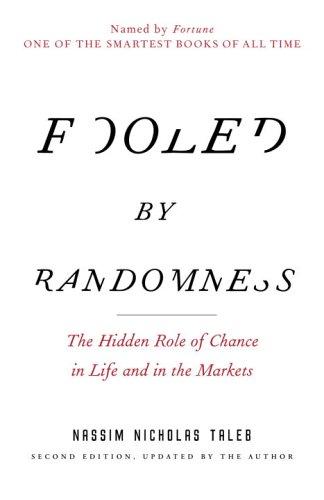
Fooled by Randomness is Nassim Nicholas Taleb's argument that humans are wired to misread luck as skill, noise as signal, and random outcomes as the product of ability or effort.
Nassim Nicholas Taleb · 2001 · 4h 45m
Full summary and key takeaways →The 12 questions
- 1.
Taleb argues that in many competitive fields, the visible winners are largely indistinguishable from lucky survivors. Which field in your own experience fits that description most closely?
- 2.
Think of a personal or professional success you're proud of. How much of it, honestly, was luck — being in the right place, knowing the right person, or avoiding a bad outcome that could easily have gone the other way?
- 3.
Survivorship bias shapes what we read, who we admire, and which strategies we copy. Where do you most often encounter it, and how has it influenced decisions you've made?
- 4.
Taleb is harsh about financial journalists and market commentators who construct narratives after the fact. What other domains generate confident post-hoc explanations that probably don't hold up?
- 5.
He describes the emotional difficulty of watching his portfolio drop even when he intellectually knows the drop is noise. Have you experienced a similar gap between what you know and what you feel in a high-stakes situation?
- 6.
The book argues that a long track record in a random environment is weak evidence of skill. How would you change the way you evaluate expertise in a domain you rely on — a doctor, a financial advisor, a manager?
- 7.
Taleb draws on Stoic philosophy as a way of coping with uncertainty without being paralyzed by it. Is that approach useful to you, or does it feel like resignation rather than strategy?
- 8.
What's the most important decision you've made in the last five years where randomness played a larger role than you initially admitted to yourself?
- 9.
He argues we should structure our lives to limit the impact of catastrophic random events rather than trying to predict them. What would that look like concretely in your financial, professional, or health decisions?
- 10.
Taleb's tone is deliberately contrarian and sometimes dismissive of people he considers naive about probability. Does that voice make the argument more or less persuasive to you personally?
- 11.
He distinguishes between noise (short-term random fluctuation) and signal (meaningful information). In your own work or life, which of the things you pay close attention to is probably just noise?
- 12.
The book was written in 2001, before the 2008 financial crisis that made Taleb famous. Does knowing what happened afterward change how you read his earlier arguments about fat tails and hidden risk?
How to run the discussion
- Pick six to eight, not all of them. An hour of real discussion covers fewer questions than anyone expects, and racing the list is what makes a book club feel like homework.
- Open with what people noticed, not what they concluded. Asking for a verdict first hardens opinions before anyone has heard each other.
- Let the disagreement run. The questions below that split a room are the ones worth the time; the ones everyone answers the same way can be skipped.
- Ask the quiet person a specific question. A direct, narrow question is far easier to answer than an open invitation to contribute.
Themes worth steering toward
If the conversation stalls, these are the threads that usually restart it.
Common questions
What are good book club questions for Fooled by Randomness?
Here are 12 book club questions for Fooled by Randomness by Nassim Nicholas Taleb, ordered to open easily and end somewhere worth arguing about. The strongest openers ask what each reader noticed rather than what they concluded, and the discussion usually turns on randomness, probability, cognitive bias.
How long should a book club discussion of Fooled by Randomness last?
Most groups run 60 to 90 minutes of actual discussion. That is roughly six to eight questions, not all of them, so pick the ones that suit your group rather than working down the list in order.
What are the main themes in Fooled by Randomness?
Randomness, Probability, Cognitive bias, Risk, Survivorship bias, Decision-making. Those are the threads most likely to divide a room, which makes them the useful places to steer a discussion that has gone quiet.
Picking the next one? See books like Fooled by Randomness or questions for other book club picks.
