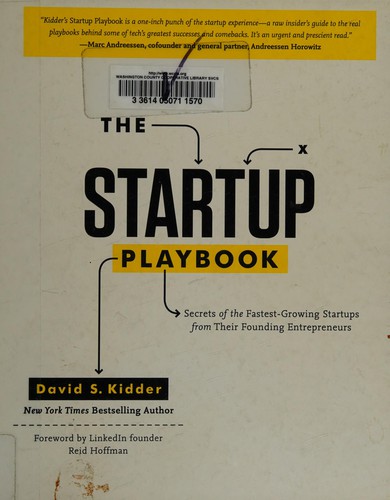
The Startup Playbook by David S. Kidder is a 2012 business book about entrepreneurship, startups, founder stories. Every successful founder in the book describes a period of near-failure. Resilience through adversity isn't a character trait to admire from a distance; it appears to be a structural feature of building anything meaningful.
Summary
The Startup Playbook is David Kidder's collection of firsthand lessons from forty prominent founders, including Reid Hoffman, Sara Blakely, Kevin Plank, and Alexis Ohanian. Kidder, himself a serial entrepreneur, conducted the interviews and organized the material around common inflection points in the startup journey: founding the company, finding the idea, building the team, funding, scaling, and handling failure. The format is part interview collection, part framework, with each founder's story followed by distilled principles.
What distinguishes the book from most startup advice collections is the consistency of the questions Kidder asks. Every founder is pressed on the same core issues: why they started, what almost killed the company, what they wish they'd known earlier, and how they handled money and talent. The repetition reveals patterns across very different businesses and founders. Almost universally, the founders describe early moments of near-failure that required a pivot in strategy, team, or focus — and almost universally, they credit a small group of early believers (first employees, first investors, first customers) with making the difference.
The book leans toward inspiration more than instruction. It's more useful for thinking about entrepreneurship than for solving specific operational problems. The frameworks Kidder inserts between interviews are serviceable but rarely add more than the stories themselves already convey. The strongest material comes directly from the founders: the texture of what it felt like to make payroll by a margin of days, or to watch a competitor outmaneuver them and decide whether to fight or fold.
As a compilation of founder perspectives, The Startup Playbook has the strength and weakness of its format: it is wide but not deep. Readers who want a single sustained argument about how to build a company will find it thin. Readers who want exposure to how a diverse group of successful founders actually experienced the early years — what surprised them, what they repeated, what they would do differently — will find it genuinely useful.
Talk to The Startup Playbook like its author wrote you back.
Get the ideas that fit your life — not generic summaries.
- Chat with the book
- Audiobook-style main ideas
- Adapts to your life and goals
- Helps you take action
Key takeaways
- 1.
Every successful founder in the book describes a period of near-failure. Resilience through adversity isn't a character trait to admire from a distance; it appears to be a structural feature of building anything meaningful.
- 2.
The first ten employees set the company's culture more than any mission statement. Founders who hired quickly and corrected slowly describe paying a cultural tax for years.
- 3.
The founding idea rarely survives contact with the market intact. What matters is whether the team can recognize the gap between their assumption and reality fast enough to adapt.
- 4.
Investors don't fund ideas; they fund founders and teams. The substance of a pitch matters less than the impression it creates about whether these are the people who will figure it out.
- 5.
Early customers deserve more investment than most founders give them. Listening to early users — not just what they say but what they do — is the fastest feedback loop available.
- 6.
Most founders describe underestimating how hard hiring is. Talent is a constraint earlier than most new founders expect, and it remains the binding constraint longer than they anticipate.
- 7.
The difference between a successful pivot and a distraction is often only visible in retrospect. The founders who navigated it well had strong opinions about what they were protecting, not just what they were changing.
- 8.
Failure is described almost uniformly as education. The founders in this book who had prior failed companies describe them as prerequisites, not detours.
Discussion questions
Use these on your own, with a book club, or as chat starters in Superbook. Book club version, ready to copy or print →
- 1.
The book covers forty founders with very different businesses. What patterns across their stories surprised you most?
- 2.
Almost every founder describes a near-death moment. What do you think separates the founders who survive those moments from the ones who don't?
- 3.
The founders are nearly unanimous that early employees shape culture more than founders can by intention. What does that suggest about how to hire your first ten people?
- 4.
Kidder presses each founder on what they wish they'd known earlier. Across the book, is there a consensus answer to that question?
- 5.
The book was published in 2012. How does the startup environment described by these founders compare to what you'd expect from a founder today?
- 6.
Several founders describe a crucial early customer or user who changed everything. Have you had a similar experience — someone who gave you feedback that reframed the whole problem?
- 7.
The pivot is a recurring theme. What distinguishes a necessary pivot from a loss of nerve or a distraction?
- 8.
Most founders describe underestimating the hiring challenge. If you've built or managed a team, what part of hiring was harder than you expected?
- 9.
Kidder is himself a serial entrepreneur. Does his framing of the interviews shape what you take from the stories? What might a different editor have drawn out instead?
- 10.
Failure is described as education throughout the book. Is there a risk in making that framing too comfortable — in treating failure as almost necessary rather than something to minimize?
- 11.
Which of the forty founders' stories stayed with you most, and why?
- 12.
If you were starting a company tomorrow, which one piece of advice from this book would you actually follow, and which would you consciously reject?
Themes
Frequently asked questions
-
Is The Startup Playbook worth reading?
Yes, if you want exposure to how successful founders actually experienced the early years of building a company, in their own words. It's primarily inspirational rather than instructional — more useful for shifting mindset than for solving specific operational problems.
-
How is The Startup Playbook organized?
As a series of founder interviews, each followed by distilled principles. The interviews are organized around common startup milestones: idea, founding, team, funding, scaling, and failure. Kidder asks each founder the same core questions, which makes the patterns across different businesses visible.
-
Who are the founders featured in The Startup Playbook?
The book features forty founders including Reid Hoffman (LinkedIn), Sara Blakely (Spanx), Kevin Plank (Under Armour), Alexis Ohanian (Reddit), and Jeff Hoffman (Priceline), among others. The range spans consumer products, internet businesses, and media.
-
Who should read The Startup Playbook?
First-time founders who want to understand what building a company actually feels like before they do it, and experienced founders who want to compare their experience to a diverse set of peers. Less useful for operators at larger companies focused on execution rather than founding questions.
-
What's the most useful section of The Startup Playbook?
The near-failure stories. Every founder describes a moment when the company almost didn't make it. Those accounts are more honest and instructive than any advice on what to do when things go well.
Similar books
Zero to One: Notes on Startups, or How to Build the Future
Peter Thiel
Shoe Dog: A Memoir by the Creator of Nike
Phil Knight
The Lean Startup
Eric Ries
Founders at Work: Stories of Startups' Early Days
Jessica Livingston
