Economics · Book club
Freakonomics book club questions
Here are 12 book club questions for Freakonomics by Steven D. Levitt and Stephen J. Dubner, ordered to open easily and end somewhere worth arguing about. Copy them, print them, or bring them up one at a time.
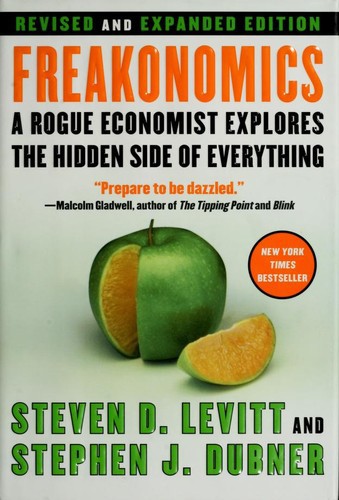
Freakonomics is economist Steven Levitt and journalist Stephen Dubner's argument that economics — properly understood as the study of incentives — can explain things that look, on the surface, like they have nothing to do with money.
Steven D. Levitt and Stephen J. Dubner · 2005 · 5h 45m
Full summary and key takeaways →The 12 questions
- 1.
Levitt argues incentives explain most behavior. Think of a situation in your own life where someone's behavior confused you until you traced their actual incentives. What did you find?
- 2.
The abortion-crime argument is the book's most contested claim. Setting aside the politics, what would it take for you to accept or reject an empirical argument this provocative?
- 3.
Real estate agents, according to the data here, don't fully act in their clients' interests. Which other experts in your life might have incentives misaligned with yours?
- 4.
The book argues conventional wisdom persists because powerful groups benefit from it. Pick a belief in your field or industry that everyone seems to accept. Who benefits if it goes unchallenged?
- 5.
Levitt describes cheating as rational behavior under certain incentive structures. Does that framing make cheating more or less troubling to you, and why?
- 6.
The drug dealers' economics chapter argues that most people in violent street gangs are economically irrational by any outside measure. What does that suggest about how people make career decisions?
- 7.
Levitt and Dubner distinguish between data that tell you correlation and data that let you infer causation. Where in your daily reading of news or research do you think that distinction gets lost most often?
- 8.
The chapter on parenting argues that most interventions parents obsess over matter less than who the parents are to begin with. How does that land for you, and what would it change about how you think about parenting decisions?
- 9.
Information asymmetry gives experts power over clients. In what areas of your own life are you the less-informed party, and how do you manage that?
- 10.
The book claims morality and incentives are often in conflict, and that incentives usually win. Is there a case from your own experience that supports or contradicts this?
- 11.
Some of the findings in the book have been contested by other researchers since 2005. Does knowing that change how you read popular social science, and how should readers calibrate trust in books like this?
- 12.
Levitt's method is to find datasets nobody thought to analyze. What overlooked dataset in your industry, community, or life might reveal something surprising if someone ran the numbers?
How to run the discussion
- Pick six to eight, not all of them. An hour of real discussion covers fewer questions than anyone expects, and racing the list is what makes a book club feel like homework.
- Open with what people noticed, not what they concluded. Asking for a verdict first hardens opinions before anyone has heard each other.
- Let the disagreement run. The questions below that split a room are the ones worth the time; the ones everyone answers the same way can be skipped.
- Ask the quiet person a specific question. A direct, narrow question is far easier to answer than an open invitation to contribute.
Themes worth steering toward
If the conversation stalls, these are the threads that usually restart it.
Common questions
What are good book club questions for Freakonomics?
Here are 12 book club questions for Freakonomics by Steven D. Levitt and Stephen J. Dubner, ordered to open easily and end somewhere worth arguing about. The strongest openers ask what each reader noticed rather than what they concluded, and the discussion usually turns on incentives, hidden information, data analysis.
How long should a book club discussion of Freakonomics last?
Most groups run 60 to 90 minutes of actual discussion. That is roughly six to eight questions, not all of them, so pick the ones that suit your group rather than working down the list in order.
What are the main themes in Freakonomics?
Incentives, Hidden information, Data analysis, Unintended consequences, Conventional wisdom. Those are the threads most likely to divide a room, which makes them the useful places to steer a discussion that has gone quiet.
Picking the next one? See books like Freakonomics or questions for other book club picks.
