Economics · Book club
Free to Choose: A Personal Statement book club questions
Here are 12 book club questions for Free to Choose: A Personal Statement by Milton Friedman and Rose Friedman, ordered to open easily and end somewhere worth arguing about. Copy them, print them, or bring them up one at a time.
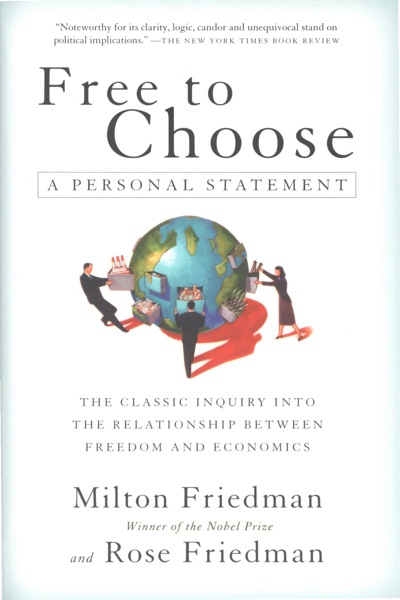
Free to Choose began as a ten-part television series on PBS in 1980, later expanded into the book Milton and Rose Friedman wrote together.
Milton Friedman and Rose Friedman · 1980 · 6h 0m
Full summary and key takeaways →The 12 questions
- 1.
The Friedmans argue economic and political freedom are inseparable. Can you think of cases where they seem to pull in opposite directions?
- 2.
Their analysis of the Great Depression assigns primary blame to the Federal Reserve. How does this account hold up against other explanations you've encountered?
- 3.
The book argues against most regulation on grounds of regulatory capture. Is capture inevitable, or are there regulatory structures that have resisted it?
- 4.
Free trade is presented as clearly beneficial. How do you weigh the aggregate gains against the concentrated losses in specific communities and industries?
- 5.
The negative income tax proposal has been adopted in modified forms in various countries. What are the arguments for it compared to categorical welfare programs?
- 6.
The Friedmans wrote in 1980. Which of their predictions about government expansion and its effects have proved accurate? Which have not?
- 7.
School vouchers are one of their most contested proposals. What evidence has accumulated about voucher programs since 1980?
- 8.
How much of the book's argument depends on the assumption that markets correct themselves over time? Where does that assumption seem most and least defensible?
- 9.
The Friedmans distinguish between equality of opportunity and equality of outcome. Where do you think that line should be drawn in a just society?
- 10.
Many countries with large public sectors also have high economic freedom rankings. Does this complicate the Friedmans' core thesis?
- 11.
The book is a deliberate polemic as well as an economic argument. How does that affect how you read the empirical claims?
- 12.
What would Milton Friedman make of the growth in concentrated market power in technology, banking, and media since 1980?
How to run the discussion
- Pick six to eight, not all of them. An hour of real discussion covers fewer questions than anyone expects, and racing the list is what makes a book club feel like homework.
- Open with what people noticed, not what they concluded. Asking for a verdict first hardens opinions before anyone has heard each other.
- Let the disagreement run. The questions below that split a room are the ones worth the time; the ones everyone answers the same way can be skipped.
- Ask the quiet person a specific question. A direct, narrow question is far easier to answer than an open invitation to contribute.
Themes worth steering toward
If the conversation stalls, these are the threads that usually restart it.
Common questions
What are good book club questions for Free to Choose: A Personal Statement?
Here are 12 book club questions for Free to Choose: A Personal Statement by Milton Friedman and Rose Friedman, ordered to open easily and end somewhere worth arguing about. The strongest openers ask what each reader noticed rather than what they concluded, and the discussion usually turns on free markets, individual liberty, government intervention.
How long should a book club discussion of Free to Choose: A Personal Statement last?
Most groups run 60 to 90 minutes of actual discussion. That is roughly six to eight questions, not all of them, so pick the ones that suit your group rather than working down the list in order.
What are the main themes in Free to Choose: A Personal Statement?
Free markets, Individual liberty, Government intervention, Monetary policy, Economic freedom. Those are the threads most likely to divide a room, which makes them the useful places to steer a discussion that has gone quiet.
Picking the next one? See books like Free to Choose: A Personal Statement or questions for other book club picks.
