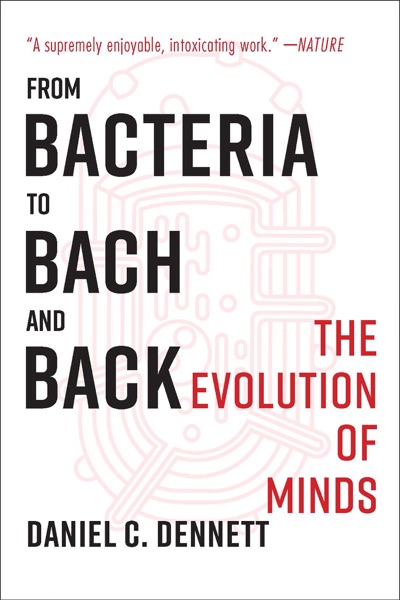
From Bacteria to Bach and Back by Daniel C. Dennett is a 2017 science book about evolution, consciousness, memes and culture. Competence without comprehension is the fundamental principle of Darwinian evolution. Bacteria solve problems they do not understand; evolution produces designs no designer grasped.
Summary
Daniel Dennett's 2017 book is his most comprehensive attempt to explain how minds — conscious, intentional, creative minds — could have evolved from mindless matter without any homunculus, soul, or top-down designer. The title captures his central image: the journey from bacteria, which respond to their environment with zero understanding, to Johann Sebastian Bach, who composed music of extraordinary complexity and depth, and then back — asking how that complexity can be traced to the same blind evolutionary process that produced the bacteria.
Dennett's argument runs through several related claims. First, evolution is the only known process that generates competence without comprehension. Bacteria "know" how to do things they have no understanding of. Natural selection produces brilliant solutions no designer understood or planned. Second, this same process — Dennett calls it a "Darwinian algorithm" — operates at the cultural level through what Richard Dawkins called memes. Words, melodies, scientific theories, and religious ideas replicate, vary, and are selected for fitness, and human brains are the environment they colonize. Third, human consciousness is itself a product of this cultural evolution — our minds as we experience them are largely made of tools, habits, and representations that our culture installed in us.
The middle sections of the book address intentionality — the about-ness of mental states — and attempt to naturalize it. Dennett defends his heterophenomenology: the idea that conscious experience can be studied as a natural phenomenon without taking first-person reports at face value or dismissing them as irrelevant. He is dismissive of "skyhooks" — philosophical explanations that explain competence by invoking a mysterious top-down cause — and insists that all genuine explanation goes from simpler to more complex.
The book is demanding. Dennett engages seriously with Chomsky, Nagel, and the tradition of philosophy of mind, and he does not simplify for non-specialists. But readers willing to follow the argument will find one of the most ambitious attempts to connect evolutionary biology, cognitive science, and philosophy in a single account. His tone is combative and confident, which some readers find invigorating and others find exhausting.
Talk to From Bacteria to Bach and Back like its author wrote you back.
Get the ideas that fit your life — not generic summaries.
- Chat with the book
- Audiobook-style main ideas
- Adapts to your life and goals
- Helps you take action
Key takeaways
- 1.
Competence without comprehension is the fundamental principle of Darwinian evolution. Bacteria solve problems they do not understand; evolution produces designs no designer grasped.
- 2.
Memes are cultural replicators. Words, melodies, and ideas spread through human populations using the same variation-and-selection logic as genes, with human brains as their vehicles.
- 3.
Human consciousness is partly a cultural construction. The self that experiences, deliberates, and creates is built from tools and representations installed by cultural evolution, not just biological.
- 4.
Intentionality — the about-ness of thoughts — can be naturalized without eliminating it. Dennett's heterophenomenology treats first-person reports as data to be explained, not as privileged access to an inner realm.
- 5.
Skyhooks are illegitimate explanations: they account for complexity by invoking more complexity from above rather than building it from below. All genuine scientific explanation goes from simple to complex.
- 6.
Bach's creativity, like all human creativity, depends on a vast cultural inheritance. Individual genius is real but only possible against a background of accumulated cultural evolution.
- 7.
The easy problems of consciousness are genuinely hard; the hard problem as Chalmers frames it may be a philosopher's confusion rather than a scientific mystery.
- 8.
Natural selection has no foresight and no purpose, yet it produces purposive-seeming design. Understanding how this is possible is central to understanding what minds are.
Discussion questions
Use these on your own, with a book club, or as chat starters in Superbook. Book club version, ready to copy or print →
- 1.
Dennett argues that competence without comprehension is the rule, not the exception. Where in your own life do you perform competences you cannot fully explain?
- 2.
The meme concept is controversial. Does the idea that your thoughts and values are partly cultural replicators using your brain as a vehicle feel illuminating, threatening, or both?
- 3.
Dennett is dismissive of the 'hard problem' of consciousness. Do you find his dismissal persuasive, or does it feel like a magician explaining away the mystery by naming it differently?
- 4.
What does it mean for human creativity — Bach's, or anyone's — if it is ultimately built from recombined cultural material rather than from inner originality?
- 5.
Dennett says there are no skyhooks — no top-down causes in nature. How does that claim interact with religious or spiritual frameworks that some people in your group hold?
- 6.
The book describes the evolution of language as a key step in the creation of human minds. What does that suggest about how language shapes what kinds of thoughts are possible?
- 7.
Heterophenomenology treats first-person experience as data about what's going on rather than as direct revelation of what's going on. Does that approach feel like scientific honesty or like explaining away something important?
- 8.
Dennett is writing against a tradition — Chomsky, Nagel, Searle — that he thinks has misunderstood mind. Having read the book, do you find his arguments against these thinkers convincing or tendentious?
- 9.
If cultural evolution installs much of our minds, what responsibility do we have for the cultural environment we create around the next generation?
- 10.
The book title uses Bach as a symbol of the highest human achievement. Is Bach a good example of Dennett's thesis, or does his music feel like a counterexample to a purely Darwinian story?
- 11.
What would it actually mean to you personally if Dennett is right that the self you experience is a kind of useful fiction constructed by evolutionary processes?
- 12.
Dennett wrote this book partly as a summary of his life's work. Does it feel like the work of someone who has won the argument, or someone who is still fighting it?
Themes
Frequently asked questions
-
Is From Bacteria to Bach and Back worth reading?
Yes, if you want the fullest statement of Dennett's philosophy of mind in one place. It's demanding and assumes some prior familiarity with the debates. Readers who found Consciousness Explained too aggressive may find this more patient; others may find it more of the same.
-
How hard is this book to read?
Quite hard. Dennett engages with technical philosophy and cognitive science, and he doesn't oversimplify. General readers with curiosity and patience will manage; readers without any prior exposure to philosophy of mind will struggle with the middle sections.
-
What is Dennett's central argument?
That minds evolved from mindless matter through Darwinian processes operating at both biological and cultural levels, and that consciousness, intentionality, and creativity can all be explained without invoking mysterious top-down causes.
-
How does this book relate to Consciousness Explained?
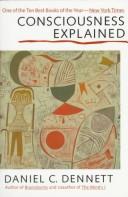
From Bacteria to Bach and Back is broader and in some ways more mature. Consciousness Explained focused on dismantling the Cartesian theater model of mind. This book tries to give a positive account of how minds could have evolved, incorporating cultural evolution and meme theory more centrally.
-
Who should read this book?
People seriously interested in the philosophy of mind, the evolution of consciousness, and the relationship between biology and culture. Not for casual readers — this is a serious philosophical work that rewards careful attention.