Talk to Getting to Yes: Negotiating Agreement Without Giving In like its author wrote you back.
Get the ideas that fit your life — not generic summaries.
- Chat with the book
- Audiobook-style main ideas
- Adapts to your life and goals
- Helps you take action
What it argues
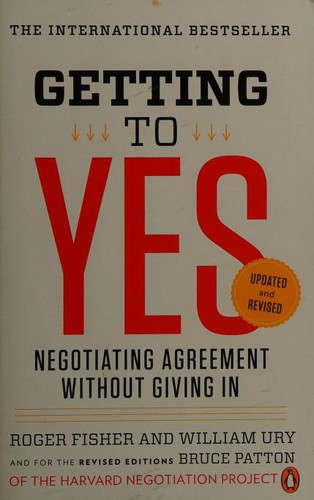
Getting to Yes emerged from the Harvard Negotiation Project in the late 1970s and laid out a method its authors called principled negotiation. The central argument is that most people negotiate by staking out positions — demanding a number, a concession, a particular outcome — and then defending those positions under pressure. Fisher and Ury argue this is both inefficient and damaging to relationships. The alternative is to focus on interests rather than positions: what people actually need versus what they say they want. Two people arguing over an orange are both claiming the whole fruit, but one wants the juice and the other wants the rind. A positional negotiator splits the orange; a principled one asks why, and both leave with everything they need.
The book organizes its method into four elements. First, separate the people from the problem: treat the relationship as something to protect even as you negotiate hard on substance. Second, focus on interests, not positions. Third, invent options for mutual gain before committing to any of them — brainstorm without judgment before evaluating. Fourth, insist on using objective criteria: market rates, expert opinions, legal standards, or any external benchmark that neither side can dismiss as mere preference. These four elements work together. They shift the negotiation from a contest of wills to a joint problem-solving exercise.
What it gets right
- 1.
Separate the people from the problem. Relationship damage and substantive disagreement are two different problems; conflating them makes both harder to solve.
- 2.
Focus on interests, not positions. A position is what someone demands; an interest is why they demand it. Interests have more room for creative solutions.
- 3.
Invent options for mutual gain before evaluating any of them. Premature judgment kills ideas that might have worked with small modifications.
What it covers
Who wrote it
Roger Fisher was a professor at Harvard Law School and the founder of the Harvard Negotiation Project, where he spent decades studying how disputes get resolved. William Ury co-founded the Project with Fisher and has since consulted on conflicts ranging from corporate deals to international crises. Ury later wrote Getting Past No, which extends the framework to situations where the other side refuses to negotiate. Together, Fisher and Ury produced one of the most influential books on practical communication ever published, translated into more than thirty languages.
