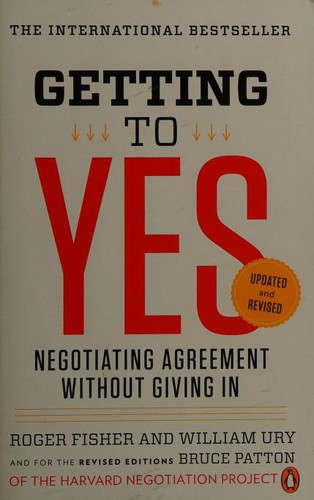
Talk to Getting to Yes: Negotiating Agreement Without Giving In like its author wrote you back.
Get the ideas that fit your life — not generic summaries.
- Chat with the book
- Audiobook-style main ideas
- Adapts to your life and goals
- Helps you take action
Getting to Yes: Negotiating Agreement Without Giving In, in detail
Getting to Yes emerged from the Harvard Negotiation Project in the late 1970s and laid out a method its authors called principled negotiation. The central argument is that most people negotiate by staking out positions — demanding a number, a concession, a particular outcome — and then defending those positions under pressure. Fisher and Ury argue this is both inefficient and damaging to relationships. The alternative is to focus on interests rather than positions: what people actually need versus what they say they want. Two people arguing over an orange are both claiming the whole fruit, but one wants the juice and the other wants the rind. A positional negotiator splits the orange; a principled one asks why, and both leave with everything they need.
The book organizes its method into four elements. First, separate the people from the problem: treat the relationship as something to protect even as you negotiate hard on substance. Second, focus on interests, not positions. Third, invent options for mutual gain before committing to any of them — brainstorm without judgment before evaluating. Fourth, insist on using objective criteria: market rates, expert opinions, legal standards, or any external benchmark that neither side can dismiss as mere preference. These four elements work together. They shift the negotiation from a contest of wills to a joint problem-solving exercise.
Fisher and Ury also address what to do when the other side won't cooperate — when they use dirty tricks, make threats, or simply refuse to engage. Their answer is the BATNA: Best Alternative to a Negotiated Agreement. Knowing your BATNA clarifies when to walk away and prevents you from accepting a bad deal out of desperation. It also recalibrates how much pressure the other side can actually apply. A strong BATNA is leverage; a weak one is a reason to negotiate better terms elsewhere before sitting down.
The book is short and practical. It was written for business disputes, labor negotiations, and international conflict, but the framework applies to salary conversations, apartment leases, and any situation where two parties want different things. It has weaknesses: the model assumes a roughly level playing field and some degree of good faith from at least one side. In deeply asymmetric situations or with genuinely bad-faith actors, the advice strains. But for the vast majority of negotiations most people face, the four-part framework holds up as well in the 2020s as it did in 1981.
The big ideas
- 1.
Separate the people from the problem. Relationship damage and substantive disagreement are two different problems; conflating them makes both harder to solve.
- 2.
Focus on interests, not positions. A position is what someone demands; an interest is why they demand it. Interests have more room for creative solutions.
- 3.
Invent options for mutual gain before evaluating any of them. Premature judgment kills ideas that might have worked with small modifications.
