Business · Book club
Googled: The End of the World As We Know It book club questions
Here are 11 book club questions for Googled: The End of the World As We Know It by Ken Auletta, ordered to open easily and end somewhere worth arguing about. Copy them, print them, or bring them up one at a time.
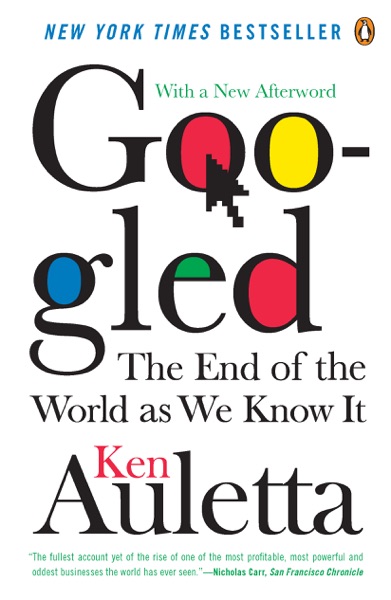
Ken Auletta has been writing about media and power for the New Yorker since the 1990s, and Googled is his attempt to explain what Google did to the industries that preceded it.
Ken Auletta · 2009 · 7h 15m
Full summary and key takeaways →The 11 questions
- 1.
Auletta portrays the newspaper and advertising executives as smart people who failed to adapt. What would adapting actually have looked like in 2005? Was it possible?
- 2.
Google's early motto was 'Don't be evil.' How does that slogan look in retrospect, given what the company became? Was it sincere, naive, or self-serving?
- 3.
The advertising cross-subsidy paid for local journalism. Should the companies that benefited from destroying it — Google, Facebook — have any obligation to replace what was lost?
- 4.
Google treats everything as a data problem. What are the things that data analysis handles well, and what does it systematically miss or distort?
- 5.
Auletta had unusual access to Google's leadership. Does the book feel like he was too close to his sources, or does the access improve the account?
- 6.
The book was published in 2009, before Facebook's rise and before mobile fully transformed search. Which of Auletta's predictions have aged well, and which look wrong now?
- 7.
Schmidt, Brin, and Page all have backgrounds as computer scientists. Does technical training produce a specific kind of business blindspot? What are its benefits and costs?
- 8.
Google disrupted industries whose disruption had significant social costs — local journalism, in particular. How should we weigh market efficiency against the social functions that inefficient markets were supporting?
- 9.
Auletta finds the media executives often more sympathetic than their detractors do. Does he convince you to see their situation as genuinely difficult rather than simply self-protective?
- 10.
What does the Google story suggest about the durability of Google's own position? What are the equivalent structural vulnerabilities that a future disruptor might exploit?
- 11.
The book's title is 'The End of the World As We Know It.' Was it? What was the world that ended, and what replaced it?
How to run the discussion
- Pick six to eight, not all of them. An hour of real discussion covers fewer questions than anyone expects, and racing the list is what makes a book club feel like homework.
- Open with what people noticed, not what they concluded. Asking for a verdict first hardens opinions before anyone has heard each other.
- Let the disagreement run. The questions below that split a room are the ones worth the time; the ones everyone answers the same way can be skipped.
- Ask the quiet person a specific question. A direct, narrow question is far easier to answer than an open invitation to contribute.
Themes worth steering toward
If the conversation stalls, these are the threads that usually restart it.
Common questions
What are good book club questions for Googled: The End of the World As We Know It?
Here are 11 book club questions for Googled: The End of the World As We Know It by Ken Auletta, ordered to open easily and end somewhere worth arguing about. The strongest openers ask what each reader noticed rather than what they concluded, and the discussion usually turns on technology disruption, media industry, corporate culture.
How long should a book club discussion of Googled: The End of the World As We Know It last?
Most groups run 60 to 90 minutes of actual discussion. That is roughly six to eight questions, not all of them, so pick the ones that suit your group rather than working down the list in order.
What are the main themes in Googled: The End of the World As We Know It?
Technology disruption, Media industry, Corporate culture, Power, Advertising. Those are the threads most likely to divide a room, which makes them the useful places to steer a discussion that has gone quiet.
Picking the next one? See books like Googled: The End of the World As We Know It or questions for other book club picks.
