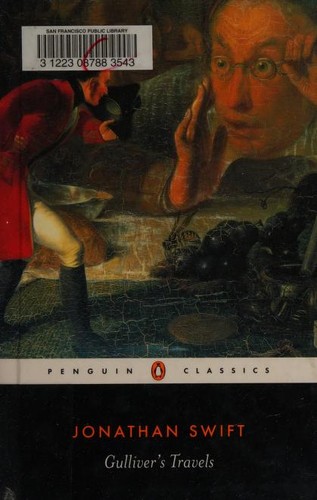
Gulliver's Travels by Jonathan Swift is a 1726 classics book about political satire, human nature and reason, pride and misanthropy. The Lilliput voyage establishes Swift's method: political absurdity rendered so literally that it becomes impossible to miss. Factions fighting over which end of an egg to break are Whigs and Tories, or Catholics and Protestants — take your pick.
Summary
Gulliver's Travels presents itself as the plain memoir of Lemuel Gulliver, an English ship's surgeon who undertakes four extraordinary voyages. In Lilliput, he is a giant among tiny people absorbed in petty factional politics. In Brobdingnag, he is the tiny creature, observed by giants who find his species morally repugnant once he explains European civilization to them. In Laputa and the Academy of Lagado, he encounters scientists so devoted to abstract reason that they have destroyed agriculture and reduced their country to poverty. In Houyhnhnmland, he finds a society of rational horses who regard humans (the vile Yahoos) with contempt, a conclusion he eventually endorses so thoroughly that he cannot bear the smell of his own family.
Swift's satire operates at multiple levels simultaneously. The first two voyages are the most enjoyable and most legible: Lilliput is transparently English and French court politics, Brobdingnag a vehicle for Swift to have a foreign monarch deliver a withering verdict on European civilization. The third voyage is the weakest (it was written last and feels sprawling), but the fourth is the most disturbing — by the end, Gulliver has gone mad with misanthropy, and Swift refuses to make it entirely clear whether Gulliver's contempt for humanity is Swift's own or the satirist's most extreme self-portrait.
The book has been read as a children's adventure story, a Tory political pamphlet, a philosophical text on reason and human nature, and a masterpiece of sustained irony. None of these readings exhausts it. Swift's prose is crystalline — some of the most elegant and controlled English prose of the eighteenth century — and his dark humor holds up with minimal translation across three centuries. The Modest Proposal writer is present throughout: the surface reasonableness barely contains the rage underneath.
Gulliver's Travels is often assigned in truncated form in schools, which does it a disservice. The fourth voyage especially, with its conclusion that Gulliver would rather live in a stable with horses than with his own wife and children, is one of the most unsettling portraits of misanthropy in literature. Whether Swift endorses Gulliver at that point — or is diagnosing something — is a genuine interpretive question, not a school-exam riddle.
Talk to Gulliver's Travels like its author wrote you back.
Get the ideas that fit your life — not generic summaries.
- Chat with the book
- Audiobook-style main ideas
- Adapts to your life and goals
- Helps you take action
Key takeaways
- 1.
The Lilliput voyage establishes Swift's method: political absurdity rendered so literally that it becomes impossible to miss. Factions fighting over which end of an egg to break are Whigs and Tories, or Catholics and Protestants — take your pick.
- 2.
The Brobdingnag voyage turns the satirical instrument around: from Europe's perspective we are giants with power, but from the outside — the King's perspective — we are 'the most pernicious race of little odious vermin that Nature ever suffered to crawl upon the surface of the earth.'
- 3.
The third voyage's Academy of Lagado is the most direct attack on the Royal Society: scientists extracting sunbeams from cucumbers, building houses from the roof down, softening marble for pillows. Reason untethered from practical life becomes its own absurdity.
- 4.
The Houyhnhnms represent pure reason — rational, passionless, incapable of lying because they have no concept of saying what is not true. Swift does not straightforwardly endorse them; a society without passion or love is its own kind of horror.
- 5.
Gulliver's final misanthropy — his revulsion at the smell of humans, his preference for horses — is the satirist's trap closing on the reader: if you've agreed with Gulliver's critiques of human folly throughout, you've been led to endorse a kind of madness.
- 6.
Swift's irony is sustained over four hundred pages without breaking. The voice never cracks. This is a technical achievement as much as a philosophical one.
- 7.
The book was immediately recognized as political satire and its targets knew they were being targeted. Swift went after Walpole, the Whig government, and the ideology of progress with equal fury.
- 8.
Pride is the novel's central sin. Each voyage humbles Gulliver in a different way — the problem is that he never stays humbled, and his final humility curdles into misanthropy rather than wisdom.
Discussion questions
Use these on your own, with a book club, or as chat starters in Superbook. Book club version, ready to copy or print →
- 1.
The King of Brobdingnag calls Europeans 'little odious vermin' after Gulliver explains gunpowder and war. Is this Swift speaking, or is the King also being satirized?
- 2.
The Laputa scientists are absurd, but are they a fair portrait of abstract reason, or is Swift being anti-intellectual? What would he make of contemporary tech culture?
- 3.
The Houyhnhnms are rational and admirable, but their society is also cold, passionless, and incapable of fiction or love. Is Swift endorsing them or critiquing them too?
- 4.
Gulliver ends the book unable to tolerate human company, preferring his horses. Is this the moral of the novel, or is it Swift showing us what misanthropy looks like when taken to its logical conclusion?
- 5.
The third voyage is widely considered the weakest. Why do you think Swift included it? What would be lost without the Academy of Lagado?
- 6.
The Modest Proposal is Swift's other great satirical text. How does its irony compare to Gulliver's? Is one darker than the other?
- 7.
Swift was writing in 1726. Which aspects of his satire feel most contemporary — which institutions or behaviors does it map onto 2026 most precisely?
- 8.
Gulliver is an unreliable narrator, but differently than in most novels — he is unreliable because he is too earnest, not too cunning. What does that do to the reader's relationship with the text?
- 9.
The book is often abridged for children to the first two voyages. Is that appropriate, or does it fundamentally misrepresent the book?
- 10.
What is Swift's view of human nature? Is it possible to reconstruct a positive view from him, or is the book fundamentally misanthropic?
- 11.
Robinson Crusoe and Gulliver's Travels were published within seven years of each other. Crusoe celebrates human self-reliance; Gulliver destroys it. What does their proximity tell us about early-eighteenth-century anxieties?
- 12.
Which voyage did you find most effective as satire, and why?
Themes
Frequently asked questions
-
Is Gulliver's Travels just a children's book?
The first two voyages read easily as adventure stories, which is why they're adapted for children. But the full text — especially the fourth voyage's conclusion, in which Gulliver chooses horses over his family — is a disturbing philosophical text for adults. The children's version and the complete text are almost different works.
-
Is Gulliver's Travels hard to read?
The prose is eighteenth-century but unusually clear — Swift valued directness over ornament. The main challenge is recognizing the satirical targets, which require some background in early-eighteenth-century British politics. A good annotated edition helps.
-
What is Swift actually attacking in the book?
Primarily: English and European political corruption, the ideology of progress, the Royal Society's scientific utopianism, colonialism, and human pride in general. The book is a sustained argument that humans have neither the reason nor the virtue to justify their self-regard.
-
Who shouldn't read Gulliver's Travels?
Readers who want emotional warmth or a sympathetic protagonist will find Gulliver frustrating — he is a vehicle, not a character. Those who find the fourth voyage's conclusion (Gulliver prefers horses to humans) repellent without seeing it as satire may bounce off the ending.
-
Is there a good film or TV adaptation?
There have been several, including a 1996 TV miniseries with Ted Danson. None has captured the darkness of the full text. The adaptations tend to emphasize the adventure elements of the first two voyages and soften the misanthropy of the fourth.