Psychology · Book club
Hardwiring Happiness: The New Brain Science of Contentment, Calm, and Confidence book club questions
Here are 11 book club questions for Hardwiring Happiness: The New Brain Science of Contentment, Calm, and Confidence by Rick Hanson, ordered to open easily and end somewhere worth arguing about. Copy them, print them, or bring them up one at a time.
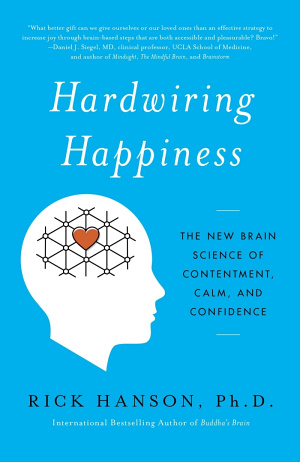
Rick Hanson is a neuropsychologist and meditation teacher, and this book is his attempt to explain why wellbeing is so hard to sustain and what the brain science suggests you can do about it.
Rick Hanson · 2013 · 4h 45m
Full summary and key takeaways →The 11 questions
- 1.
Hanson argues that positive experiences don't stick because the brain evolved to let them go. Does this match your experience? Which kinds of good moments do you find hardest to hold onto?
- 2.
The technique of 'taking in the good' requires deliberately pausing during positive moments. What obstacles — habit, embarrassment, busyness — prevent you from doing this?
- 3.
The book makes a distinction between having a positive experience and installing it as a neural resource. What would it mean for your wellbeing to take this distinction seriously for a week?
- 4.
Hanson draws on neuroscience to support his practices but is honest that the direct evidence for his specific protocol is limited. Does that affect your willingness to try it?
- 5.
Think of a psychological resource you want more of — calm, courage, patience. What positive experiences in your recent life might be raw material for building it?
- 6.
The negativity bias affects memory. Think of a period in your life you remember as mostly hard. Is it possible the good moments were present but didn't register as fully?
- 7.
Hanson says modesty or discomfort can prevent people from letting positive experiences register. Where does that resistance come from for you?
- 8.
The HEAL protocol includes a 'link' step: holding positive material alongside negative material to reduce the negative charge. Does this sound credible to you? Where would you try it?
- 9.
How would your day look different if you treated every moment of pleasure, satisfaction, or connection as something worth thirty seconds of deliberate attention?
- 10.
Hanson comes from both clinical psychology and the meditation tradition. Where do you see those two influences shaping the book's approach differently from a pure neuroscience account?
- 11.
The book promises a shift in emotional baseline. Is that a goal you hold for yourself? What would a reliably calmer, more contented version of your daily experience actually look like?
How to run the discussion
- Pick six to eight, not all of them. An hour of real discussion covers fewer questions than anyone expects, and racing the list is what makes a book club feel like homework.
- Open with what people noticed, not what they concluded. Asking for a verdict first hardens opinions before anyone has heard each other.
- Let the disagreement run. The questions below that split a room are the ones worth the time; the ones everyone answers the same way can be skipped.
- Ask the quiet person a specific question. A direct, narrow question is far easier to answer than an open invitation to contribute.
Themes worth steering toward
If the conversation stalls, these are the threads that usually restart it.
Common questions
What are good book club questions for Hardwiring Happiness: The New Brain Science of Contentment, Calm, and Confidence?
Here are 11 book club questions for Hardwiring Happiness: The New Brain Science of Contentment, Calm, and Confidence by Rick Hanson, ordered to open easily and end somewhere worth arguing about. The strongest openers ask what each reader noticed rather than what they concluded, and the discussion usually turns on happiness, neuroscience, mindfulness.
How long should a book club discussion of Hardwiring Happiness: The New Brain Science of Contentment, Calm, and Confidence last?
Most groups run 60 to 90 minutes of actual discussion. That is roughly six to eight questions, not all of them, so pick the ones that suit your group rather than working down the list in order.
What are the main themes in Hardwiring Happiness: The New Brain Science of Contentment, Calm, and Confidence?
Happiness, Neuroscience, Mindfulness, Negativity bias, Resilience. Those are the threads most likely to divide a room, which makes them the useful places to steer a discussion that has gone quiet.
Picking the next one? See books like Hardwiring Happiness: The New Brain Science of Contentment, Calm, and Confidence or questions for other book club picks.
