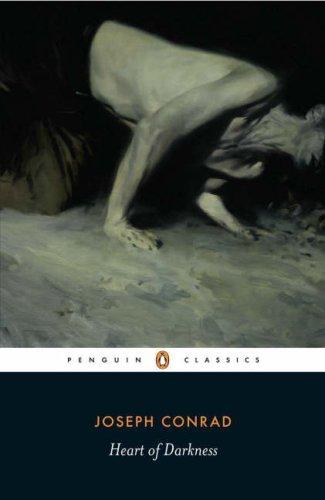
Heart of Darkness by Joseph Conrad is a 1899 literary fiction book about colonialism and its violence, civilization vs. savagery, moral corruption. Marlow is not simply an observer of colonialism — he is an employee of the colonial system, and the novella's moral weight depends on taking that seriously.
Summary
Marlow, a sailor sitting on a boat on the Thames, tells the story of a journey he made up the Congo River to find Kurtz, a brilliant company agent who has gone silent deep in the interior. The company that employs Marlow extracts ivory from central Africa. What Marlow finds at the end of his journey is a man who has gone beyond the rules — worshipped, surrounded by severed heads on poles, whispering about "the horror."
Conrad was writing from his own experience: he navigated the Congo in 1890 and what he saw broke something in him permanently. The novella is not, however, primarily a journalistic account of colonial atrocities. It is something more uncomfortable — a meditation on what happens when the idea of civilization is stripped away, and on what the narrator, who is not Kurtz, is willing to see and say. Marlow is implicated in the system he is describing. He works for the company. He reports to its bureaucracy. He is part of the machine even as he registers his disgust.
The book became the center of a major literary-political controversy when Chinua Achebe argued in 1975 that Conrad was himself a "thoroughgoing racist" who used Africa as a backdrop for European psychodrama while denying Africans their humanity. That critique has not been refuted; it has changed the way the novella is taught and read. It is now impossible — and dishonest — to read Heart of Darkness as simply a critique of colonialism. It both critiques colonialism and reproduces some of its worst assumptions. That double quality is, depending on your view, either a damning flaw or an honest demonstration of how deeply the ideology it claims to oppose is embedded in its narrator.
At under 40,000 words it can be read in an afternoon, but it is extremely dense. The prose is not difficult; it is deliberately murky, hedged, repetitive in a way that enacts the difficulty of seeing clearly. The questions it leaves open are real questions. Readers who engage with the critical conversation around it — particularly Achebe's essay — will find it considerably more complex than a classroom summary would suggest.
Talk to Heart of Darkness like its author wrote you back.
Get the ideas that fit your life — not generic summaries.
- Chat with the book
- Audiobook-style main ideas
- Adapts to your life and goals
- Helps you take action
Key takeaways
- 1.
Marlow is not simply an observer of colonialism — he is an employee of the colonial system, and the novella's moral weight depends on taking that seriously.
- 2.
Kurtz represents one extreme: a man who dropped the pretense of civilization and followed his impulses to their end. But Conrad does not clearly offer a better alternative.
- 3.
Achebe's 1975 critique — that Conrad used Africa as a backdrop and African characters as props — is accurate and cannot simply be dismissed as ahistorical.
- 4.
The prose's famous vagueness is deliberate: Conrad renders imperialism as something that resists clear seeing, not despite the narrator's intelligence but because of it.
- 5.
The ending — Marlow lying to Kurtz's Intended about his last words — is either a kind mercy or a capitulation to the same illusion-making that enables the whole system.
- 6.
The Thames opening frames European civilization itself as a once-dark place, implicating empire universally rather than locating the problem in Belgium alone.
- 7.
Kurtz's 'horror' can mean the horror of what he has done, the horror of what he has discovered about human nature, or both — Conrad refuses to pin it down.
- 8.
The novella is best read alongside its critics, not as a standalone work — the conversation around it is now part of what it means.
Discussion questions
Use these on your own, with a book club, or as chat starters in Superbook. Book club version, ready to copy or print →
- 1.
Achebe argues the novella denies Africans their humanity by using them as backdrop. After reading, do you agree? Does the critique change how you experience the text?
- 2.
Marlow is disgusted by the company but keeps working for it. Is he a moral witness, an unreliable narrator, or both?
- 3.
What do you think Kurtz actually discovered — about human nature, about himself, about the colonial project? What does 'the horror' mean to you?
- 4.
Marlow lies to Kurtz's Intended at the end. Does he do it out of kindness, cowardice, or something else?
- 5.
The Thames opening places European civilization in the same category as the Congo — 'this also has been one of the dark places of the earth.' Does Conrad develop that thought, or does he drop it?
- 6.
The prose is famously murky and hedged. Is that a deliberate artistic choice that enacts the novel's themes, or is it a failure of nerve?
- 7.
Conrad was himself an outsider to English society — a Polish immigrant writing in his third language. Does that change how you read his perspective on empire?
- 8.
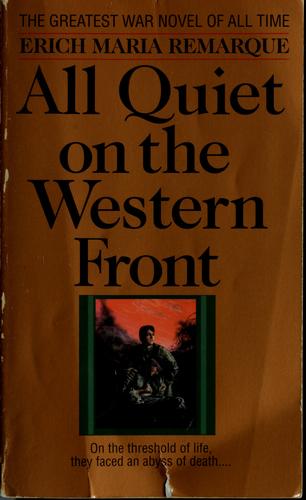
Compared to All Quiet on the Western Front, which also depicts systemic violence and its costs, which book is more honest about complicity?
- 9.
The women in the novella — Marlow's aunt, Kurtz's Intended, the African woman — are all very differently drawn. What does Conrad seem to think about women?
- 10.
How much of the novella's continued prestige depends on its literary technique, and how much does that prestige survive Achebe's critique intact?
- 11.
Kurtz wrote a pamphlet beginning 'We whites must necessarily appear to them [savages] as supernatural beings.' At what point in the novella is that worldview shown to be false?
- 12.
If you had to name a contemporary novel that grapples more honestly with colonialism and its psychological legacy, what would it be?
Themes
Frequently asked questions
-
Is Heart of Darkness a critique of colonialism?
Partly. Conrad renders the Belgian colonial system in the Congo as brutal and absurd. But Chinua Achebe's influential 1975 essay argues that Conrad reproduced racist assumptions about Africa even while criticizing empire. Both things are true simultaneously, which is why the novella remains contested.
-
Is Heart of Darkness hard to read?
The prose is not technically difficult, but it is deliberately murky and atmospheric. Conrad builds meaning through repetition, hedging, and mood rather than clear statement. Readers who want precise narrative will find it frustrating; readers comfortable with ambiguity tend to find it absorbing.
-
What does 'the horror' mean?
Conrad leaves it deliberately open. It can mean the horror of what Kurtz has done, what he has discovered about human nature, or what the colonial system is. The ambiguity is the point.
-
Is Apocalypse Now based on Heart of Darkness?
Yes. Francis Ford Coppola's 1979 film transplants the story to the Vietnam War, with Kurtz (played by Marlon Brando) as a rogue American officer. The film is not a straight adaptation but engages seriously with the novella's themes.
-
Who shouldn't read this book?
Readers who want a clear moral framework or a satisfying resolution. Conrad offers neither. If you need your protagonist to take a clear ethical stance, Marlow's hedged observation will feel like a failure.