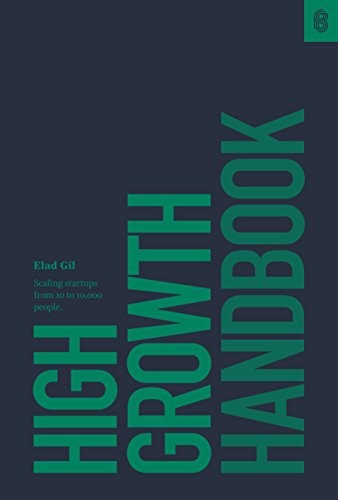
High Growth Handbook by Elad Gil is a 2018 business book about scaling, startups, leadership. The CEO's job changes dramatically at scale. The skills that got a company to product-market fit — high personal involvement, direct problem-solving — actively harm performance in a company of 200 or more people.
Summary
High Growth Handbook is Elad Gil's guide to the operational and organizational challenges that arise once a startup has found product-market fit and needs to scale from dozens of employees to hundreds or thousands. Gil is an investor and former operator who has worked with or backed companies including Airbnb, Stripe, Square, and Coinbase. The book addresses a gap in the startup literature: most startup advice is about getting to traction, but relatively little discusses what breaks immediately afterward and how to fix it.
The book is organized around the specific problems that emerge at scale: when to hire a COO, how the CEO's job changes as the company grows, how to build a board that helps rather than hinders, how to manage the transition from founder-led hiring to systematic recruiting, how to think about M&A as a scaling tool, and how late-stage fundraising works. Each chapter includes a long-form interview with a founder or executive who has navigated that specific problem — Marc Andreessen on boards, Claire Hughes Johnson on scaling operations, Keith Rabois on executive hiring.
What makes the book useful is its specificity. Gil is not writing for people who are still trying to find a business model. He is writing for founders and operators dealing with the concrete institutional problems that arrive between Series A and IPO: the first VP hire who doesn't scale, the executive team that stops communicating directly, the board that becomes a governance problem rather than a resource. The advice is pragmatic and draws on real decisions made at real companies.
The weakness of the book is its format. Like Do More Faster, it's a collection — essays, interviews, and checklists — rather than a sustained argument. The interviews are often the best material, but the editing is uneven and some sections feel more like frameworks for their own sake than accumulated wisdom. High Growth Handbook is most valuable as a reference: the kind of book you pull out when you're about to face a specific situation, not one you read cover to cover looking for insight.
Talk to High Growth Handbook like its author wrote you back.
Get the ideas that fit your life — not generic summaries.
- Chat with the book
- Audiobook-style main ideas
- Adapts to your life and goals
- Helps you take action
Key takeaways
- 1.
The CEO's job changes dramatically at scale. The skills that got a company to product-market fit — high personal involvement, direct problem-solving — actively harm performance in a company of 200 or more people.
- 2.
Boards become liabilities when founders don't manage them. The founders who get the most from their boards treat board management as a recurring priority, not a formality before the quarterly meeting.
- 3.
Hiring a COO too early is as common a mistake as hiring one too late. The right time is when the CEO has a specific set of operational problems they need to hand off, not when the company feels generally chaotic.
- 4.
The first wave of executives who scale a company from 10 to 100 is rarely the same wave who scale it from 100 to 1000. Anticipating this and managing the transition carefully is one of the hardest human problems in scaling.
- 5.
M&A is a tool for acquiring capabilities and talent, not just revenue. Many of the most valuable acquisitions at scale are small and strategic: a team with expertise you need that would take two years to build.
- 6.
Late-stage fundraising (Series C and beyond) is more about narrative than metrics. Investors are underwriting a theory of the future, and the founder's job is to make that theory compelling and specific.
- 7.
Culture doesn't maintain itself at scale. The informal behaviors that define culture at twenty employees need to be made explicit, documented, and systematically reinforced by a team of hundreds.
- 8.
Talent density — the ratio of high performers to everyone else — is hard to maintain as a company grows. Most scaling companies see it decline unless executive hiring is treated with the same rigor as product development.
Discussion questions
Use these on your own, with a book club, or as chat starters in Superbook. Book club version, ready to copy or print →
- 1.
Gil argues that the CEO's job changes fundamentally at scale. What specific behaviors that help in the early days hurt later, and how do you know when you've crossed that threshold?
- 2.
The book has a strong thesis about board management. Have you seen a board that functioned well for a founder, and what made it work?
- 3.
The COO question — when to hire one, who it should be, what they should own — is one of the most practically useful in the book. How would you answer it for a company you know?
- 4.
Gil says the first executive team rarely scales all the way. How do you manage the transition from executives who built the company to executives who can run it at the next level, without destroying the culture they created?
- 5.
The M&A chapter treats acquisitions as talent and capability plays as much as revenue plays. Does that framing match what you've observed in how companies actually use M&A?
- 6.
Culture documentation — writing down what's informal — is described as a scaling necessity. When does that documentation help, and when does it become bureaucratic in a way that actually degrades culture?
- 7.
The book is explicitly written for post-product-market-fit companies. What's the risk of reading it before you're there?
- 8.
Several of the interview subjects are very candid about mistakes. Which mistake described in the book seems most common, and what makes it hard to avoid?
- 9.
Late-stage fundraising is described as a narrative exercise. What's the most compelling narrative a company you know has told about its future, and did it match reality?
- 10.
Gil is both an operator and an investor. Does that dual perspective make the book more useful, or does it sometimes create a tension between what's good for founders and what's good for investors?
- 11.
The handbook format means different sections will be relevant at different points in a company's growth. Which chapter would you read first if you were facing a scaling challenge today?
- 12.
What does High Growth Handbook leave out that you'd want from a complete guide to scaling a company?
Themes
Frequently asked questions
-
Is High Growth Handbook worth reading?
Yes, for founders and operators at companies between Series A and IPO scale. The book addresses a real gap: most startup advice is about finding product-market fit, but Gil focuses on what breaks afterward. If you're pre-traction, most of the book won't be relevant yet.
-
How long does it take to read High Growth Handbook?
Around six to seven hours for the full book, though it's designed to be used as a reference rather than read straight through. Many readers treat specific chapters as guides when they're about to face the problem the chapter addresses.
-
Who are the interview subjects in High Growth Handbook?
The book includes extended conversations with Marc Andreessen, Claire Hughes Johnson (Stripe's COO), Keith Rabois, Sam Altman, Aaron Levie, and others who have built or funded high-growth companies. These interviews are often the most practically valuable parts of the book.
-
Who should read High Growth Handbook?
Founders and executives at companies that have found product-market fit and are navigating rapid scaling. Investors who want to understand what their portfolio companies are experiencing. Less relevant for first-time founders still looking for traction or for operators at large, stable companies.
-
What's the most actionable idea in High Growth Handbook?
Board management as a continuous CEO responsibility, not a quarterly formality. Gil describes specifically how to run board meetings, how to manage individual board members between meetings, and how to avoid the common failure mode where a board becomes adversarial because the CEO stopped managing the relationship.
Similar books
The Hard Thing About Hard Things
Ben Horowitz
Blitzscaling: The Lightning-Fast Path to Building Massively Valuable Companies
Reid Hoffman and Chris Yeh
High Output Management
Andrew S. Grove
Measure What Matters
John Doerr
