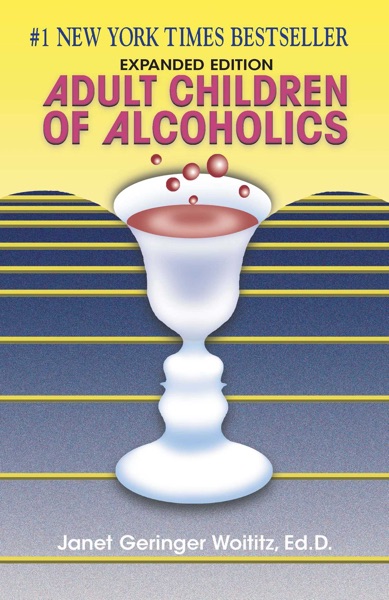
Adult Children of Alcoholics by Janet G. Woititz is a 1983 psychology book about family dysfunction, trauma, recovery. Woititz identifies thirteen patterns common to adults raised in alcoholic families — traits that were adaptive in childhood but create difficulties in adult life.
Summary
Adult Children of Alcoholics is Janet Woititz's clinical guide to the lasting psychological patterns that develop in children raised in alcoholic families. Published in 1983, it became one of the most widely read books in the recovery literature and spent nearly three years on the New York Times bestseller list. Its central contribution is a list of thirteen common characteristics that adult children of alcoholics tend to share — traits formed as adaptations to an unpredictable, chaotic household that persist into adult life even when the drinking is no longer present.
Woititz's thirteen characteristics include: difficulty knowing what normal is, problems with honesty, trouble following projects through to completion, harsh self-judgment, difficulty having fun, trouble with intimate relationships, overreaction to changes beyond personal control, constant seeking of approval, feelings of being different from other people, excessive responsibility, extreme loyalty, difficulty with cause-and-effect thinking, and confusion between love and pity. She argues that each of these was adaptive in childhood — they were coping strategies — but they become liabilities in adult relationships and work settings where the underlying crisis no longer exists.
The book is short and deliberately accessible. Woititz was a therapist writing for a clinical and self-help audience, and the text reads as a series of plainly stated observations rather than academic argument. She illustrates each characteristic with case examples and provides brief guidance on how to begin addressing it. The tone is validating rather than prescriptive — the primary goal seems to be recognition, the moment when a reader realizes that their patterns have a name and a coherent explanation.
Critics have noted that the thirteen characteristics Woititz describes are common enough in the general population that almost anyone could recognize themselves in the list. That's a fair critique of its diagnostic precision. But the book's enduring influence suggests that the recognition it offers is genuinely useful for people who have never had language for their experience. It is best read as a starting point rather than a clinical assessment, and it works best alongside therapy or a recovery program rather than as a standalone resource.
Talk to Adult Children of Alcoholics like its author wrote you back.
Get the ideas that fit your life — not generic summaries.
- Chat with the book
- Audiobook-style main ideas
- Adapts to your life and goals
- Helps you take action
Key takeaways
- 1.
Woititz identifies thirteen patterns common to adults raised in alcoholic families — traits that were adaptive in childhood but create difficulties in adult life.
- 2.
The core wound is unpredictability. When a child cannot predict a parent's behavior or mood, they develop hypervigilance and a distorted sense of what normal looks like.
- 3.
Difficulty trusting others and trouble with intimacy often stem from early experiences in which closeness was reliably followed by hurt, disappointment, or abandonment.
- 4.
Excessive responsibility and perfectionism are coping mechanisms. The child learns to control what can be controlled and to minimize any behavior that might trigger the parent.
- 5.
Adult children of alcoholics often confuse love with pity or caretaking. The pattern of being drawn to people who need fixing has roots in the family dynamic they grew up in.
- 6.
The need for external approval is linked to the absence of consistent, reliable positive feedback during childhood. Adults raised in these environments often cannot generate internal validation.
- 7.
Recovery involves identifying which of these patterns belong to the original family situation and which ones the adult has made their own. The distinction matters for how change is approached.
- 8.
The book applies beyond strictly alcoholic families. The same patterns appear in households defined by any chronic dysfunction — mental illness, abuse, emotional neglect, or extreme rigidity.
Discussion questions
Use these on your own, with a book club, or as chat starters in Superbook. Book club version, ready to copy or print →
- 1.
Woititz's list of thirteen characteristics is very broad. How many of them did you recognize in yourself, and do you think that breadth is a strength or a weakness of the framework?
- 2.
She argues that these patterns were adaptive in childhood. Can you trace a specific pattern you have back to a situation in which it would have been genuinely useful to have developed it?
- 3.
The book focuses heavily on recognition — naming and understanding the patterns — rather than on how to change them. Is that emphasis appropriate, or does it leave readers without enough practical guidance?
- 4.
Woititz says adult children of alcoholics often don't know what normal is. What sources did you use growing up to calibrate what 'normal' family behavior looked like?
- 5.
The chapter on intimacy suggests that people raised in chaotic households are often attracted to chaos in their adult relationships because it feels familiar. Have you seen this dynamic play out in your own life or in someone close to you?
- 6.
How does the concept of excessive loyalty interact with the difficulty in leaving harmful relationships? Where does the loyalty come from, and what would need to change for someone to override it?
- 7.
The book was written in 1983, before the explosion of trauma research. Does the framework hold up in light of what we now know about adverse childhood experiences and attachment theory?
- 8.
Woititz says that adult children of alcoholics have an overdeveloped sense of responsibility for others and an underdeveloped sense of responsibility for themselves. What does that imbalance look like in practice?
- 9.
The book has been criticized for being so broad that almost anyone can identify with it. Is that a problem — does it dilute the usefulness of the framework for people who genuinely grew up in alcoholic households?
- 10.
Recovery literature generally asks readers to take stock of their patterns and their origins. How do you think about the difference between understanding where a pattern came from and actually changing it?
- 11.
Woititz says these patterns appear in adult children raised in any chronically dysfunctional family, not just alcoholic ones. Do you think the alcohol-specific framing helps or limits the book's usefulness?
Themes
Frequently asked questions
-
Do you have to be from an alcoholic family to benefit from this book?
No. Woititz herself notes that the thirteen characteristics she describes appear in adults raised in any chronically dysfunctional household — one defined by mental illness, physical illness, rigidity, or any other ongoing disruption to normal parenting. Many readers with no alcoholic parents recognize themselves in the list.
-
Is Adult Children of Alcoholics outdated?
Some of the clinical framing reflects 1983 thinking. The book predates attachment theory becoming mainstream and lacks the trauma vocabulary that has since developed. But the core observations about behavioral patterns remain recognizable and useful, even if the explanatory framework has been updated by later research.
-
How long is the book?
Short — roughly 100 pages in most editions. It's written accessibly and can be read in two to three hours, making it one of the more approachable books in the recovery literature.
-
Is this a self-help book or a clinical guide?
Both. Woititz wrote it for a general audience and for therapists working with this population. The tone is accessible rather than academic, and the book is structured around recognition — here is the pattern, here is where it came from — rather than clinical protocols.
-
What should I read after this?
Bessel van der Kolk's The Body Keeps the Score provides a more scientifically grounded account of how childhood trauma affects adult functioning. Alice Miller's The Drama of the Gifted Child covers related territory with more depth on emotional suppression.
Similar books
The Body Keeps the Score
Bessel van der Kolk
Man's Search for Meaning
Viktor E. Frankl
Quiet: The Power of Introverts in a World That Can't Stop Talking
Susan Cain
Behave: The Biology of Humans at Our Best and Worst
Robert M. Sapolsky
