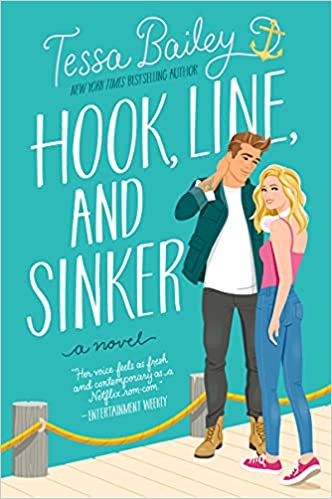
Hook, Line, and Sinker by Tessa Bailey is a 2022 romance book about friendship crossing into love, identity and reinvention, vulnerability and armor. Fox's playboy persona is armor, not identity — and the novel traces the specific wound that built it with more care than the formula requires.
Summary
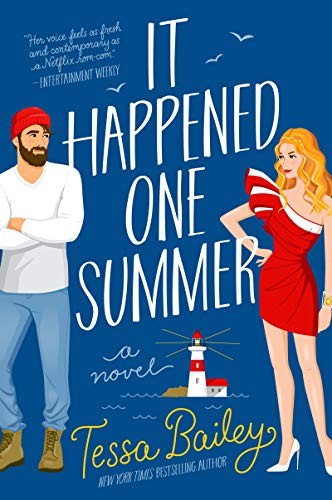
Hannah Bellinger has always been the dependable one — her sister Piper's anchor, the practical twin who keeps things running. She arrives back in Westport, Washington to supervise a documentary film shoot, carrying a script she wrote and a determination to step into something that's actually hers. Fox Mayfield, fisherman and self-styled charmer, offers to help. They've been texting since the events of It Happened One Summer — building what both of them are careful to call just a friendship, even as it is clearly something more.
The friends-to-lovers tension here is different in texture from the enemies-to-lovers setup of the first book. Hannah and Fox already like each other. The stakes are that affection: both characters are afraid that admitting they want more will destroy the easiest relationship either of them has. Fox, in particular, has built an entire persona around being unserious about love, which turns out to be an armor rather than a preference. The novel takes its time dismantling that armor, and the dismantling is the most interesting thing in the book.
Bailey's prose is warm and fast-moving, as it was in It Happened One Summer, but the emotional register here runs a little deeper. Hannah is a more complex character than Piper — she has spent so long being the competent supporting character in other people's stories that she's genuinely unsure what she wants for herself. Her filmmaking ambition gives the novel a through-line that isn't just about the romance, which keeps the book from feeling like a holding pattern between conversations and kisses.
This is a sequel that works whether or not you've read the first book, though the Westport community and the relationship between Hannah and Piper have more resonance with context. If friends-to-lovers is your preferred romance subgenre, it's among the better contemporary executions — the friendship feels real, the fear of losing it feels real, and the resolution doesn't shortchange either.
Talk to Hook, Line, and Sinker like its author wrote you back.
Get the ideas that fit your life — not generic summaries.
- Chat with the book
- Audiobook-style main ideas
- Adapts to your life and goals
- Helps you take action
Key takeaways
- 1.
Fox's playboy persona is armor, not identity — and the novel traces the specific wound that built it with more care than the formula requires.
- 2.
Hannah's arc is explicitly about moving from supporting character in other people's lives to protagonist of her own, which gives the romance a second spine.
- 3.
The friendship between Hannah and Fox is established before the romance begins, which means both characters have something real to lose — a higher stakes setup than most romances attempt.
- 4.
Bailey uses the documentary filmmaking subplot to give Hannah a concrete project that tracks her growth independently of the love plot.
- 5.
The texting relationship between books creates a particular kind of intimacy — built over distance, in language, without physical presence — that pays off meaningfully when they're finally in the same town.
- 6.
The Westport community, familiar from the first book, functions as a chorus here: people who know Fox's patterns and are watching to see if this time is different.
- 7.
The emotional climax hinges on Fox choosing vulnerability over self-protection, which is both satisfying as romance and credible as character.
- 8.
The book is aware of its own genre conventions and plays with them: Fox's reputation precedes him in ways the novel acknowledges rather than ignores.
Discussion questions
Use these on your own, with a book club, or as chat starters in Superbook. Book club version, ready to copy or print →
- 1.
Fox has spent years performing a version of himself that keeps people from expecting too much. At what point does Hannah stop accepting that performance, and what forces her to?
- 2.
Hannah calls the friendship with Fox the easiest relationship she has. What does that say about her other relationships, and does the novel examine those adequately?
- 3.
The friends-to-lovers setup requires both characters to pretend not to want what they want. Who do you think is pretending harder, and who breaks first?
- 4.
Hannah's script and her filmmaking ambition are central to her character arc. Does the novel give that ambition sufficient resolution, or does it get swallowed by the romance?
- 5.
Fox's backstory involves a specific early wound that shaped his relationship with love. Does revealing that backstory feel earned, or does it arrive as an explanation rather than something built into the character?
- 6.
The texting relationship between books is an unusual structural choice — a slow intimacy built off-page. How does that affect your sense of how well these two know each other?
- 7.
Piper and Brendan from the first book appear here. Do their appearances strengthen the sequel or make it feel like it's servicing the first book's fans?
- 8.
Hannah is defined partly by competence and dependability. Are those presented as virtues, limitations, or both?
- 9.
Compared to It Happened One Summer, where does the emotional stakes feel higher, and where does it feel lower?
- 10.
Fox makes a significant gesture near the end that is romantic but also somewhat over the top for the character. Did it work for you, or did it feel out of register?
- 11.
The small-town community watches Fox closely here in a way that creates social pressure on the romance. Is that pressure productive or constraining for the story?
- 12.
Would this book work as well without having read It Happened One Summer? What does knowledge of the first book add?
Themes
Frequently asked questions
-
Do I need to read It Happened One Summer first?
It works as a standalone, but reading in order rewards you with more context for the Westport community, for Hannah and Piper's relationship, and for Fox's dynamic with Brendan. The investment in the setup pays off in the sequel.
-
Is Hook, Line, and Sinker better than It Happened One Summer?
Different rather than better. This one has more emotional complexity and a stronger hero arc. The first book has more comedy and a more conventional setup. Most readers have a preference, but both are strong.
-
What is the friends-to-lovers dynamic like here compared to other romances?
More grounded than most. The friendship feels real, not just a holding pattern before the romance activates. Both characters have specific fears about crossing the line, and those fears are treated as legitimate rather than just obstacles.
-
Who shouldn't read this book?
Readers who find slow emotional reveals frustrating, or who want plot-driven rather than character-driven romance. The book is long, and most of the tension is internal. If you need events to happen, this will feel slow.
-
Is the steam level similar to the first book?
Yes — moderate to high, consistent with Bailey's style. The physical heat earns its place in the emotional arc rather than functioning as set pieces.