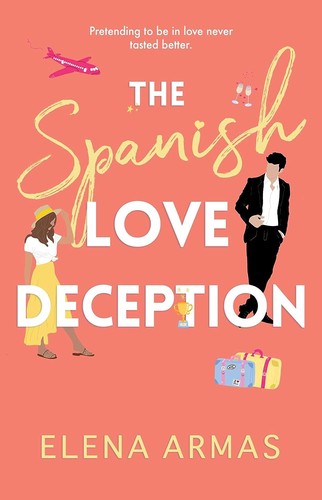
The Spanish Love Deception by Elena Armas is a 2021 romance book about fake relationships, enemies to lovers, self-worth. Miscommunication as a narrative engine: the novel sustains almost its entire tension on the gap between what Aaron means and what Catalina hears, which is either a clever structural choice or a maddening one.
Summary
Catalina Martin needs a date for her sister's wedding in Spain, and she needs one fast. Having blurted out the existence of a fictional American boyfriend to her very real Spanish family, she is now committed to producing him at the wedding — or facing questions she can't answer. The only person available and willing is Aaron Blackford, her tall, infuriating, relentlessly composed colleague, who has been a thorn in her side since the day they met.
What the book is really about is less the fake-dating setup and more what happens when two people who have spent years misreading each other are forced into proximity without their usual armor. Catalina has spent so long assuming Aaron dislikes her that she's built an entire internal mythology around his silences and disapprovals. The road trip across Spain, the wedding preparations, and the shared bed scenes become a slow dismantling of that mythology — not through grand romantic gestures but through accumulated small moments where Aaron turns out to be someone quite different from who she imagined.
Armas writes in first person, present tense, with Catalina's voice dominating every page — anxious, self-deprecating, occasionally unreliable in the way people are unreliable about their own feelings. The pacing is slow burn to an almost meditative degree, which is either the book's greatest strength or its most significant test of patience, depending on the reader. The Spanish setting is rendered with genuine affection, and the family dynamics feel lived-in rather than decorative. The romance earns its resolution because both characters do visible work to get there.
This is a book that rewards readers who enjoy extended tension and interiority over plot momentum. If you need things to happen quickly, the first two-thirds will frustrate you. If you're comfortable spending hundreds of pages inside a character's head while she slowly figures out what's obvious to everyone else, The Spanish Love Deception delivers exactly what it promises. It belongs firmly in the Hating Game lineage of workplace slow-burn romance — office antagonism, miscommunication as a structural engine, and a payoff calibrated for maximum delay.
Talk to The Spanish Love Deception like its author wrote you back.
Get the ideas that fit your life — not generic summaries.
- Chat with the book
- Audiobook-style main ideas
- Adapts to your life and goals
- Helps you take action
Key takeaways
- 1.
Miscommunication as a narrative engine: the novel sustains almost its entire tension on the gap between what Aaron means and what Catalina hears, which is either a clever structural choice or a maddening one.
- 2.
The fake-dating trope works here because both characters have genuine reasons to agree to it, and the pretense forces honest conversations they'd otherwise avoid.
- 3.
Catalina's self-doubt is the real antagonist — not Aaron, not the wedding, not the family. Her internal monologue tracks one person learning to trust her own perceptions.
- 4.
The Spanish setting does meaningful work: family as community, meals as ritual, the wedding as a social pressure cooker that strips away both characters' professional distance.
- 5.
Aaron Blackford is written as a quiet character whose emotions are largely communicated through action rather than speech — a deliberate choice that makes the reader work alongside Catalina to decode him.
- 6.
The slow-burn pacing is a feature, not a bug, for readers who want the emotional payoff earned across real time rather than compressed into a few charged scenes.
- 7.
The book captures something true about workplace dynamics: how much of our dislike of a colleague is projection, and how proximity changes that calculus.
- 8.
Armas's first-person, present-tense voice creates an intimacy that keeps the reader inside Catalina's experience even when her conclusions are wrong.
Discussion questions
Use these on your own, with a book club, or as chat starters in Superbook. Book club version, ready to copy or print →
- 1.
Catalina's entire misreading of Aaron is sustained for years. How much of her interpretation do you think was willful, and how much was genuine error?
- 2.
The fake-dating setup requires Catalina to lie to her entire family. Does the novel treat this as morally serious, or does it treat the lie as just a plot device?
- 3.
Aaron's quietness is legible to the reader as different from coldness fairly early on. Why do you think Armas kept Catalina in the dark so long — and does it work?
- 4.
The Spanish family scenes are warm but also pressure-filled. How does Armas use the wedding setting to push the main couple toward honesty they wouldn't reach otherwise?
- 5.
This is a long slow burn. Where, if at all, did you start feeling impatient, and what kept you reading?
- 6.
Catalina has a specific wound around being underestimated by men in professional settings. How does this backstory change the way the romance reads?
- 7.
The Hating Game is the obvious comparison point. Where does The Spanish Love Deception land harder, and where does it fall short?
- 8.
Aaron makes several choices that risk his own professional standing for Catalina's benefit. Does the book let him be a fully rounded character, or is he mostly a love interest?
- 9.
How does the novel handle the gap between Spanish and American cultural expectations around family, marriage, and romantic expression?
- 10.
The resolution requires Catalina to take an active step rather than just receive Aaron's feelings. Was that earned by the characterization up to that point?
- 11.
Who in your reading group would bounce off this book, and why? What's the honest case against it?
Themes
Frequently asked questions
-
Is The Spanish Love Deception worth reading?
Yes, if you enjoy slow-burn romance and have patience for an extended internal monologue. The payoff is real and the Spanish setting is genuinely evocative. If you need plot momentum or find miscommunication tropes exhausting, manage your expectations.
-
How long is The Spanish Love Deception?
Around 480 pages, which is long for the genre. The pace is deliberate throughout, with most of the tension happening inside Catalina's head. Budget about seven hours of reading time.
-
What is the book about without spoilers?
A Spanish-American woman asks her antagonistic coworker to pose as her boyfriend at her sister's wedding in Spain. What follows is a slow, close look at how two people who've misread each other for years finally start to see clearly.
-
Who shouldn't read this book?
Readers who find slow burns frustrating, or who are impatient with protagonists who take a long time to understand their own feelings. The miscommunication is sustained almost to the end, which some readers find satisfying and others find maddening.
-
Is there a sequel?
Yes. The American Roommate Experiment (2022) is a companion novel set in the same world, featuring Rosie, Catalina's roommate from the first book. The two books are connected but can be read independently.