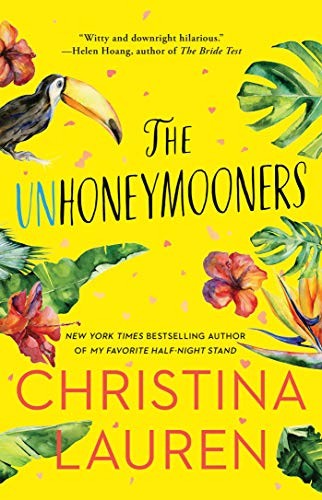
The Unhoneymooners by Christina Lauren is a 2019 romance book about bad luck and superstition, enemies to lovers, family rivalry. The bad-luck framing is funnier in execution than it sounds in summary — Olive's streak of misfortune is deployed with precision timing rather than as repetitive complaint.
Summary
Olive Torres has always been the unlucky twin. Her sister Ami wins everything — contests, prizes, goodwill — while Olive can't catch a break. So when Ami's wedding is attended by every single guest except Olive and one other person, both immune to the food poisoning that has felled the rest, Olive ends up on the Maui honeymoon with Ethan Thomas, her sister's new brother-in-law and the one person she can't stand. They'll have to pretend to be the happy couple to avoid losing the nonrefundable trip.
At its core, The Unhoneymooners is about what happens when you're forced out of your rut by circumstances entirely outside your control. Olive has built a self-narrative around being the unlucky one, which has become a convenient excuse to not try too hard for things. Ethan, for reasons that unfold slowly, has his own reasons for keeping people at arm's length. Maui functions less as a backdrop and more as a pressure chamber — warm, beautiful, inescapable — where the pretense of being a couple requires them to actually pay attention to each other.
Christina Lauren is a writing duo (Christina Hobbs and Lauren Billings) with a long track record of breezy, fast-moving romantic comedies, and The Unhoneymooners shows their strengths at their most polished. The dialogue is quick, the secondary characters are sharp and funny, and the pacing keeps things moving without sacrificing emotional stakes. The book is genuinely funny in ways that hold up — not just setup-punchline funny, but character-funny, which is harder to pull off.
This is comfort reading of a high order. It doesn't ask difficult questions, doesn't leave you with unresolved feelings, and the ending is exactly what you want it to be. Readers looking for literary ambition or moral complexity will be disappointed; readers looking for a well-executed romantic comedy with warm characters and a Maui setting should be fully satisfied. It's the kind of book people finish in a day and immediately recommend to a friend.
Talk to The Unhoneymooners like its author wrote you back.
Get the ideas that fit your life — not generic summaries.
- Chat with the book
- Audiobook-style main ideas
- Adapts to your life and goals
- Helps you take action
Key takeaways
- 1.
The bad-luck framing is funnier in execution than it sounds in summary — Olive's streak of misfortune is deployed with precision timing rather than as repetitive complaint.
- 2.
The fake-relationship setup works especially well here because both characters know they actively dislike each other, which makes the softening more surprising.
- 3.
Olive's self-story about being the unlucky twin is a believable psychological defense mechanism that the novel treats with more care than the premise requires.
- 4.
Christina Lauren's signature voice is fast-paced and witty without sacrificing emotional truth — the comedy and the feeling coexist rather than undermining each other.
- 5.
The family dynamics, particularly the twin relationship, give the romance stakes beyond just whether the couple gets together.
- 6.
Ethan is a less typical romantic hero in the genre — he starts as apparently contemptuous rather than just aloof, which makes his turn more meaningful.
- 7.
The Maui setting earns its place: the isolation, the beauty, and the enforced proximity all do structural work the plot needs.
- 8.
The book is an efficient emotional delivery system. It knows what it is and doesn't try to be anything else, which is harder to pull off than it looks.
Discussion questions
Use these on your own, with a book club, or as chat starters in Superbook. Book club version, ready to copy or print →
- 1.
Olive has spent years framing herself as the unlucky twin. How much of that self-narrative is genuine belief versus a protective story that keeps her from wanting too much?
- 2.
Ethan and Olive's initial antagonism is based on a misunderstanding that takes a long time to surface. Does the novel earn the delay, or does it feel like withheld information for plot purposes?
- 3.
The twin relationship between Olive and Ami is warm but also loaded with comparison. How does the book handle sibling rivalry without making either sister a villain?
- 4.
Maui is doing a lot of work in this novel. Would the same story work set somewhere less naturally romantic and isolated?
- 5.
Christina Lauren writes romantic comedy rather than straight romance. Where do you feel the comedy overtaking the emotional substance, if at all?
- 6.
The fake-couple premise requires both Olive and Ethan to behave in ways that feel dishonest to the people around them. Does the novel take that dishonesty seriously?
- 7.
Ethan's reason for initially seeming hostile to Olive is eventually revealed. Does knowing it change how you read their early scenes in retrospect?
- 8.
Compared to The Spanish Love Deception or Pride and Prejudice, where does the enemies-to-lovers tension here hit hardest and where does it feel lighter?
- 9.
The ending is unambiguously happy. Does the novel earn that happiness through genuine character change, or does it feel more like a genre obligation?
- 10.
Who in your life is the Olive and who is the Ami? Does the lucky/unlucky framing feel true to any sibling dynamic you know?
- 11.
If you were designing the ideal reader for this book, who is it? And who would it be wasted on?
Themes
Frequently asked questions
-
Is The Unhoneymooners worth reading?
Yes, if you want a fast, funny romantic comedy that delivers exactly what it promises. It's one of the better-executed fake-relationship stories in recent contemporary romance. Don't come for literary ambition; come for a well-crafted comfort read.
-
How long does it take to read?
Most readers finish in four to six hours. The chapters are short, the pacing is fast, and it's the kind of book where you read one more chapter at midnight and suddenly it's 2 a.m.
-
What is it about without spoilers?
The unlucky twin ends up on her sister's honeymoon in Maui with the one person she can't stand, and they have to pretend to be a couple to keep the free trip. Enemies-to-lovers ensues.
-
Who shouldn't read this book?
Anyone looking for serious literary fiction, moral complexity, or a slow emotional burn. This is a sunny, fast-moving rom-com. If that sounds like it's not enough, it isn't the book for you.
-
Is there a movie adaptation?
Not as of mid-2026, though the book has been discussed as adaptation material. The authors have had several of their titles optioned for screen.