Science · Book club
How Buildings Learn book club questions
Here are 12 book club questions for How Buildings Learn by Stewart Brand, ordered to open easily and end somewhere worth arguing about. Copy them, print them, or bring them up one at a time.
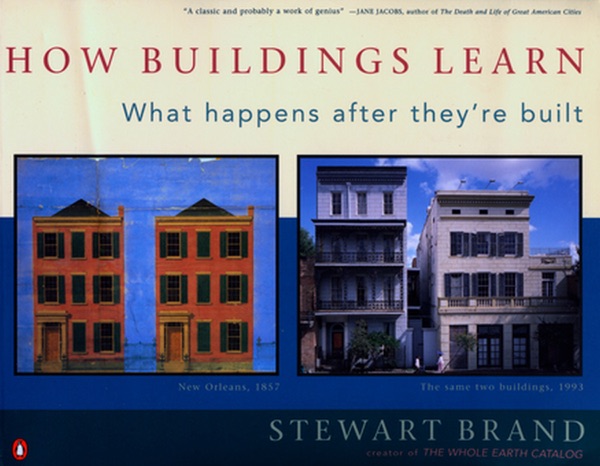
How Buildings Learn is Stewart Brand's argument that buildings are not finished products but ongoing processes — and that the buildings most valued over time are those designed to change gracefully rather than resist change defensively.
Stewart Brand · 1994 · 6h 15m
Full summary and key takeaways →The 12 questions
- 1.
Brand argues that the most admired buildings often age worst. Does that match your experience of buildings you've lived or worked in?
- 2.
The Shearing Layers concept applies beyond buildings — to organizations, software, even relationships. What else in your life has layers changing at different rates?
- 3.
Have you ever inhabited a building that felt impossible to make your own? What made it feel that way?
- 4.
MIT's Building 20 thrived because it was considered dispensable. Where in your work or life do the low-status, unprotected things outperform the prestigious ones?
- 5.
Brand is critical of architecture as a profession for treating users as passive. What other professions have the same problem — designing for the moment of delivery rather than for ongoing use?
- 6.
The book was published in 1994. How has commercial real estate, open-plan offices, and smart-building technology changed the arguments Brand makes?
- 7.
He argues that old buildings are often more sustainable than new ones because the energy cost of demolition and construction is enormous. How does this change how you think about renovation versus replacement?
- 8.
What's the most heavily modified building you know — home, school, office — and what does the accumulation of changes tell you about the people who used it?
- 9.
Brand is sympathetic to vernacular architecture and skeptical of architectural celebrity. Is that fair? Are there celebrated architects who do design for longevity?
- 10.
If you were renovating a home or office, how would you apply the Shearing Layers concept? Which layers would you invest in making more adaptable?
- 11.
The book argues that users are always the real designers. Does that make the initial architect's role less important, or just differently important?
- 12.
Brand ends with an argument for humility in design. Where in your own work do you impose a finished solution where openness to ongoing modification would serve better?
How to run the discussion
- Pick six to eight, not all of them. An hour of real discussion covers fewer questions than anyone expects, and racing the list is what makes a book club feel like homework.
- Open with what people noticed, not what they concluded. Asking for a verdict first hardens opinions before anyone has heard each other.
- Let the disagreement run. The questions below that split a room are the ones worth the time; the ones everyone answers the same way can be skipped.
- Ask the quiet person a specific question. A direct, narrow question is far easier to answer than an open invitation to contribute.
Themes worth steering toward
If the conversation stalls, these are the threads that usually restart it.
Common questions
What are good book club questions for How Buildings Learn?
Here are 12 book club questions for How Buildings Learn by Stewart Brand, ordered to open easily and end somewhere worth arguing about. The strongest openers ask what each reader noticed rather than what they concluded, and the discussion usually turns on architecture, adaptation, systems thinking.
How long should a book club discussion of How Buildings Learn last?
Most groups run 60 to 90 minutes of actual discussion. That is roughly six to eight questions, not all of them, so pick the ones that suit your group rather than working down the list in order.
What are the main themes in How Buildings Learn?
Architecture, Adaptation, Systems thinking, Time and change, Design. Those are the threads most likely to divide a room, which makes them the useful places to steer a discussion that has gone quiet.
Picking the next one? See books like How Buildings Learn or questions for other book club picks.
