Science · Book club
How Not to Be Wrong: The Power of Mathematical Thinking book club questions
Here are 12 book club questions for How Not to Be Wrong: The Power of Mathematical Thinking by Jordan Ellenberg, ordered to open easily and end somewhere worth arguing about. Copy them, print them, or bring them up one at a time.
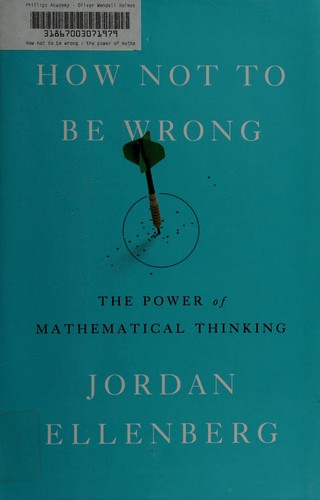
Jordan Ellenberg is a research mathematician who writes as if mathematics is something you would want to think about over dinner.
Jordan Ellenberg · 2014 · 8h 0m
Full summary and key takeaways →The 12 questions
- 1.
Ellenberg argues that mathematical thinking is a practical tool, not an academic specialty. Where in your own decisions do you notice you're reasoning in a linear or proportional way when the real relationship isn't linear?
- 2.
The survivor bias chapter is about planes, but the principle applies to financial advice, medical treatments, and career decisions. Where in your own field do you primarily see the successes?
- 3.
Regression to the mean produces false impressions that coaching, praise, or criticism caused a change. Where in your experience have you credited an intervention that was probably just regression?
- 4.
Ellenberg shows that expected value and utility don't always align — sometimes a lower expected-value choice is rational because of how the downside feels. Where do you find yourself making that tradeoff deliberately?
- 5.
Arrow's impossibility theorem says every voting system has a flaw. Does that argument change how you think about political systems or committee decisions?
- 6.
The book's treatment of p-values suggests that published science is systematically less reliable than it appears. How much has that changed how you read science journalism?
- 7.
Ellenberg distinguishes between null hypothesis significance testing and actually estimating the size of an effect. Where in your professional life are you measuring significance when you should be measuring magnitude?
- 8.
What's a belief you hold where you think you're reasoning mathematically but might actually be doing something more like motivated pattern-matching?
- 9.
Ellenberg writes about the lotteries where careful mathematical analysis revealed a profitable edge. What does it say that these systems persisted for years before being exploited?
- 10.
The book implies that most errors in public debate come from applying correct reasoning past its range of validity. Can you think of a current example where that's happening?
- 11.
If mathematical thinking is learnable, why isn't it better taught? What would change about how you were educated if this book's perspective were taken seriously?
- 12.
Ellenberg says mathematics is the science of not being wrong. What would it mean to apply that standard to a decision you're currently facing?
How to run the discussion
- Pick six to eight, not all of them. An hour of real discussion covers fewer questions than anyone expects, and racing the list is what makes a book club feel like homework.
- Open with what people noticed, not what they concluded. Asking for a verdict first hardens opinions before anyone has heard each other.
- Let the disagreement run. The questions below that split a room are the ones worth the time; the ones everyone answers the same way can be skipped.
- Ask the quiet person a specific question. A direct, narrow question is far easier to answer than an open invitation to contribute.
Themes worth steering toward
If the conversation stalls, these are the threads that usually restart it.
Common questions
What are good book club questions for How Not to Be Wrong: The Power of Mathematical Thinking?
Here are 12 book club questions for How Not to Be Wrong: The Power of Mathematical Thinking by Jordan Ellenberg, ordered to open easily and end somewhere worth arguing about. The strongest openers ask what each reader noticed rather than what they concluded, and the discussion usually turns on mathematics, logic, probability.
How long should a book club discussion of How Not to Be Wrong: The Power of Mathematical Thinking last?
Most groups run 60 to 90 minutes of actual discussion. That is roughly six to eight questions, not all of them, so pick the ones that suit your group rather than working down the list in order.
What are the main themes in How Not to Be Wrong: The Power of Mathematical Thinking?
Mathematics, Logic, Probability, Critical thinking, Reasoning. Those are the threads most likely to divide a room, which makes them the useful places to steer a discussion that has gone quiet.
Picking the next one? See books like How Not to Be Wrong: The Power of Mathematical Thinking or questions for other book club picks.
