Science · Book club
How the Mind Works book club questions
Here are 12 book club questions for How the Mind Works by Steven Pinker, ordered to open easily and end somewhere worth arguing about. Copy them, print them, or bring them up one at a time.
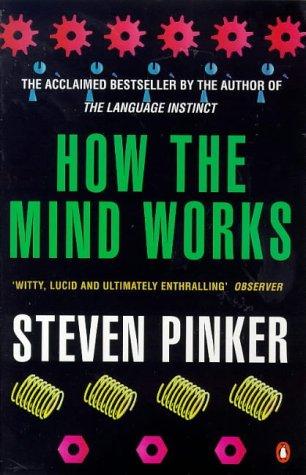
How the Mind Works is Steven Pinker's synthesis of cognitive science and evolutionary psychology, built around a central thesis: the mind is a computational system — a neural computer — shaped by natural selection to solve the adaptive problems that faced our ancestors on the Pleistocene savanna.
Steven Pinker · 1997 · 13h 15m
Full summary and key takeaways →The 12 questions
- 1.
Pinker's central claim is that the mind is a computational system shaped by natural selection. Does that framing change how you think about your own mental life?
- 2.
The visual illusion examples show that perception is active inference rather than recording. Had you thought about perception that way before? Does it change anything practically?
- 3.
He argues that many aspects of social behavior are evolutionary adaptations: status seeking, jealousy, coalition formation. Does that evolutionary explanation reduce or enrich your understanding of those behaviors?
- 4.
The Wason selection task shows people are much better at detecting cheating than at solving logically identical abstract problems. What does that suggest about the nature of human rationality?
- 5.
Evolutionary psychology is controversial because it infers ancient adaptive function from current behavior. What are the strongest objections to that methodology?
- 6.
Pinker devotes a chapter to the hard problem of consciousness and admits it is unsolved. Does that admission strengthen or weaken the book's overall case?
- 7.
How do you feel about the idea that emotions are adaptations — computational programs for managing recurrent adaptive challenges? Does that framing honor or diminish the importance of emotional experience?
- 8.
The book is very long and covers an enormous range of topics. Did the breadth feel like a strength or a limitation?
- 9.
Pinker argues that the mind has specialized modules for different domains rather than a single general intelligence. Is there evidence from your own experience for that modularity?
- 10.
He discusses gender differences in cognition and social behavior from an evolutionary perspective. How do you evaluate those claims given how contested they are?
- 11.
If the mind is a neural computer, what does that imply about the possibility of artificial intelligence that genuinely thinks rather than just computes?
- 12.
Which specific claim in the book do you find most contentious, and what evidence would change your mind?
How to run the discussion
- Pick six to eight, not all of them. An hour of real discussion covers fewer questions than anyone expects, and racing the list is what makes a book club feel like homework.
- Open with what people noticed, not what they concluded. Asking for a verdict first hardens opinions before anyone has heard each other.
- Let the disagreement run. The questions below that split a room are the ones worth the time; the ones everyone answers the same way can be skipped.
- Ask the quiet person a specific question. A direct, narrow question is far easier to answer than an open invitation to contribute.
Themes worth steering toward
If the conversation stalls, these are the threads that usually restart it.
Common questions
What are good book club questions for How the Mind Works?
Here are 12 book club questions for How the Mind Works by Steven Pinker, ordered to open easily and end somewhere worth arguing about. The strongest openers ask what each reader noticed rather than what they concluded, and the discussion usually turns on cognition, evolutionary psychology, perception.
How long should a book club discussion of How the Mind Works last?
Most groups run 60 to 90 minutes of actual discussion. That is roughly six to eight questions, not all of them, so pick the ones that suit your group rather than working down the list in order.
What are the main themes in How the Mind Works?
Cognition, Evolutionary psychology, Perception, Emotion, Consciousness. Those are the threads most likely to divide a room, which makes them the useful places to steer a discussion that has gone quiet.
Picking the next one? See books like How the Mind Works or questions for other book club picks.
