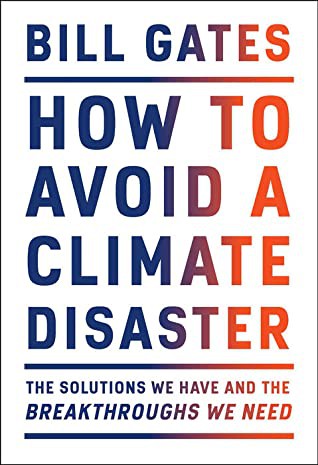
How to Avoid a Climate Disaster by Bill Gates is a 2021 science book about climate change, technology and innovation, energy systems. The number to understand is 51 billion: tons of greenhouse gases emitted globally each year. Getting to zero means eliminating essentially all of them, not just cutting them by half.
Summary
How to Avoid a Climate Disaster is Bill Gates's attempt to explain the scale of the climate problem and outline what it would actually take to reach zero greenhouse gas emissions by 2050. Gates writes as a technologist and investor who spent a decade educating himself on energy systems, and the book reflects both the strengths and the limitations of that vantage point. It is more precise about engineering constraints than most popular climate books, and more honest about which solutions are ready and which are not.
The book's organizing framework is the 51 billion tons of greenhouse gases emitted globally each year. Gates walks through each major sector — electricity generation, manufacturing, agriculture, transportation, buildings, and land use — explaining where the emissions come from and what a zero-carbon alternative would require. His "Green Premium" concept, the cost difference between a fossil fuel solution and its clean equivalent, is the most useful analytical tool in the book. It focuses attention on where the technology gap is small (electricity, some vehicles) and where it remains enormous (steel, cement, aviation, fertilizer).
Gates is consistently more bullish on technological solutions than on behavioral change, and this is a genuine bias in the book worth noting. He gives relatively little attention to demand reduction, consumption changes, or the political economy of fossil fuel interests. His prescription centers on government funding for clean energy research, carbon pricing to close the Green Premium, and international coordination on standards and deployment. Whether that framing is realistic or naive depends on what you think about the relationship between technology and political will.
The book is clearest and most valuable in its middle sections, where Gates explains why certain widely promoted solutions — rooftop solar, current battery storage, direct air capture — are necessary but not sufficient, and why the hardest sectors to decarbonize (cement, steel, long-haul shipping) receive far less public attention than they deserve. It is a useful corrective to both naive optimism and defeatist pessimism, insisting that the problem is solvable but only with sustained effort across every sector.
Talk to How to Avoid a Climate Disaster like its author wrote you back.
Get the ideas that fit your life — not generic summaries.
- Chat with the book
- Audiobook-style main ideas
- Adapts to your life and goals
- Helps you take action
Key takeaways
- 1.
The number to understand is 51 billion: tons of greenhouse gases emitted globally each year. Getting to zero means eliminating essentially all of them, not just cutting them by half.
- 2.
The Green Premium — the cost difference between a clean alternative and its fossil fuel equivalent — is the key metric for tracking progress and targeting investment. Where it's low or negative, deployment can proceed now.
- 3.
Electricity is the easiest sector to decarbonize; steel, cement, aviation fuel, and agricultural emissions are the hardest and receive far less attention than they deserve.
- 4.
Current battery technology cannot store enough energy to back up an electricity grid through winter or extended low-wind periods. Long-duration storage remains an unsolved problem.
- 5.
Nuclear power, including next-generation designs, is part of Gates's preferred solution set. The political difficulty of nuclear is real but separate from its engineering viability.
- 6.
Adaptation — preparing for the climate change already locked in — is as important as mitigation and has been chronically underfunded, particularly in poor countries most exposed to harm.
- 7.
Government policy, specifically carbon pricing and R&D funding for breakthrough technologies, matters more than individual consumer choices for driving the scale of change required.
- 8.
The timeline is tight. The infrastructure built in the next decade will shape emissions for thirty or forty years. Decisions made in the 2020s are disproportionately important.
Discussion questions
Use these on your own, with a book club, or as chat starters in Superbook. Book club version, ready to copy or print →
- 1.
Gates argues the problem is solvable with technology and policy, not behavior change. Do you find that framing reassuring or evasive?
- 2.
Which sector's decarbonization challenge did you find most surprising — electricity, agriculture, manufacturing, or something else?
- 3.
The Green Premium concept focuses attention on cost gaps. What are the limits of using cost as the primary metric for evaluating clean energy transitions?
- 4.
Gates is relatively positive about nuclear energy. Has reading the book changed your view of nuclear's role, or do you remain skeptical? Why?
- 5.
The book emphasizes rich-country responsibility for technology development while acknowledging that emissions growth is primarily driven by middle-income countries. How do you think about that distributional question?
- 6.
What is the relationship between individual consumer choices and systemic change? Does Gates get the balance right?
- 7.
Gates is himself a major investor in several technologies he recommends in the book. Does that conflict of interest affect how you read his recommendations?
- 8.
Adaptation versus mitigation: the book discusses both, but most public attention goes to mitigation. Should we be putting more resources into helping vulnerable populations adapt to what's already coming?
- 9.
What did you know about carbon emissions from cement and steel before reading this? Does it change how you think about infrastructure spending?
- 10.
Gates says government R&D funding is essential for breakthrough technologies. What does the history of the internet, GPS, or mRNA vaccines tell us about that claim?
- 11.
If you could redirect one category of investment based on this book — away from an overhyped solution and toward an underfunded one — what would it be?
- 12.
Is the book optimistic or pessimistic? What evidence in your daily life supports or contradicts Gates's overall frame?
Themes
Frequently asked questions
-
Is How to Avoid a Climate Disaster worth reading?
Yes, particularly for the sector-by-sector breakdown of where emissions actually come from and why some solutions are harder than others. It is less useful on politics and justice, and Gates's optimism about technology-led solutions may not be shared by everyone. But the analytical framework is genuinely useful.
-
What is the Green Premium?
The additional cost of choosing a zero-carbon alternative over a fossil-fuel equivalent. If clean steel costs 20% more than conventional steel, the Green Premium is 20%. Gates uses this metric to identify where clean alternatives are already competitive and where significant technology investment is still needed.
-
Is Bill Gates a credible author on climate change?
He has invested substantially in learning the subject and in funding clean energy research. His engineering-and-investment perspective is genuinely valuable. His perspective on political economy, behavior change, and climate justice is thinner, and those gaps are real limitations of the book.
-
How does this book compare to other climate books?
More technically specific than most, and more focused on industrial emissions that don't get covered in consumer-facing climate narratives. Less politically radical than books like Klein's This Changes Everything. Good for readers who want an engineer's view of the problem.
-
What does Gates think about individual action?
He acknowledges it matters at the margins but argues systemic change — policy, technology, and infrastructure — dwarfs what consumer choices can accomplish. He is critical of the idea that individual behavior change can substitute for policy reform.
Similar books
A Brief History of Time
Stephen Hawking
The Sixth Extinction: An Unnatural History
Elizabeth Kolbert
Sapiens: A Brief History of Humankind
Yuval Noah Harari
Zero to One: Notes on Startups, or How to Build the Future
Peter Thiel
