Science · Book club
How to Create a Mind book club questions
Here are 12 book club questions for How to Create a Mind by Ray Kurzweil, ordered to open easily and end somewhere worth arguing about. Copy them, print them, or bring them up one at a time.
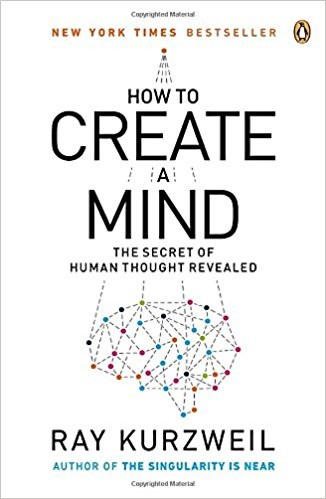
Ray Kurzweil's central claim in How to Create a Mind is that the neocortex — the part of the brain responsible for higher thought — operates on a single repeating algorithm called the pattern recognition theory of mind.
Ray Kurzweil · 2012 · 7h 15m
Full summary and key takeaways →The 12 questions
- 1.
Kurzweil argues that the neocortex uses a single repeating algorithm. Does the elegance of that claim make you more or less suspicious of it as a complete account of human thought?
- 2.
The book was published in 2012, before the current deep learning revolution. Which of Kurzweil's predictions have since materialized, and which still seem far off?
- 3.
If the human mind is fundamentally a pattern-recognition hierarchy, what follows for questions of free will, creativity, and moral responsibility?
- 4.
Kurzweil treats the Turing Test as the relevant threshold for intelligence. Do you think behavioral indistinguishability is sufficient for attributing consciousness, or is there something more required?
- 5.
The book distinguishes between emulating the brain and understanding it. Does Kurzweil's account feel more like an explanation of the mind or an engineering specification for copying it?
- 6.
Deep learning systems trained on vast datasets now do many of the things Kurzweil predicted. Does their success confirm the book's thesis, or does the way they work differ enough from his model that the confirmation is superficial?
- 7.
Kurzweil is confident that consciousness arises from information processing of sufficient complexity. What do you think is missing from that account, if anything?
- 8.
The book's neuroscience has been criticized by working neuroscientists as oversimplified. How do you weigh an accessible, unified theory against a more accurate but messier picture?
- 9.
If a machine could pass for human in every conversation you had with it, would your behavior toward it change? Should it?
- 10.
Kurzweil's career combines invention, futurism, and business. Does knowing his background affect how you evaluate his scientific claims?
- 11.
The singularity thesis depends on exponential growth continuing indefinitely. What reasons are there to think it might plateau, and what would that imply for Kurzweil's timeline?
- 12.
Reading this in 2026 with the benefit of a decade of AI progress, what is the single most important thing the book got right and the single most important thing it missed?
How to run the discussion
- Pick six to eight, not all of them. An hour of real discussion covers fewer questions than anyone expects, and racing the list is what makes a book club feel like homework.
- Open with what people noticed, not what they concluded. Asking for a verdict first hardens opinions before anyone has heard each other.
- Let the disagreement run. The questions below that split a room are the ones worth the time; the ones everyone answers the same way can be skipped.
- Ask the quiet person a specific question. A direct, narrow question is far easier to answer than an open invitation to contribute.
Themes worth steering toward
If the conversation stalls, these are the threads that usually restart it.
Common questions
What are good book club questions for How to Create a Mind?
Here are 12 book club questions for How to Create a Mind by Ray Kurzweil, ordered to open easily and end somewhere worth arguing about. The strongest openers ask what each reader noticed rather than what they concluded, and the discussion usually turns on artificial intelligence, neuroscience, pattern recognition.
How long should a book club discussion of How to Create a Mind last?
Most groups run 60 to 90 minutes of actual discussion. That is roughly six to eight questions, not all of them, so pick the ones that suit your group rather than working down the list in order.
What are the main themes in How to Create a Mind?
Artificial intelligence, Neuroscience, Pattern recognition, Consciousness, Technological singularity. Those are the threads most likely to divide a room, which makes them the useful places to steer a discussion that has gone quiet.
Picking the next one? See books like How to Create a Mind or questions for other book club picks.
