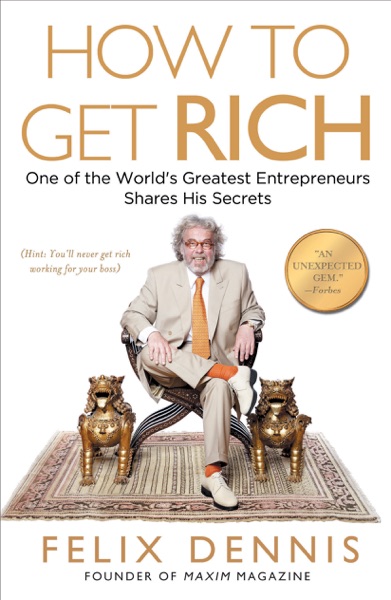
How to Get Rich by Felix Dennis is a 2006 business book about entrepreneurship, wealth creation, risk-taking. Ownership of equity is the only real path to significant wealth. Salary, however high, keeps you comfortable but not free.
Summary
Felix Dennis was a British publishing magnate who built a multi-hundred-million-pound empire from nothing, and How to Get Rich is his attempt to tell the whole truth about how that actually happened. Not the sanitized version. Dennis is explicit that the book is about getting rich in the specific sense of owning equity in things that generate money, not about being happy, not about work-life balance, and not about finding your passion. Those are different books. This one is about accumulation, and Dennis treats it with the bluntness of someone who has no more mountains to climb.
The core argument is that ownership is everything. Dennis spent years building magazines and other media properties for other people before he understood that salary, however large, makes you comfortable but not rich. The only path to serious wealth is owning a significant stake in something that can scale without requiring proportionally more of your time. He distinguishes sharply between those who will never be rich because they are too cautious, those who might be rich if they stop working for others, and those who have the particular combination of hunger, resilience, and willingness to be disliked that actually produces major fortunes.
Dennis is refreshingly honest about the costs. He is not selling the dream. He writes openly about the damage wealth accumulation did to his personal life, the friends he failed, the years he lost to cocaine and distraction, and the question of whether any of it was worth it. This ambivalence is what separates the book from the usual genre of self-congratulatory business memoir. He tells you exactly how to get rich and then pauses to ask whether you actually want what you think you want.
The practical sections are unusually concrete. Dennis covers how to negotiate equity stakes, when to take on partners, how to think about hiring and delegation, and what the psychological profile of a serious wealth-builder actually looks like. His style is sardonic and occasionally poetic — he was also a poet — which makes the book oddly enjoyable to read for something that is essentially a manual for single-minded accumulation.
Talk to How to Get Rich like its author wrote you back.
Get the ideas that fit your life — not generic summaries.
- Chat with the book
- Audiobook-style main ideas
- Adapts to your life and goals
- Helps you take action
Key takeaways
- 1.
Ownership of equity is the only real path to significant wealth. Salary, however high, keeps you comfortable but not free.
- 2.
The will to get rich requires being comfortable being disliked. Popularity and great wealth rarely coexist for long.
- 3.
Start before you are ready. Almost every major fortune began with incomplete information, inadequate resources, and someone who moved anyway.
- 4.
Choosing the right niche matters more than picking the right industry. Dominate a small space first before expanding.
- 5.
Delegation is not optional. If you cannot let go of control, the business can never grow beyond what one person can manage.
- 6.
Fear of failure is the single biggest barrier to wealth. Dennis calls it the monster under the bed — visible only in the dark.
- 7.
Partners are usually a mistake early on. Take debt over equity dilution unless the partner brings something irreplaceable.
- 8.
Getting rich is different from staying rich. Many people acquire wealth and then lose it because the skills that build fortunes are not the same as those that preserve them.
Discussion questions
Use these on your own, with a book club, or as chat starters in Superbook. Book club version, ready to copy or print →
- 1.
Dennis says the will to be rich is the single most important variable. Do you actually have that kind of hunger, or do you have a milder preference that you've been telling yourself is hunger?
- 2.
He argues that salary earners, however well-paid, are fundamentally in a different category from owners. Does the distinction feel true in your own experience of work?
- 3.
Dennis is explicit that getting rich cost him relationships and years of his life. Is there a version of his path you'd find acceptable? Where is your actual line?
- 4.
He recommends starting in a niche small enough to dominate. What niche in your own field is currently under-served or owned by people who aren't very good at it?
- 5.
His chapter on fear calls it the primary reason talented people don't become wealthy. What fear, specifically, is blocking the thing you say you want to do?
- 6.
Dennis argues that most partnerships are value-destroying because people take partners for psychological comfort rather than genuine capability. Have you ever seen that dynamic play out?
- 7.
He says wealth is amoral — that money doesn't care about your reasons for wanting it. Do you agree, and does it change anything about how you think about building it?
- 8.
The book is written by someone who regrets some of what he traded for money. What would you need to see before deciding the trade was worth it?
- 9.
Dennis writes that the biggest mistake is waiting until you can afford to quit your day job. What is the smallest viable version of a thing you could build without quitting anything?
- 10.
He has a chapter on luck and argues that you can manufacture it by putting yourself in more situations where luck can find you. Where are you not putting yourself often enough?
- 11.
Dennis distinguishes between 'being in business' and 'owning a business.' Which category does your current situation fall into?
- 12.
If you took Dennis's advice seriously for two years, what specifically would you do differently starting Monday?
Themes
Frequently asked questions
-
Is How to Get Rich actually useful or just a memoir?
Both, unevenly. The first half is more memoir and philosophy; the practical advice on equity, hiring, and negotiation is in the second half. The memoir parts are worth reading because Dennis is honest about failure and cost in a way most business books aren't. If you only want tactics, skim the opening.
-
Does Dennis think getting rich is worth it?
He's genuinely ambivalent. He says he'd do it again because the alternative — not knowing — would have been worse. But he's clear that the pursuit damaged friendships, relationships, and his health. He doesn't sell the dream; he describes the transaction and leaves the decision to the reader.
-
What is Dennis's main advice for someone starting from zero?
Own equity, start in a niche small enough to dominate, avoid partners unless unavoidable, and act before you feel ready. The specific vehicle matters less than moving fast and maintaining ownership of what you build.
-
How long does it take to read How to Get Rich?
Around four to five hours. The chapters are short and the prose moves quickly. Dennis writes with the cadence of a raconteur, so it reads faster than the page count suggests.
-
Who shouldn't read this book?
People looking for a feel-good entrepreneurship narrative or a path to wealth that doesn't require sacrifice. Dennis is explicit that his approach demands a particular kind of single-minded hunger. If you're not sure you have it, the book will tell you to find out before going further.
Similar books
Zero to One: Notes on Startups, or How to Build the Future
Peter Thiel
Shoe Dog: A Memoir by the Creator of Nike
Phil Knight
The Hard Thing About Hard Things
Ben Horowitz
The Millionaire Fastlane
MJ DeMarco
