History · Book club
How We Got to Now book club questions
Here are 12 book club questions for How We Got to Now by Steven Johnson, ordered to open easily and end somewhere worth arguing about. Copy them, print them, or bring them up one at a time.
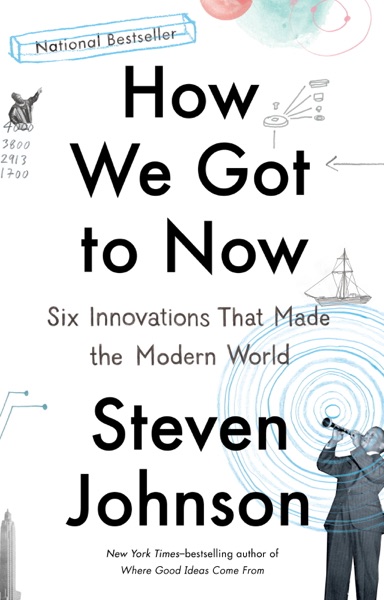
How We Got to Now traces six innovations — glass, cold, sound, clean, time, and light — and follows each one through unexpected chains of consequence into the present.
Steven Johnson · 2014 · 4h 15m
Full summary and key takeaways →The 12 questions
- 1.
Johnson's 'hummingbird effect' suggests we can't predict the most important consequences of any innovation. What current technology do you think will have its biggest impacts in an unrelated domain?
- 2.
The adjacent possible explains why the same inventions emerge in multiple places simultaneously. Does knowing that change how you think about individual genius in history?
- 3.
Which of the six innovation histories — glass, cold, sound, clean, time, light — did you find most surprising, and why?
- 4.
Johnson writes about obscure innovators who changed the world without getting credit. Who in your own field contributes quietly but doesn't get recognized?
- 5.
The clean water chapter argues that sanitation infrastructure saved more lives than medicine. How does that change your sense of what kinds of public investment matter most?
- 6.
Refrigeration ended seasonal, local food cultures. What else have we lost through innovations that seemed purely beneficial when they were introduced?
- 7.
Johnson is optimistic about the pattern of human innovation. Do you share that optimism, and what evidence would challenge it?
- 8.
The book covers only six innovations. Which one do you think he should have included instead, and what hummingbird effects would you trace from it?
- 9.
Johnson mostly credits anonymous networks rather than lone geniuses. Is there an innovation you know well where this account feels wrong — where one person really did matter decisively?
- 10.
The book was also a BBC documentary series. Does knowing that change how you read it — does the popular format limit the argument in any way?
- 11.
The modern standard of time created by railroads is now invisible. What other invisible infrastructure shapes your daily life in ways you rarely acknowledge?
- 12.
Johnson's approach is resolutely positive — there's no chapter on innovations that made things worse. What would a darker version of this book look like?
How to run the discussion
- Pick six to eight, not all of them. An hour of real discussion covers fewer questions than anyone expects, and racing the list is what makes a book club feel like homework.
- Open with what people noticed, not what they concluded. Asking for a verdict first hardens opinions before anyone has heard each other.
- Let the disagreement run. The questions below that split a room are the ones worth the time; the ones everyone answers the same way can be skipped.
- Ask the quiet person a specific question. A direct, narrow question is far easier to answer than an open invitation to contribute.
Themes worth steering toward
If the conversation stalls, these are the threads that usually restart it.
Common questions
What are good book club questions for How We Got to Now?
Here are 12 book club questions for How We Got to Now by Steven Johnson, ordered to open easily and end somewhere worth arguing about. The strongest openers ask what each reader noticed rather than what they concluded, and the discussion usually turns on innovation, interconnectedness, technology history.
How long should a book club discussion of How We Got to Now last?
Most groups run 60 to 90 minutes of actual discussion. That is roughly six to eight questions, not all of them, so pick the ones that suit your group rather than working down the list in order.
What are the main themes in How We Got to Now?
Innovation, Interconnectedness, Technology history, Unintended consequences, Networks. Those are the threads most likely to divide a room, which makes them the useful places to steer a discussion that has gone quiet.
Picking the next one? See books like How We Got to Now or questions for other book club picks.
