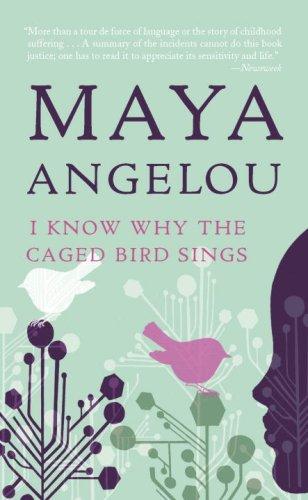
I Know Why the Caged Bird Sings by Maya Angelou is a 1969 memoir book about racism, identity, resilience. Language is survival. Angelou's five years of silence after her rape are broken not by therapy but by literature, and the book argues that access to language is access to selfhood.
Summary
Maya Angelou's first volume of autobiography covers her childhood and adolescence in Stamps, Arkansas and San Francisco during the 1930s and 1940s, ending with the birth of her son at age sixteen. It is one of the defining American memoirs, both for the directness with which it confronts racism, sexual violence, and displacement, and for the richness of its prose — Angelou writes about her childhood with a lyrical attention that transforms painful material into something generous and lasting.
The early sections establish the texture of Black life in the segregated South. Angelou and her brother Bailey are raised largely by their grandmother, whom they call Momma, who owns a general store and maintains a rigid dignity under the daily humiliations of Jim Crow. The children are also sent to live periods with their mother in St. Louis, where, at age eight, Angelou is raped by her mother's boyfriend. After she names her attacker and he is killed, she stops speaking for nearly five years, believing her words have the power to cause death.
The muteness ends when a neighbor, Mrs. Bertha Flowers, introduces Angelou to literature and teaches her that language can be both safe and transformative. This encounter with books — with Dickens, Poe, Shakespeare, and the Black writers her grandmother considered equally dangerous — is central to the book's argument about what reading can do. Angelou's love of language is not incidental to her survival; it is the mechanism of it.
The second half follows the family to California during the Second World War and covers Angelou's adolescence in San Francisco, including a period of homelessness, a summer living in a junkyard commune of runaway teenagers, and her determination to become the city's first Black streetcar conductor. The book ends not with resolution but with beginning: she is sixteen, has just given birth, and is, as she understands it, finally becoming herself.
Talk to I Know Why the Caged Bird Sings like its author wrote you back.
Get the ideas that fit your life — not generic summaries.
- Chat with the book
- Audiobook-style main ideas
- Adapts to your life and goals
- Helps you take action
Key takeaways
- 1.
Language is survival. Angelou's five years of silence after her rape are broken not by therapy but by literature, and the book argues that access to language is access to selfhood.
- 2.
Racism operates through accumulation. The book records not one dramatic injustice but a constant background of small degradations — the white dentist who won't treat Black patients, the graduation speaker who treats Black students as an afterthought — that shape a childhood.
- 3.
Dignity can be maintained under oppression without requiring that the oppression be denied. Momma's survival strategies are neither accommodation nor naivete; they are hard-won wisdom.
- 4.
Trauma has a grammar. Angelou's muteness after the rape is a response to a specific, terrifying belief about causality. Understanding her silence requires understanding her logic, not dismissing it.
- 5.
Community and displacement alternate throughout the book. Angelou is repeatedly uprooted — sent between parents, relocated from South to West — and the memoir is partly about constructing identity when geography cannot be counted on.
- 6.
The coming-of-age narrative includes the negotiation of racial identity as a specific challenge that white narratives of adolescence do not share. Angelou is explicit that becoming herself requires understanding what being Black in America means.
- 7.
Literature provides both a refuge and a model. Angelou reads voraciously, and the books she encounters give her ways of being and speaking that shape who she becomes.
- 8.
The memoir form itself is an act of resistance. By making her childhood intelligible and interesting to a wide audience, Angelou claims the right to be a subject of literary attention rather than a statistical victim.
Discussion questions
Use these on your own, with a book club, or as chat starters in Superbook. Book club version, ready to copy or print →
- 1.
Angelou's silence after the rape is explained by a specific logic she had as a child. How does the adult narrator handle that logic — does she judge the child she was?
- 2.
Mrs. Bertha Flowers gives Angelou books and tells her that written words come alive only when spoken aloud. What does this suggest about the relationship between reading and voice?
- 3.
How does Angelou render the daily texture of segregation? What techniques does she use to make structural racism felt rather than just documented?
- 4.
Momma's pride and self-protective strategies represent one generation's response to racism. How does Angelou's generation differ in its responses?
- 5.
The book was controversial and frequently banned when it was published. What about it do you think provoked that reaction, and does the provocation still feel alive today?
- 6.
Angelou ends the book not at a point of resolution but at a beginning. What does it mean to structure an autobiography as an opening rather than a conclusion?
- 7.
Bailey, Angelou's brother, is a recurring presence. What does the sibling relationship add to the narrative?
- 8.
The book has a noticeably lyrical, literary style. Does the style feel appropriate to the material, or does it sometimes create a tension with the rawness of what is being described?
- 9.
How does Angelou treat the white characters in the book? Are any of them rendered with full humanity, and what does the book do with the ones who are not?
- 10.
The title comes from Paul Laurence Dunbar's poem 'Sympathy.' How does that poem's image of the caged bird applying to Angelou's experience?
- 11.
At sixteen, Angelou is living independently, is pregnant, and has already done more living than most people do in decades. How does the memoir prepare you for that endpoint?
- 12.
This is the first of seven volumes of autobiography Angelou eventually published. Does the book feel complete on its own, or does it compel you toward the next volume?
Themes
Frequently asked questions
-
Is I Know Why the Caged Bird Sings autobiographical?
Yes. It is the first of Angelou's seven autobiographical volumes and covers her childhood and adolescence through age sixteen. The events, characters, and places are drawn from her life, though the prose style is literary rather than reportorial.
-
Why is this book frequently banned?
It has been challenged and removed from school curricula primarily because of its frank depiction of childhood sexual abuse and its frank language around race and sexuality. Some objections focus on what critics consider an anti-white bias. The American Library Association consistently lists it among the most frequently challenged books.
-
What is the book about, in brief?
It is about a Black girl growing up in the segregated American South and later in California during the 1930s and 1940s, navigating racism, sexual trauma, displacement, and adolescence — and eventually finding in language and literature a way to survive and begin to become herself.
-
How long does it take to read?
About five to six hours. The chapters are short and the prose moves quickly despite its lyricism. Many readers read it in a weekend.
-
Where does I Know Why the Caged Bird Sings fit in the American canon?
It is widely considered one of the essential American memoirs and one of the foundational texts of African American literature. It appeared at a specific cultural moment — 1969, at the intersection of the civil rights and feminist movements — and helped legitimate the memoir form as a vehicle for serious literary work.