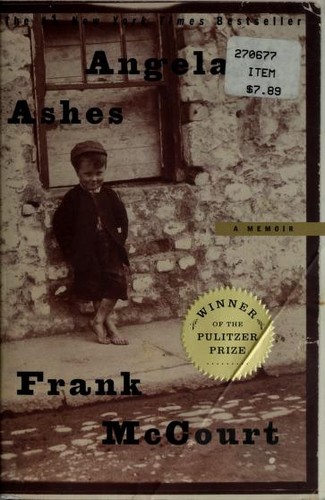
Angela's Ashes by Frank McCourt is a 1996 memoir book about poverty, ireland, resilience. Humor is a survival mechanism, not a denial of suffering. McCourt's comedy operates alongside — not instead of — the gravity of what his family endured.
Summary
Angela's Ashes is Frank McCourt's memoir of a catastrophically impoverished Irish Catholic childhood, first in Brooklyn and then in Limerick, during the 1930s and 1940s. Published when McCourt was sixty-six years old, it won the Pulitzer Prize and became one of the best-selling memoirs of the twentieth century. Its success depended on the apparent paradox at its center: the material is unrelievedly grim — infant deaths, hunger, drunken paternal abandonment, disease — yet the book is often funny, and the narrator's voice maintains a vitality that the circumstances do not explain.
The McCourt family returns to Ireland from Brooklyn after the death of the twins, Frank's infant brothers, and the family's arrival in Limerick marks the beginning of what the adult narrator will describe as a wretched childhood. Limerick in the 1930s was a city of grinding unemployment, sectarian rigidity, and class contempt directed at the rural poor. Frank's father Malachy is charismatic, well-read, and chronically unemployable due to alcoholism. He regularly drinks away his dole money, leaving Angela and the children to survive on charity, tea, and bread.
The Church appears throughout as an institution that simultaneously oppresses and sustains. The priests and schoolmasters who enforce doctrine also provide the only education available; the Confraternity and the religious festivals mark the calendar of an otherwise featureless poverty. McCourt renders this contradiction without resolving it — religion is neither refuge nor simple villain, but something his family inhabits without being able to evaluate.
Frank's voice as narrator is the book's central achievement. He tells the story largely from the perspective of himself as a child — limited in understanding, not yet equipped to name what is happening to him — while allowing the adult's retrospective intelligence to color the selection of detail. The result is a kind of double-consciousness: the child suffers, the adult shapes the suffering into art, and the gap between the two is where the book's humor and its pathos both live.
Talk to Angela's Ashes like its author wrote you back.
Get the ideas that fit your life — not generic summaries.
- Chat with the book
- Audiobook-style main ideas
- Adapts to your life and goals
- Helps you take action
Key takeaways
- 1.
Humor is a survival mechanism, not a denial of suffering. McCourt's comedy operates alongside — not instead of — the gravity of what his family endured.
- 2.
Poverty in the memoir is specific and material: it is wet shoes, shared beds, inadequate nutrition, and the particular degradation of charity. Its texture is what makes it real.
- 3.
The memoir form enables a double perspective — the child who experienced and the adult who narrates — and McCourt exploits that gap with precision.
- 4.
Parental failure comes in multiple forms. Malachy's alcoholism is active destruction; Angela's depression is resignation. Both are shaped by forces larger than individual character.
- 5.
The Catholic Church in mid-century Ireland was a totalizing institution that shaped desire, shame, education, and social standing. McCourt portrays this with ambivalence, not polemic.
- 6.
The ambition to escape poverty through language and intelligence is the book's engine. Frank's reading, his clerking job, his saving, are all directed toward the ship back to America.
- 7.
Sibling bonds provide sustenance that adult relationships cannot. The relationships between Frank and his brothers are among the book's most honest.
- 8.
The book is a belated reckoning. McCourt waited decades to write it, and the memoir's authority comes partly from the distance — the ability to shape grief into form.
Discussion questions
Use these on your own, with a book club, or as chat starters in Superbook. Book club version, ready to copy or print →
- 1.
McCourt describes a childhood of profound deprivation with considerable humor. Does the humor seem appropriate, or does it sometimes feel like a way of managing the reader's discomfort?
- 2.
Malachy McCourt is portrayed with complexity — a loving, useless, charming failure. Do you find that complexity earned, or does the memoir let him off too easily?
- 3.
Angela, the mother, is the book's namesake but often seems passive. How does the book explain or excuse her passivity? Do you accept that explanation?
- 4.
The Catholic Church appears as both oppressor and sustainer. How does McCourt balance those two functions without collapsing into simple anti-clericalism?
- 5.
The memoir was written by a man in his sixties about a childhood that ended fifty years earlier. How does that temporal distance shape what gets remembered and what gets omitted?
- 6.
Is there a coherent argument in the book about what causes poverty, or does it simply document poverty? Does the distinction matter?
- 7.
The narrative voice is often that of the child experiencing events he doesn't fully understand. What are the advantages and the risks of that technique?
- 8.
The Pulitzer committee described the book as 'a luminous memoir of a miserable Irish Catholic childhood.' Is 'luminous' the right word for what McCourt achieves with the material?
- 9.
McCourt emigrated to America as a young man and made a successful life there. Does that outcome shape how he tells the story — does knowing the ending change the telling?
- 10.
How does the memoir handle the specific social world of Limerick — the class system, the sectarian tensions, the contempt for the rural poor?
- 11.
The book ends with Frank's arrival back in America. Does it feel like a conclusion or an escape? What has been resolved?
Themes
Frequently asked questions
-
Is Angela's Ashes a true story?
It is presented as memoir and the events are drawn from McCourt's life. Some family members disputed specific details and characterizations after publication, and McCourt acknowledged that memory reconstructs rather than records. The emotional truth is broadly accepted; the documentary accuracy is contested in places.
-
Why did McCourt wait so long to write it?
He has said he needed the distance of decades to transform painful material into something he could shape and control. He also had a long career as a high school teacher that left little time for extended writing. The book emerged from retirement.
-
How long does Angela's Ashes take to read?
About seven to eight hours. At over 350 pages it is substantial, but the voice carries readers quickly through even the most harrowing sections.
-
What won McCourt the Pulitzer?
The Pulitzer board cited the memoir's 'luminous, artful' narrative. The prize recognized both the literary achievement — the voice, the structure, the darkly comic handling of grim material — and the cultural documentation of mid-century Irish poverty.
-
Is the sequel worth reading?
'Tis, which covers McCourt's return to America and early adulthood, is enjoyable but lacks the concentrated power of the first book. Most readers consider Angela's Ashes the essential one.