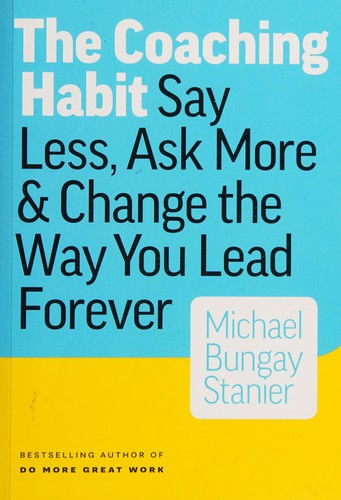
The Coaching Habit by Michael Bungay Stanier is a 2016 business book about coaching, management, communication. The advice trap is the manager's most common failure mode: jumping to solutions before fully understanding the problem, creating dependency rather than capability.
Summary
The Coaching Habit is Michael Bungay Stanier's practical guide to asking better questions — specifically, seven questions that he argues should become habitual for any manager who wants to coach rather than just direct. The book is deliberately short and direct, designed to be read in an afternoon and applied the next morning.
The premise is that most managers over-advise and under-question. They jump to solutions before fully understanding the problem, and in doing so they rob people of the experience of solving problems themselves. The result is a loop Stanier calls the "advice trap": the leader gives advice, the team member implements it, the team member comes back with the next problem, the leader gives more advice, and slowly the leader becomes the solution engine for everything and the team becomes dependent.
The seven questions — including "What's on your mind?", "And what else?", "What's the real challenge here for you?", "What do you want?", and the "Lazy Question" ("How can I help?") — are tools for breaking this loop. Each question is designed to do a specific thing: slow down the rush to advice, surface the real issue beneath the presenting issue, shift ownership back to the person being coached, and resist the impulse to rescue.
The question that gets the most attention is "And what else?" — the AWE question. Asking it once after any answer often surfaces information the first answer left out. Asking it twice or three times — without discomfort — often gets to the real issue that wasn't going to come out otherwise. It's genuinely useful and genuinely countercultural in organizations that reward quick decisive answers.
Talk to The Coaching Habit like its author wrote you back.
Get the ideas that fit your life — not generic summaries.
- Chat with the book
- Audiobook-style main ideas
- Adapts to your life and goals
- Helps you take action
Key takeaways
- 1.
The advice trap is the manager's most common failure mode: jumping to solutions before fully understanding the problem, creating dependency rather than capability.
- 2.
Seven questions form the coaching habit: What's on your mind? And what else? What's the real challenge? What do you want? How can I help? If you're saying yes to this, what are you saying no to? What was most useful about this?
- 3.
The 'And what else?' question is the most powerful of the seven. It creates space for the information that wasn't coming out, surfaces the real issue, and resists the impulse to solve before fully hearing.
- 4.
Coaching is not a separate activity that requires a formal session. It's a way of interacting — asking more, telling less — that can fit into any conversation.
- 5.
Most people rush to advice because it feels helpful and because being asked for advice signals expertise. Learning to wait is uncomfortable and countercultural.
- 6.
The 'Lazy Question' — 'How can I help?' — is not lazy. It forces the person to take ownership of naming what they need rather than receiving whatever solution the leader reflexively produces.
- 7.
Ending with 'What was most useful about this?' creates a feedback loop that improves future coaching conversations and signals that the conversation was in service of the other person.
- 8.
The three stages of a good coaching conversation: help the person identify the right thing to work on, connect it to their core motivation, and confirm what they need from you.
Discussion questions
Use these on your own, with a book club, or as chat starters in Superbook. Book club version, ready to copy or print →
- 1.
Stanier describes the advice trap — the pattern of giving advice faster than you should. Where in your work does this pattern show up most reliably?
- 2.
What question do you most rely on when starting a difficult conversation? How does it shape where the conversation goes?
- 3.
Try 'And what else?' three times consecutively in your next significant conversation. What comes out in the third answer that wasn't in the first?
- 4.
Think about someone on your team who regularly brings you problems. Are they bringing you problems they could solve themselves? What would change if you asked 'What do you want?' before offering anything?
- 5.
Stanier says coaching is not a formal activity but a way of interacting. What percentage of your conversations with direct reports involve you asking questions versus giving answers?
- 6.
The 'Lazy Question' — 'How can I help?' — requires the other person to specify their need. Why is that uncomfortable for both parties, and what does that discomfort reveal?
- 7.
What conversation have you been avoiding because you didn't know how to start it? Could one of the seven questions open it?
- 8.
Stanier's approach requires resisting the impulse to give advice. For you personally, what does that impulse feel like and what triggers it?
- 9.
How do you currently end your coaching or 1:1 conversations? What would change if you closed every one with 'What was most useful about this?'
- 10.
The book is deliberately short. Does the brevity help or hurt your confidence that the approach will work in the complexity of real management situations?
- 11.
What's the difference between asking 'What's the real challenge?' and asking 'What's the problem?' What does the word 'real' do?
Themes
Frequently asked questions
-
Is The Coaching Habit worth reading?
Yes. It's short, practical, and immediately applicable. The seven questions are simple enough to remember and use the same day, and the 'And what else?' question alone is worth the read. It's one of the most actionable management books available.
-
How long does it take to read The Coaching Habit?
About two to three hours. It's deliberately brief — around 200 pages in a small format — and designed to be read in one sitting. The point is to apply it immediately rather than absorb a complete framework.
-
Do I need to be formally training as a coach to use this book?
No. The book is explicitly aimed at managers and leaders who want to integrate coaching behavior into everyday conversations, not at professional coaches. The seven questions require no certification and no formal coaching context.
-
What's the most important of the seven questions?
Stanier would say 'And what else?' is the most transformative, because it's both the simplest and the most countercultural. Most managers don't ask it once, let alone twice, because they're already constructing their response while the other person is still talking.
-
Who should read The Coaching Habit?
Managers who want to develop their team's capability rather than just their output, anyone who tends to over-advise and then wonders why people keep coming back to them with the same problems, and leaders at any level who want to be more useful in conversations without more training.