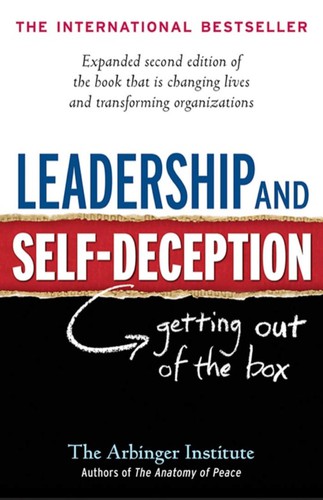
Leadership and Self-Deception by The Arbinger Institute is a 2000 business book about self-awareness, leadership, organizational culture. Being 'in the box' means seeing other people as objects — as obstacles, vehicles, or irrelevancies — rather than as people with their own needs and perspectives.
Summary
Leadership and Self-Deception is The Arbinger Institute's business fable about a leadership problem that most leaders don't recognize in themselves: the tendency to see other people as objects rather than as people. Written in narrative form, it follows a new executive named Tom Callum through a series of conversations that reveal how his attempts to solve problems at work are actually making them worse — because the way he's seeing his colleagues is itself the problem.
The book's central concept is "being in the box." When you're in the box, you've betrayed your own sense of what another person needs — perhaps you ignored a colleague's obvious stress, or failed to help when you knew you should — and you've then rationalized that betrayal by making the other person the problem. From inside the box, everything confirms your justification: their flaws become evidence for why they don't deserve your help; their virtues become threats to your self-image.
The critical insight is that when you're in the box, everything you do to try to solve problems makes them worse. You lecture about teamwork while refusing to genuinely collaborate. You demand accountability while protecting yourself from it. You work to change others' behavior without recognizing that your own way of seeing them is the source of the dysfunction. You can't solve a problem you're contributing to while denying you're contributing to it.
Getting out of the box is not primarily a technique. It's a shift in perception — seeing other people as people with their own needs, concerns, and perspectives rather than as obstacles or tools. The book argues that this shift is the precondition for any real leadership or genuine organizational change, and that all the systems and skills in the world don't compensate for being fundamentally in the box about the people you're trying to lead.
Talk to Leadership and Self-Deception like its author wrote you back.
Get the ideas that fit your life — not generic summaries.
- Chat with the book
- Audiobook-style main ideas
- Adapts to your life and goals
- Helps you take action
Key takeaways
- 1.
Being 'in the box' means seeing other people as objects — as obstacles, vehicles, or irrelevancies — rather than as people with their own needs and perspectives.
- 2.
You get in the box by betraying your own sense of what another person needs, and then justifying that betrayal by making the other person the problem.
- 3.
When you're in the box, everything you do to fix problems makes them worse. You can't solve a problem you're contributing to while you're blind to your contribution.
- 4.
The box inflates your own virtues and the other person's flaws. This distortion makes you confident about diagnoses that are wrong and solutions that don't work.
- 5.
Organizational dysfunction is not primarily about wrong systems or bad skills. It's about people being in the box about each other — and the systems and skills failing because of it.
- 6.
You can't get someone else out of the box. You can only get yourself out. And often, getting yourself out changes the dynamic enough that others shift naturally.
- 7.
Being out of the box doesn't mean being nice or avoiding conflict. It means engaging with other people as people rather than as objects, which makes conflict more productive.
- 8.
Leadership is not a role or a set of behaviors. It's a way of being with other people — and being in the box disqualifies you from leading regardless of your title or technique.
Discussion questions
Use these on your own, with a book club, or as chat starters in Superbook. Book club version, ready to copy or print →
- 1.
Think of someone at work you currently find difficult or frustrating. Apply the box concept: have you at any point failed to respond to that person as a person? How might that have started the dynamic?
- 2.
The book says you get in the box by betraying what you know you should do and then justifying it. Can you trace a specific example of this in your own experience?
- 3.
When you're in the box, your virtues inflate and the other person's flaws become vivid. Where in a current work relationship might this distortion be operating?
- 4.
The book argues that you can't get someone else out of the box — only yourself. How does this change how you think about conflicts you're currently in?
- 5.
The narrative format is unusual for a business book. Did it help or hinder your engagement with the ideas? What does the choice of format signal about how the authors think the ideas need to be absorbed?
- 6.
Where in your organization is there a persistent conflict or dysfunction that multiple attempts to fix haven't solved? Could a 'box' analysis explain why the interventions haven't worked?
- 7.
Getting out of the box requires seeing another person as having legitimate needs and perspectives. Is there a person in your professional life whose perspective you've genuinely tried to take recently? What did you learn?
- 8.
The book is primarily about work relationships, but the dynamic it describes applies in personal life too. Do you find the concepts easier or harder to apply at home than at work?
- 9.
Leadership and Self-Deception says the prerequisite for effective leadership is being out of the box. If that's true, what does it imply about leadership development programs that focus on skills rather than self-awareness?
- 10.
How do you know when you're in the box? What does it feel like from the inside, compared to what the book says it should feel like?
- 11.
If your whole team could read this book together and apply it honestly, what would change about how you work?
Themes
Frequently asked questions
-
Is Leadership and Self-Deception worth reading?
Yes, if you're open to the premise that how you see people matters as much as what you do with them. The business fable format makes the ideas more accessible than a straight argument would, and the concept of the box is one of those frameworks that, once you have it, you can't stop noticing.
-
How long does it take to read Leadership and Self-Deception?
Around three to four hours. It's written as a business novel, so it reads faster than most management books of similar length.
-
Is 'the box' a real thing or just a metaphor?
It's a metaphor for a mode of perception that behavioral psychologists and philosophers have described in various ways. The Arbinger Institute draws on work in phenomenology and self-deception research. Whether you accept the philosophical foundation or not, the pattern it describes is recognizable from organizational life.
-
Who should read Leadership and Self-Deception?
Anyone in a leadership or management role who wants to understand why relationships are harder than they should be — and specifically why fixing the other person never seems to fix the relationship. Also useful for team leaders facing persistent dysfunction who have tried systemic fixes without success.
-
What's the main limitation of the book?
The framework explains interpersonal dysfunction well but gives limited guidance for organizational systems design, power dynamics, or genuinely irreconcilable differences. It can also feel like it places too much responsibility on individuals for dynamics that have structural causes. The narrative format, while accessible, means the ideas are not argued with full rigor.