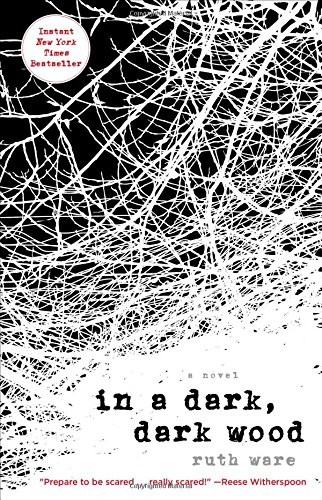
In a Dark, Dark Wood by Ruth Ware is a 2015 thriller book about memory and amnesia, female friendship and rivalry, isolation. The hen party setting does real work: the cultural pressure to perform warmth regardless of actual feeling creates a specific social pressure cooker that the isolated-house premise then seals shut.
Summary
Nora receives an out-of-the-blue invitation to a hen party she has no reason to attend — it's for Clare, a friend she hasn't spoken to in ten years, whose circle Nora no longer belongs to. She accepts anyway, and finds herself in a remote glass-and-steel house in the middle of a Northumberland forest, surrounded by people who know Clare far better than she does, some of whom barely bother to conceal their hostility. Two days in, someone is dead and Nora is in hospital with head injuries and no memory of what happened.
The novel opens with Nora already injured, already knowing something terrible has occurred, and the narrative works backward and forward simultaneously: present-tense hospital scenes intercut with the slowly-remembered events of the weekend. Ware uses the amnesia frame effectively — the reader's knowledge and Nora's recover at roughly the same pace, which prevents the dramatic irony from becoming frustrating. The isolated house, the locked-in group of people with prior relationships and concealed resentments, and the surrounding forest that makes escape feel impossible are all Agatha Christie premises handled with contemporary directness.
This is Ware's debut, and it reads like one in some respects: the character sketches of the supporting cast are thinner than they'd become in later books, and a few of the resentments feel installed rather than earned. But the pace is excellent from the first page, the setting genuinely works, and the hen party premise gives the social dynamics a specific acidic quality — the performative friendship, the unspoken competition, the way women who don't like each other are culturally expected to perform closeness.
For a first novel it's accomplished, and it launched a template that Ware has refined across seven books. It's the most fun of her novels rather than the most sophisticated — a beach read with genuine menace, exactly what the best entries in this subgenre aim to be.
Talk to In a Dark, Dark Wood like its author wrote you back.
Get the ideas that fit your life — not generic summaries.
- Chat with the book
- Audiobook-style main ideas
- Adapts to your life and goals
- Helps you take action
Key takeaways
- 1.
The hen party setting does real work: the cultural pressure to perform warmth regardless of actual feeling creates a specific social pressure cooker that the isolated-house premise then seals shut.
- 2.
Ware's decision to open with Nora already hospitalized and amnesiac creates a double narrative tension: the reader wants to know both what happened and what Nora will remember.
- 3.
The glass house — entirely visible from outside, with nowhere to hide — inverts the usual isolated-house thriller convention and creates a different kind of claustrophobia.
- 4.
The ten-year gap in Nora's friendship with Clare is doing structural work: old resentments, unresolved questions, and the specific vulnerability of someone who no longer fully understands the social dynamics she's re-entering.
- 5.
Ware uses the forest setting to do genuine gothic atmosphere work — the surrounding woodland as something that presses in, that doesn't care, that makes noise at night.
- 6.
The novel demonstrates that familiar social situations — parties, old friendships, group holidays — can be made genuinely threatening by a single change in the conditions.
- 7.
The resolution depends on a confrontation with something Nora chose not to examine about her own past, which gives the thriller plot a modest psychological hook.
Discussion questions
Use these on your own, with a book club, or as chat starters in Superbook. Book club version, ready to copy or print →
- 1.
Nora accepts the invitation despite having no real reason to go. What does the novel suggest about why she does — is it curiosity, loneliness, unfinished business, or something she herself doesn't understand?
- 2.
The glass house is visible from the outside and provides no cover. What does that architectural choice do to the thriller's standard dynamic of hidden threats?
- 3.
Hen parties involve a particular performance of female friendship. How does the novel use that performativity — is it just a setting, or is it making a point about something?
- 4.
The ten-year absence from Clare's life means Nora is a partial stranger at the party. Does that position — insider-outsider — give her a more reliable perspective on events, or a less reliable one?
- 5.
Who did you suspect, and at what point? Did the novel's misdirection feel fair or manipulative?
- 6.
The forest surrounding the house is used atmospherically rather than literally. Does it function as genuine menace, or does the rural-gothic register feel borrowed rather than earned?
- 7.
The novel's portrait of female friendship includes a significant dose of competition, resentment, and performance. Is that portrait fair, too cynical, or not cynical enough?
- 8.
Compared to Ware's later work — particularly The Turn of the Key — this reads as a debut. What feels less developed here, and what was already fully formed in her first novel?
- 9.
The amnesia frame means Nora and the reader recover information at the same pace. How does that device affect your sympathy for her?
- 10.
The hen party ends in a death. Does the novel imply the outcome was preventable, or does it frame it as the result of long-established patterns finally reaching a breaking point?
- 11.
What stays with you after finishing this one? Is it the plot mechanics, the atmosphere, the social dynamics, or something else?
Themes
Frequently asked questions
-
Is In a Dark, Dark Wood a good starting point for Ruth Ware?
Yes and no. It's the most accessible entry point and the fastest read, but it's also her debut and shows it. If you want her at her most polished, start with The Turn of the Key or The It Girl. If you want her most purely entertaining, start here.
-
Is it actually scary?
More unsettling than scary. The forest atmosphere works, and the social dynamics in the house create genuine dread. It's not a horror novel — the threat is human rather than supernatural — but the isolation and the escalating tension are effective.
-
How long does it take to read?
Around five hours. The chapters are short and the pacing is aggressive; many readers finish it in a day or two.
-
Who might not enjoy this?
Readers who need deep characterization or significant psychological complexity. The supporting cast is painted in broad strokes, and the focus is firmly on architecture and pace rather than interiority.
-
Is there a film adaptation?
Film rights were sold, but no feature film had been produced as of publication.