Psychology · Book club
Influence, New and Expanded: The Psychology of Persuasion book club questions
Here are 12 book club questions for Influence, New and Expanded: The Psychology of Persuasion by Robert B. Cialdini, ordered to open easily and end somewhere worth arguing about. Copy them, print them, or bring them up one at a time.
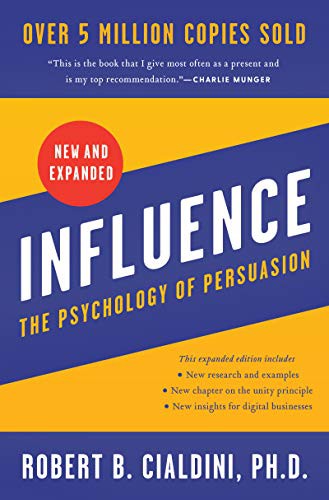
Influence, New and Expanded is the 2021 revision of Robert Cialdini's foundational 1984 work on the psychology of persuasion.
Robert B. Cialdini · 2021 · 6h 45m
Full summary and key takeaways →The 12 questions
- 1.
Which of the seven principles do you find most convincing as an explanation of your own past decisions? Can you name a specific situation?
- 2.
Cialdini says awareness offers only partial defense against these principles. When have you recognized you were being influenced and still complied anyway?
- 3.
The reciprocity principle works even when gifts are small and uninvited. What uninvited gifts or favors have shaped your behavior toward someone without you realizing it at the time?
- 4.
Commitment and consistency explain why small requests lead to larger ones. Where in your life are you currently committed to a direction you chose years ago without re-examining whether it still fits?
- 5.
Social proof is most powerful in ambiguous situations. Think of a time you relied on what others were doing because you weren't sure what the right thing to do was. Did it lead you to a good decision?
- 6.
The new unity principle argues that shared group membership creates compliance that goes beyond liking. What groups do you belong to where you feel that pull most strongly?
- 7.
Cialdini spent years undercover in compliance industries. What does the detail of that research change about how you read his conclusions?
- 8.
Authority signals — credentials, titles, uniforms — work through heuristics. When is relying on authority a reasonable cognitive shortcut and when is it genuinely dangerous?
- 9.
The original Influence was published in 1984. Which of the principles seem more powerful now than they were forty years ago, and which seem less?
- 10.
The book can be read as a how-to guide for persuaders or a defense manual for targets. Which lens is more useful to you, and does using the principles yourself feel ethical?
- 11.
Scarcity and urgency tactics are everywhere in e-commerce and marketing. After reading this book, which tactics do you still find effective despite knowing how they work?
- 12.
If you were designing a product, a pitch, or a fundraising campaign using all seven principles, what would it look like? Where does that exercise become uncomfortable?
How to run the discussion
- Pick six to eight, not all of them. An hour of real discussion covers fewer questions than anyone expects, and racing the list is what makes a book club feel like homework.
- Open with what people noticed, not what they concluded. Asking for a verdict first hardens opinions before anyone has heard each other.
- Let the disagreement run. The questions below that split a room are the ones worth the time; the ones everyone answers the same way can be skipped.
- Ask the quiet person a specific question. A direct, narrow question is far easier to answer than an open invitation to contribute.
Themes worth steering toward
If the conversation stalls, these are the threads that usually restart it.
Common questions
What are good book club questions for Influence, New and Expanded: The Psychology of Persuasion?
Here are 12 book club questions for Influence, New and Expanded: The Psychology of Persuasion by Robert B. Cialdini, ordered to open easily and end somewhere worth arguing about. The strongest openers ask what each reader noticed rather than what they concluded, and the discussion usually turns on persuasion, influence, decision-making.
How long should a book club discussion of Influence, New and Expanded: The Psychology of Persuasion last?
Most groups run 60 to 90 minutes of actual discussion. That is roughly six to eight questions, not all of them, so pick the ones that suit your group rather than working down the list in order.
What are the main themes in Influence, New and Expanded: The Psychology of Persuasion?
Persuasion, Influence, Decision-making, Social psychology, Behavior change. Those are the threads most likely to divide a room, which makes them the useful places to steer a discussion that has gone quiet.
Picking the next one? See books like Influence, New and Expanded: The Psychology of Persuasion or questions for other book club picks.
