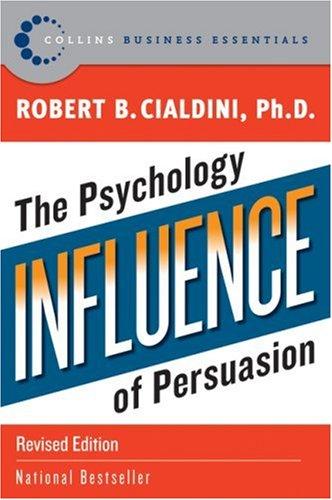
Talk to Influence: The Psychology of Persuasion like its author wrote you back.
Get the ideas that fit your life — not generic summaries.
- Chat with the book
- Audiobook-style main ideas
- Adapts to your life and goals
- Helps you take action
What it argues
Influence is Robert Cialdini's account of why people say yes, and how that agreement is manufactured. Cialdini spent years studying compliance professionals — salespeople, fundraisers, recruiters, con artists — and identified six principles they reliably exploit: reciprocity, commitment and consistency, social proof, authority, liking, and scarcity. The book's argument is that these principles work not because people are stupid, but because they usually work. They are cognitive shortcuts that evolved to help us navigate a complex world, and that fact is precisely what makes them dangerous when someone else learns to trigger them deliberately.
Each principle gets its own chapter with both the mechanism and the countermeasures. Reciprocity is the obligation to return a favor, even an uninvited one — which is why a free sample is never really free. Commitment and consistency explains why people who sign a small petition are more likely to agree to a larger request later: once we've taken a position, we feel internal pressure to behave consistently with it. Social proof is the tendency to look at what others are doing when we are uncertain what to do ourselves. Authority is the tendency to defer to credentials and titles even when the underlying expertise is absent. Liking explains why a friend's recommendation works better than any advertisement. Scarcity is the pull of "limited time only."
What it gets right
- 1.
The six principles of influence — reciprocity, commitment, social proof, authority, liking, and scarcity — are cognitive shortcuts that evolved to work, which is why they are so easy to exploit.
- 2.
Reciprocity is powerful even when the gift was uninvited. Free samples, small favors, and holiday cards all activate the same obligation to return something.
- 3.
Commitment and consistency: once people take a small public stand, they feel internal pressure to behave in ways that are consistent with it. The foot-in-the-door technique depends entirely on this.
What it covers
Who wrote it
Robert B. Cialdini is Regents' Professor Emeritus of Psychology and Marketing at Arizona State University. He spent his career studying compliance and persuasion, including years of fieldwork inside sales organizations, fundraising campaigns, and advertising agencies. Influence, first published in 1984 and revised most recently in 2021, has sold over five million copies and is widely assigned in business and psychology programs. His follow-up Pre-Suasion, published in 2016, examines how context shapes receptivity before a message is even delivered.
