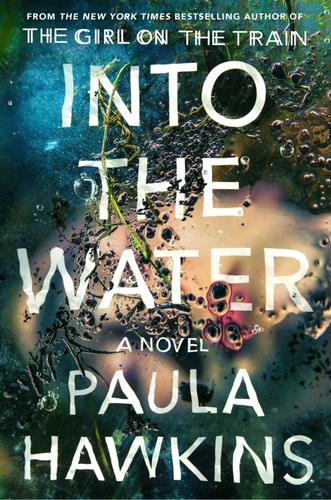
Into the Water by Paula Hawkins is a 2017 thriller book about female danger and history, sisterhood and estrangement, small community and silence. The Drowning Pool's historical function — a place where inconvenient women were disposed of under various pretexts across centuries — is the novel's central metaphor and its most resonant element.
Summary
In a small English town, women have been dying in a river pool called the Drowning Pool for centuries. The latest is Nel Abbott, apparently fallen or jumped from a cliff above the water. Her estranged sister Jules arrives to care for Nel's teenage daughter Lena, who is grieving and hostile and may know more than she's saying. The investigation involves a cast of interconnected townspeople — a detective with his own history with the pool, the parents of a schoolgirl who died there earlier that year — all narrated in rotating close third-person perspectives.
Into the Water is Hawkins' follow-up to The Girl on the Train, and it's a more ambitious and more flawed book. The ambition is the multi-narrator structure — there are more than ten distinct perspectives — and the attempt to braid a contemporary mystery with the historical mythology of women drowned as witches or dangerous wives. The flaw is that with this many voices, none of them quite lands as deeply as Rachel did in the previous book. The novel asks for investment in a dozen characters simultaneously and achieves it with only a few of them.
The pool's mythology is the most interesting element: Hawkins uses the idea that this location has specifically been used to eliminate inconvenient women — the difficult, the sexual, the ones who didn't conform — as a frame for the contemporary story. Nel was researching this history before she died; her manuscript hangs over the investigation. The town is protecting something; the question is what, and which of the many narrators is hiding it.
Hawkins is better at constructing female interiority than the mechanics of thriller plotting, and Into the Water shows that imbalance. The first third is genuinely confusing — too many voices introduced too quickly — and the mystery's resolution requires the reader to track threads across perspectives in a way that feels more effortful than rewarding. But the Jules-Lena dynamic is the book's emotional core, and the historical layer about women and rivers gives this one a darker register than The Girl on the Train.
Talk to Into the Water like its author wrote you back.
Get the ideas that fit your life — not generic summaries.
- Chat with the book
- Audiobook-style main ideas
- Adapts to your life and goals
- Helps you take action
Key takeaways
- 1.
The Drowning Pool's historical function — a place where inconvenient women were disposed of under various pretexts across centuries — is the novel's central metaphor and its most resonant element.
- 2.
Nel's manuscript about the pool women runs as a counterpoint to the investigation. Her research was getting somewhere before she died.
- 3.
The multi-narrator structure serves the book's argument — that community silence requires everyone's participation — but it disperses the emotional investment.
- 4.
Jules and Nel's estrangement — its cause, its history, the way it shapes Jules's grief — is the novel's strongest character thread and the one Hawkins resolves most satisfyingly.
- 5.
Lena is the character who knows most and says least. Hawkins manages her as a pivot point: teenager-as-obstruction is a real risk and she mostly avoids it.
- 6.
The town's protection of its killer is rooted in something other than simple loyalty — Hawkins is interested in how communities decide which deaths matter and which don't.
- 7.
Into the Water is structurally more ambitious than The Girl on the Train and less successful as a reading experience. The ratio of aspiration to execution is the key critical question.
- 8.
The novel's feminism is more explicit than Hawkins' previous work — the historical women were killed for being what they were. That argument comes through clearly even where the plot doesn't.
Discussion questions
Use these on your own, with a book club, or as chat starters in Superbook. Book club version, ready to copy or print →
- 1.
The novel has more than ten narrators. Did that number help you understand the town's collective knowledge, or did it prevent you from caring about any single character deeply?
- 2.
Nel's manuscript about the pool women is the book's most interesting literary conceit. Did Hawkins give it enough space, or should it have been larger?
- 3.
The town has a specific way of deciding which women's deaths matter. Can you articulate the principle the novel is working with?
- 4.
Jules and Nel's estrangement — its cause revealed late — changes how you read Jules's grief and guilt. Was the revelation earned, or did it feel withheld artificially?
- 5.
Lena is a grieving teenager who knows what happened and won't say. How did you read her silence — self-protection, loyalty, punishment?
- 6.
Compared to The Girl on the Train, this novel is more explicitly feminist — the pool's history makes the gender politics overt. Does that explicitness strengthen or weaken the book?
- 7.
The detective has his own history with the pool and the town. What does Hawkins do with his perspective that she couldn't have done with an outsider detective?
- 8.
The first third is often cited as the novel's weakest section because of how many characters are introduced. Did you find it confusing, or did the gradual assembly of the picture work for you?
- 9.
Hawkins writes about grief specifically — not trauma in the abstract but grief for a specific difficult person. Does that distinction matter to how the book reads?
- 10.
The ending offers resolution but not complete closure. Which threads did you feel were satisfyingly tied, and which felt left open?
- 11.
How does a place — a specific location with a specific history — shape how people behave in the novel? Does Hawkins make the Drowning Pool feel genuinely threatening?
Themes
Frequently asked questions
-
Do I need to read The Girl on the Train first?
No — Into the Water is a completely separate story with no overlapping characters. But The Girl on the Train introduces Hawkins' style and is generally considered the stronger book. Reading it first sets reasonable expectations.
-
Is Into the Water as good as The Girl on the Train?
Most readers find it less immediately satisfying because of the larger cast and more complicated structure. It's more ambitious — the historical frame and the explicit feminist argument go further — but the execution is uneven. Worth reading if you liked the first book.
-
Is Into the Water confusing?
The first quarter can be. More than ten named narrators are introduced in quick succession. Hawkins provides brief identifiers at each chapter head, but the early chapters require patience. The confusion eases once the character dynamics become clear.
-
What is Into the Water about without spoilers?
A woman is found dead in a river pool historically associated with the deaths of inconvenient women across centuries. Her estranged sister investigates while caring for her niece. The mystery involves the whole town and the woman's research into the pool's history.
-
Who shouldn't read Into the Water?
Readers who need a tight focus on one or two protagonists, or who want a thriller that prioritizes plot momentum over thematic texture. The large cast and slower build will frustrate readers who want the pace of The Girl on the Train.