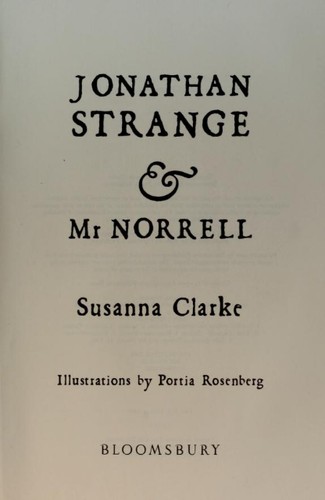
Jonathan Strange & Mr Norrell by Susanna Clarke is a 2004 fantasy book about knowledge and its hoarding, faerie and the uncanny, empire and magic. Hoarding knowledge to control it is presented as a kind of cowardice masquerading as responsibility. Norrell's catalog is both his greatest achievement and his most revealing flaw.
Summary
Jonathan Strange & Mr Norrell is a Victorian-style novel set in an alternate early nineteenth-century England where magic was once practiced but has fallen dormant. Mr Norrell, a reclusive Yorkshire magician who has spent decades hoarding every book of magic he can find, surfaces in London to prove magic still exists and puts it to use supporting the war against Napoleon. Jonathan Strange, a younger, more intuitive magician, eventually becomes his pupil and then his rival. Behind both of them, barely visible at first, is a dangerous figure from England's magical past: the Raven King and the Faerie realm he once ruled.
The novel is fundamentally about the tension between institutional control of knowledge and the wild, dangerous possibilities that come with genuine inquiry. Norrell hoards magic to manage it; Strange wants to push into territory Norrell considers forbidden. The Faerie storyline — which runs parallel to the main narrative and grows increasingly sinister — is where Clarke does her most unsettling work. Faerie in this book is not whimsical. It is alien and vast and entirely indifferent to human happiness.
Clarke wrote the novel over ten years, and it shows in the texture. The footnotes alone constitute a shadow history of English magic, full of invented sources and invented magicians that feel completely real. The prose style deliberately mimics nineteenth-century fiction — Austen and Dickens are the obvious ancestors — and Clarke uses that period register to make the uncanny feel credible. The pacing is genuinely Victorian: unhurried, digressive, interested in manners and social position. This is either the book's great strength or its central obstacle depending on the reader.
The ideal reader for this book is someone who can commit to 800 pages of deliberate, formal prose and trusts that the payoff is worth the patience. It is not for readers who find Victorian fiction tedious. But for readers who love it, this novel does something almost no fantasy novel does: it makes magic feel genuinely strange and genuinely threatening, and it builds a world so internally consistent that the invented footnotes feel like real scholarship.
Talk to Jonathan Strange & Mr Norrell like its author wrote you back.
Get the ideas that fit your life — not generic summaries.
- Chat with the book
- Audiobook-style main ideas
- Adapts to your life and goals
- Helps you take action
Key takeaways
- 1.
Hoarding knowledge to control it is presented as a kind of cowardice masquerading as responsibility. Norrell's catalog is both his greatest achievement and his most revealing flaw.
- 2.
Clarke's faerie is one of the most genuinely alien portrayals in modern fantasy — not dark elves or mischievous sprites but something incomprehensible and vast, operating on entirely different values.
- 3.
The footnotes are a novel-within-the-novel. Reading them transforms the book from a story about magicians into a texture of invented history that rewards close attention.
- 4.
The Napoleonic War setting is not backdrop decoration. It lets Clarke explore how power uses and co-opts unusual talents, and what happens when institutions can't control what they've summoned.
- 5.
Strange and Norrell's relationship maps onto debates about empiricism versus tradition, individual brilliance versus institutional caution — and the novel refuses to declare a winner.
- 6.
The cost of engaging with magic — the price characters pay for going too deep — is the book's darkest consistent theme. Clarke never lets magic be free.
- 7.
Clarke's female characters, particularly Arabella and Lady Pole, carry the emotional center of the novel even though they're often sidelined by the male protagonists. The novel is aware of this injustice.
- 8.
The Raven King hovers over the entire novel as an absence. What England lost when it lost its wildest magic is what the book is mourning throughout.
Discussion questions
Use these on your own, with a book club, or as chat starters in Superbook. Book club version, ready to copy or print →
- 1.
Norrell believes magic must be controlled and regulated to survive. Strange believes it must be practiced freely or it dies. Which position does the novel ultimately endorse?
- 2.
The faerie gentleman's obsession with Lady Pole and Arabella is framed as incomprehensible to him — he genuinely doesn't understand he's doing harm. Is that a more or less disturbing kind of evil than deliberate cruelty?
- 3.
The footnotes sometimes contain more interesting material than the main text. Did you read them? If you skipped them, did you feel you missed something?
- 4.
Clarke's prose is deliberately Victorian in register. Did that feel like immersion or affectation? Does the formal style earn its keep?
- 5.
The Napoleonic War setting lets Clarke show how governments use and exploit unusual people. Does Strange's service in the war feel heroic, tragic, or something more complicated?
- 6.
This book took ten years to write and it shows — in the density of the invented history, the care of the plotting. Does that kind of ambition produce better books, or just longer ones?
- 7.
Arabella's fate drives much of Strange's arc. The novel has been criticized for using her as a plot device for a male character's journey. Is that a fair reading?
- 8.
The Raven King never appears directly but determines almost everything. Why do you think Clarke kept him offstage? Does the mystery serve the book or frustrate it?
- 9.
How does this compare to other epic fantasy you've read — Tolkien, Le Guin, Pratchett — in terms of what it's actually interested in?
- 10.
The ending is deeply ambiguous about what Strange and Norrell have gained and lost. Did it feel earned, or did it leave you dissatisfied?
- 11.
Clarke's magic system is deliberately vague and historical rather than rigorous and rule-bound. Do you prefer magic systems that have clear logic, or ones that preserve genuine mystery?
- 12.
If you'd read this in 2004 rather than now, do you think it would have felt more groundbreaking? What has fantasy fiction done in the twenty years since that changes how this reads?
Themes
Frequently asked questions
-
Is Jonathan Strange & Mr Norrell really 800 pages?
Yes, and the pacing is genuinely Victorian — unhurried and digressive. If you find Dickens or Austen tedious, this book will be hard work. If you love that kind of reading, the length feels exactly right. Most readers who bounce off it do so in the first hundred pages; if you make it to the war section, you're likely in.
-
What is the book actually about?
On the surface, two rival magicians in Napoleonic England. Underneath: the tension between hoarding knowledge and sharing it, the cost of genuine magical power, and England's complicated relationship with its own wild, irrational past. The faerie storyline is where the real darkness lives.
-
Is Jonathan Strange & Mr Norrell worth reading?
For readers who love Victorian prose and epic worldbuilding, it's one of the best fantasy novels of the last twenty years. For readers who want faster pacing or clearer magic systems, it will be a grind. There is no middle ground — readers tend to love it or abandon it.
-
Who shouldn't read it?
Readers who need plot momentum to keep turning pages. Readers who find footnotes annoying. Readers who want magic to have clear, logical rules. The book is dense, formal, and patient, and it expects the reader to be the same.
-
Is there an adaptation?
Yes — a seven-episode BBC TV adaptation aired in 2015, widely praised for its casting and visual design. It condenses the novel significantly and loses the footnotes entirely, but it is an excellent companion piece.